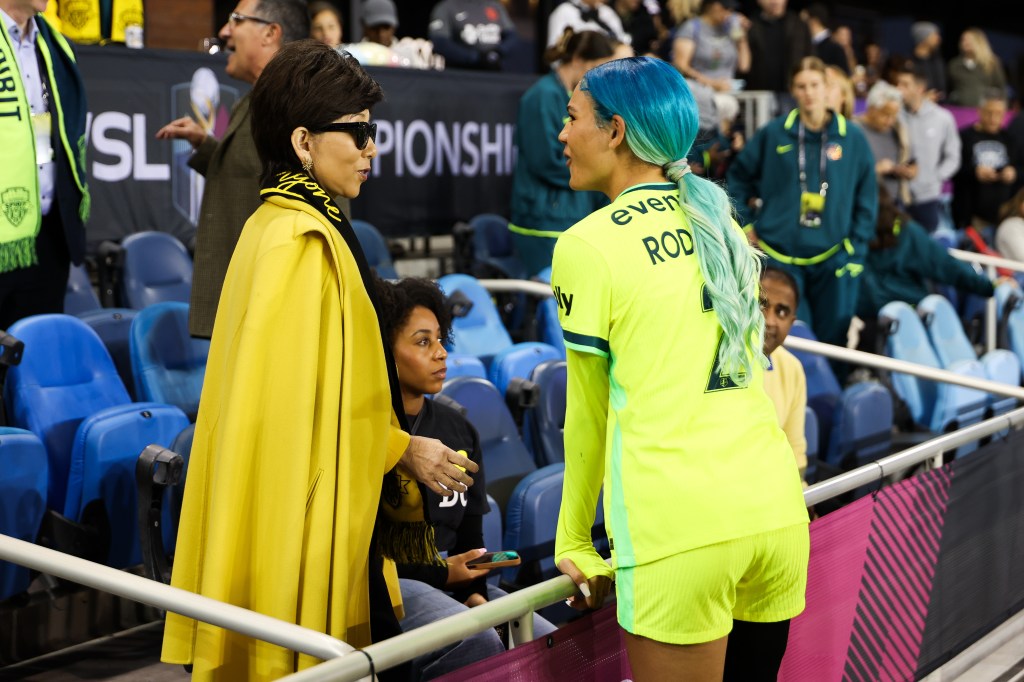
Among all the billionaire investors who have entered women’s sports over the past few years, one stands out. She’s not in the closely-watched WNBA, and some of her investments are outside the U.S., so her name might not be as familiar as those owners. But Michele Kang just made a move that should cement the impact her investment will have on her own sport—soccer—and beyond.
Kang owns the Washington Spirit, the London City Lionesses, and the OL Lyonnes in France. She made a splash, too, with her $4 million gift to USA women’s rugby. More quietly, she has been investing in understanding the needs of female athletes—from large-scale studies of women’s health to
backing a brand making shoes (or boots, in soccer) for female athletes to programs for youth and coaching.
Earlier this year, she took this work out of her own organization, Kynisca, and partnered with U.S. Soccer. (With the U.S. Soccer brand name, it’s easier to get researchers and study participants on board, she told me.) A total of $55 million will go toward these efforts, including the new Kang Women’s Institute, which she launched yesterday.
Only 6% of sports science studies women. It’s caught at an unfortunate intersection—the lack of historical investment in women’s sports and the under-investment in overall women’s health research. “It’s an overall bias in society,” Kang says. But it could be what moves the needle for women’s sports—on the field or court, and as a business.
Emma Hayes, the legendary coach of the U.S. Women’s National Team and an adviser to this effort, told me she realized how little we know about how to train female athletes when three of her players at Chelsea (where as manager, she took the team to seven titles) had ACL injuries. Physical therapists expected six-to-seven month recoveries, typical for men. But women recover slower due to lower testosterone and slower muscle growth. In one major competition—the FA Cup—several Chelsea players all had their periods. It affected their reaction times, and Hayes wanted to understand how to train for these realities. Then there’s the work to come on pregnancy—how to support athletes throughout their pregnancies and how to strategize their return to play, keeping in mind differences like whether they had a vaginal birth or C-section.
Much of the most transformative work, however, will happen at the youth level. Girls often drop out of sports around age 12; it’s a perfect storm of discomfort during puberty, self-doubt, and body confidence issues. Kang has committed to a program that will address how youth sports work in the U.S.—and how coaches motivate girls. “It’s not as simple as just going to the field with an extra tampon and a sanitary towel, though that would be helpful,” Hayes says she’s observed. “Everything from ensuring we don’t wear white shorts to what are the best ways for having challenging conversations in what is a really tricky period for young girls?”
These are critical business issues as women’s sports grow. For professional soccer, U.S. leagues can struggle to compete for talent with Europe, where star players can earn much more money (Trinity Rodman, on Kang’s Washington Spirit, is
the top example of this challenge right now). The youth pipeline will only become more important.
For all sports, winning on the field or court feeds back into business success—any sports exec will tell you, no matter what business strategies you put into place, you still have to win.
Read my full story, which broke the news of the Kang Institute yesterday, in
Fortune here.
Emma Hinchliffeemma.hinchliffe@fortune.comThe Most Powerful Women Daily newsletter is Fortune’
s daily briefing for and about the women leading the business world. Subscribe here. Read and share today’s online edition here.