| | Vladimir Putin travels to India, China’s property sector woes deepen, and France’s AI champion rolls͏ ͏ ͏ ͏ ͏ ͏ |
| |  | Flagship |  |
| |
|
The World Today | 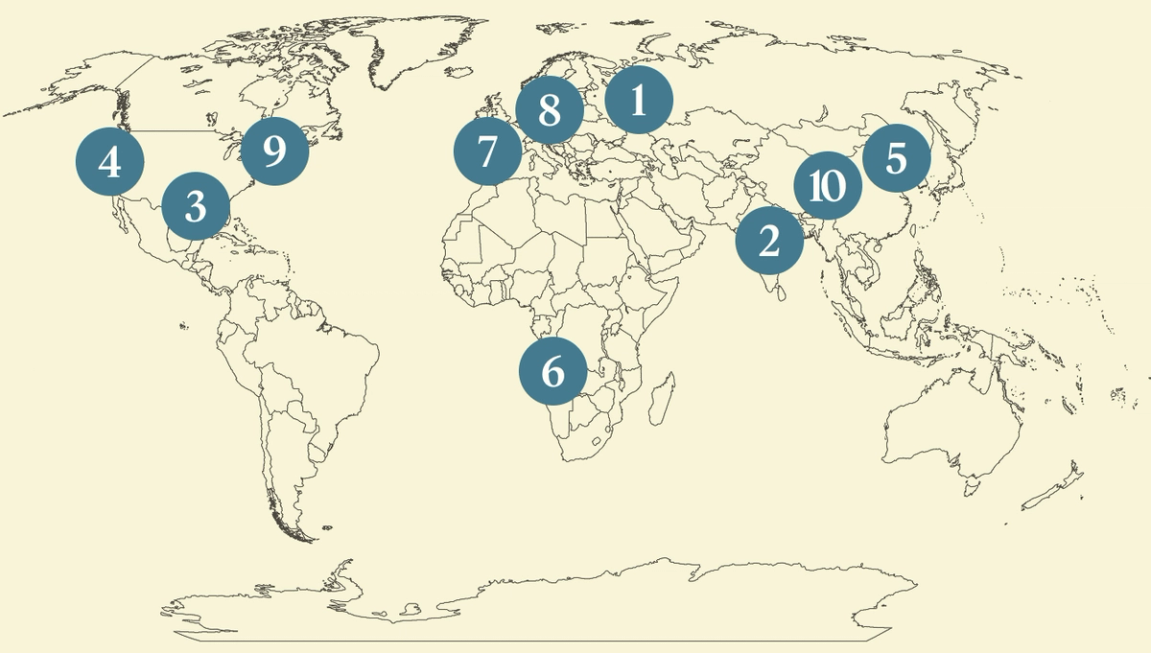 - Vladimir Putin visits India
- New Delhi’s app backlash
- Palantir defends aiding ICE
- US set to embrace robots
- China property woes persist
- Debt gap gets bigger
- AI models get smaller
- Climate study retracted
- US schools’ disability debate
- China’s booming migrant lit
 A feel-good story about discovering a hoard of silver coins. |
|
Putin visits India amid US pressure |
 Putin and Modi in August. Sputnik/Alexander Kazakov/Pool via Reuters Putin and Modi in August. Sputnik/Alexander Kazakov/Pool via ReutersRussian President Vladimir Putin begins a two-day state visit to India on Thursday that aims to showcase Moscow’s sustained overseas friendships, despite US pressure on New Delhi to stop buying Russian oil. The countries are expected to bolster trade and defense ties, and Indian Prime Minister Narendra Modi will likely underscore that New Delhi doesn’t plan to cease Russian energy purchases, analysts said. But Modi will navigate a balancing act to avoid antagonizing Washington in the midst of delicate trade negotiations. US President Donald Trump’s pressure campaign has forced India to “pursue a renewed multialignment, not out of ideological conviction but as a practical necessity,” experts wrote in Foreign Affairs — ironically, the very outcome Trump was trying to prevent. |
|
India walks back app install mandate |
 Dado Ruvic/Reuters Dado Ruvic/ReutersIndia walked back an order requiring smartphone companies to preinstall a government cybersecurity app, following widespread backlash. Officials say the Sanchar Saathi app is aimed at curbing cyber fraud, but critics worried it could curtail privacy or allow for surveillance. Apple reportedly refused to comply with the directive. New Delhi’s mandate would have lowered the threshold “for continuous government visibility into citizens’ digital lives,” a tech writer argued in The Hindu, and grouped India with other countries that tightly control digital platforms: Russia mandated a state messaging app be preinstalled on phones earlier this year. |
|
Palantir defends ICE support |
 Adam Gray/AFP via Getty Images Adam Gray/AFP via Getty ImagesUS immigration authorities ramped up their crackdown on Wednesday, sending agents into the cities of New Orleans and Minneapolis. Leaders in the Democrat-run cities had been bracing for the Trump administration to step up enforcement, following similar ICE operations in Los Angeles, Chicago, and Charlotte. Technology has become increasingly central to the US president’s deportation campaign: Using a tool called Immigration OS, software firm Palantir is helping ICE “track undocumented immigrants and deport them faster,” The Washington Post reported. Palantir CEO Alex Karp, once a vocal Democrat, defended his company’s support for ICE, arguing that his time in Europe showed how “unfettered immigration” results in “mass social dislocation.” |
|
US turns to robots in AI race |
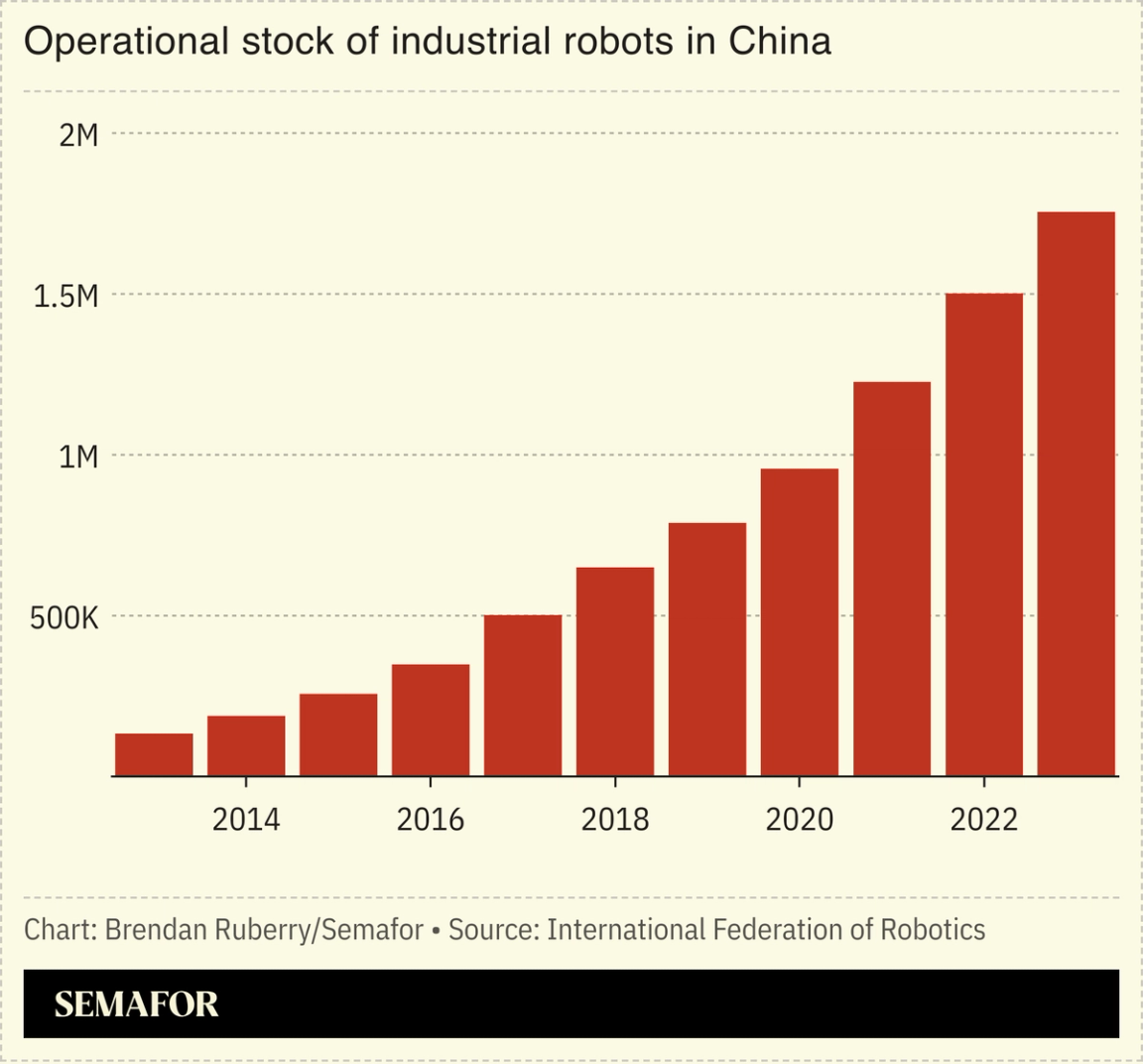 The US is eyeing robots to accelerate the country’s AI prospects. Physical, AI-powered tech — ranging from factory automation tools to humanoids — has taken a backseat in the US as tech giants pour billions into data centers for AI software like chatbots. China, meanwhile, has leaned heavily into robotics. The US commerce secretary is now meeting with robotics industry CEOs in hopes of turbocharging the sector, Politico reported, the latest example of the Trump administration’s embrace of industrial policy to counter China technologically. Despite China’s progress in robotics, the US retains a strong advantage in AI, a Bloomberg Intelligence report found, partly because American firms are more focused on monetization than their Chinese counterparts, which have suppressed pricing. |
|
More cracks in China property sector |
 Tingshu Wang/Reuters Tingshu Wang/ReutersA slate of new metrics points to China’s challenges in turning around its beleaguered property sector. Total local government debt has ballooned to $18 trillion due to dampened property sales, and local bond issuances hit a record high for the year. The real estate industry’s listed firms have seen combined losses of more than $9 billion, a Nikkei analysis found. And analysts are worrying about the financial health of one of the country's most reliable developers. Beijing appears particularly sensitive to the crisis: The government reportedly ordered two real estate data providers to stop publishing figures, and Shanghai’s online censors recently took down more than 40,000 social media posts that were pessimistic about the sector. |
|
World Bank warning on debt gap |
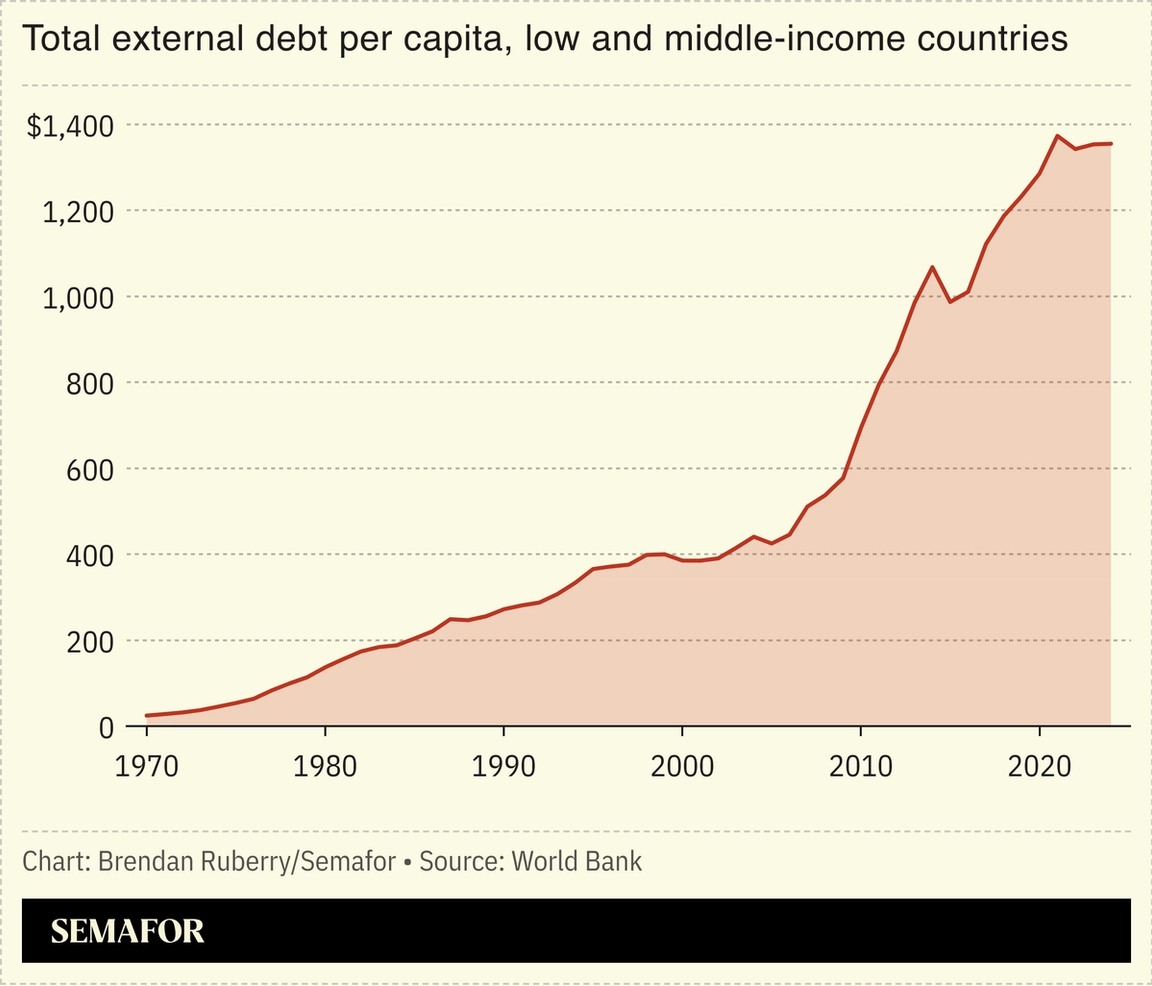 The gap between developing nations’ debt repayments and new financing from 2022 to 2024 reached a 50-year high, a World Bank report found. The $741 billion shortfall is a result of high borrowing costs, with interest payments hitting a record $415.4 billion last year. While some risky borrowers like Suriname and Angola have raised billions through debt sales this year, the World Bank warned policymakers should “make the most of the breathing room that exists today to put their fiscal houses in order instead of rushing back into external debt markets.” The Bank for International Settlements, an institution owned by central banks, has similarly raised the alarm over risks posed by ballooning public debt. |
|
Small AI models could revive gadgets |
 Mistral AI CEO Arthur Mensch. Ludovic Marin/Pool via Reuters Mistral AI CEO Arthur Mensch. Ludovic Marin/Pool via ReutersFrench AI company Mistral released a new family of AI models this week whose most interesting feature is how small they are: lean enough to run on smartphones. The smallest of the bunch is a fraction of the size of competitors, but achieves “much more performance,” the startup’s cofounder said. The small AI systems, which can be used on local hardware with no internet connection, could help “revive the consumer gadget space,” Semafor’s technology editor wrote: The models can be embedded into drones, cars, and robots. Mistral is central to Europe’s AI ambitions, with the continent seen as a distant third to the US and China in the race to dominate the next wave of advanced tech. |
|
 George Orwell called The Observer “the enemy of nonsense.” In a world full of it, The Observer is more needed than ever. Break through the noise of the 24-hour news cycle and go beyond daily headlines with The Observer. Subscribe today and start your digital access to The Observer for just £1 for your first month. |
|
Major climate change study retracted |
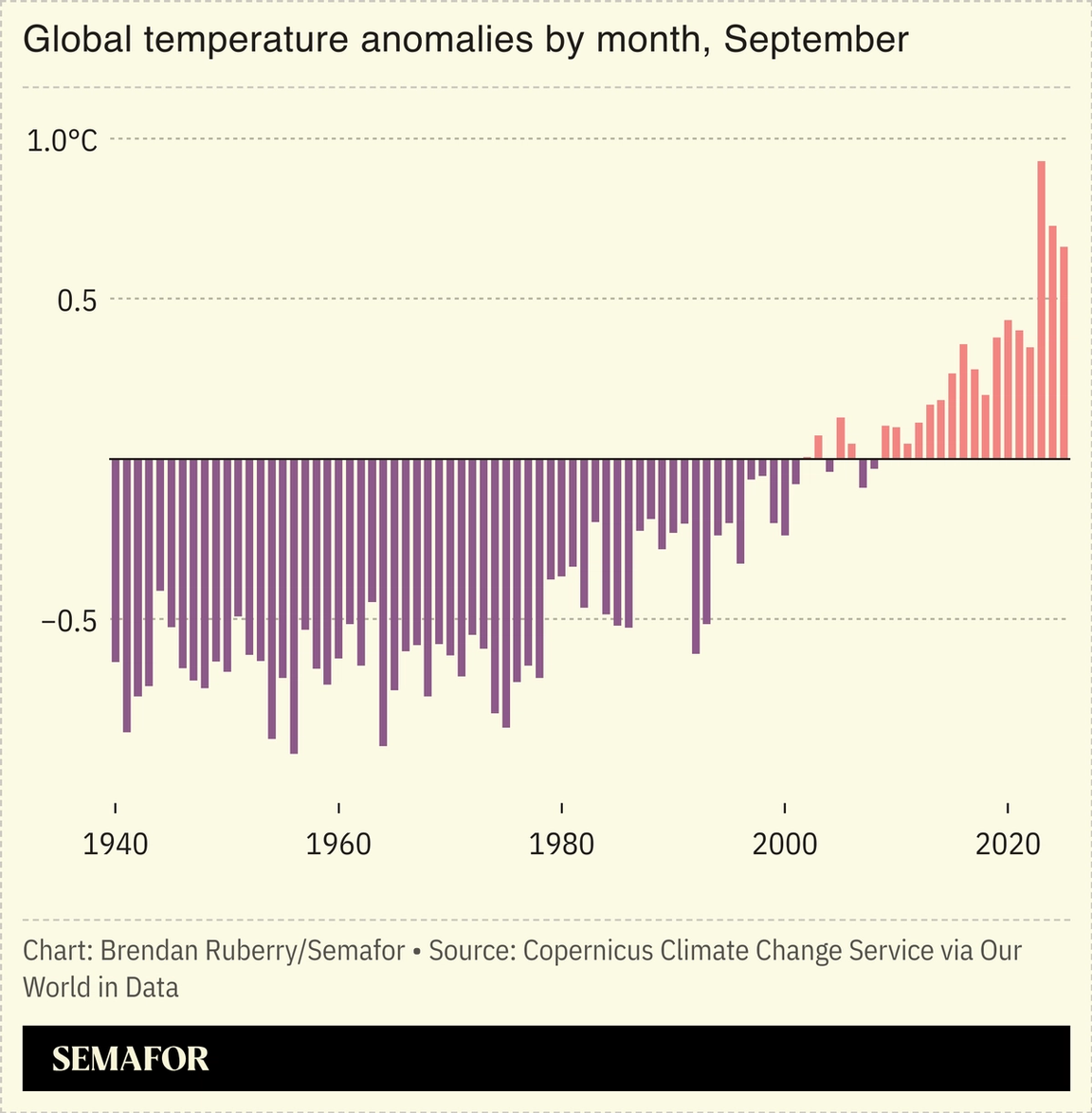 An influential 2024 study that found that climate change would devastate the world’s economy has been retracted. The paper, published by Nature, said that in the most extreme climate scenarios, the world’s economy would be 62% smaller by 2100 than in a counterfactual with no climate change; under more realistic scenarios, it would be around 20% smaller. The findings influenced central banks’ risk management. But reanalysis found major anomalies in its data, without which the study’s predictions were statistically indistinguishable from earlier research. One of the study’s authors said the “general qualitative messages are very much the same,” and plans to resubmit the paper with revisions. |
|
US colleges’ disability debate |
 Rebecca Cook/Reuters Rebecca Cook/ReutersThe percentage of students at elite US universities who have academic accommodations for disability has skyrocketed. A fifth of Brown and Harvard’s undergraduates, and 38% of Stanford’s, are registered as disabled. The University of Chicago has seen accommodations triple in eight years. The uptick is largely driven by increasing diagnoses for ADHD and mental health issues. Academics told The Atlantic that accommodations were highest at prestigious schools, with one professor arguing that it wasn’t about helping “kids in wheelchairs” but about “rich kids getting extra time on tests.” Other countries have seen rises: Research noted that 48% of children born in Wales in 2002-03 were at some point classed as having special educational needs, a finding that led to major policy changes. |
|
|


