OPEC sparks spending spree

Global news you can trust.

Download the Reuters App.


Power Up

Power Up


A Reuters Open Interest newsletter

By Ron Bousso, ROI Energy Columnist


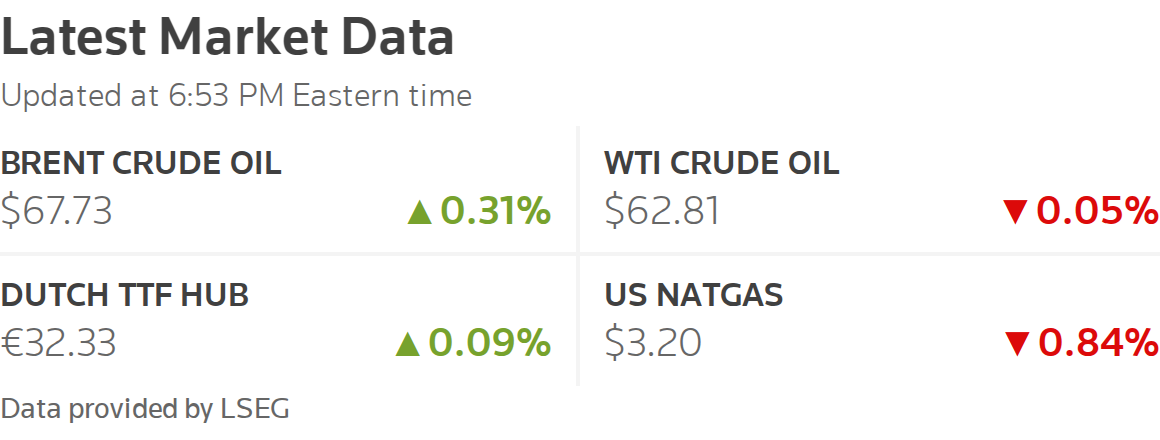
Data refreshes every time you open this email. For more energy news, click here. Please send any feedback to powerup@thomsonreuters.com.

Hello Power Up readers,

The mindboggling growth of the United States’ liquefied natural gas (LNG) industry has  turned the country into the world's top exporter of the super-chilled fuel over the past decade, but the industry is now facing an unfamiliar danger.

The huge demand for gas from LNG plants and colder weather across the northeast have pushed benchmark natural gas prices above $5 per million British thermal unit this week, their highest point in three years. At the same time, ample global LNG supplies have kept prices in demand centres in Europe and Asia at multi-year lows.

As a result, the spread between U.S. and European gas prices is today at its lowest since April 2021. This dynamic is squeezing profit margins for U.S. LNG producers, which continue to expand capacity at pace.

Things could get worse in the coming years. More on this below.

Staying with natural gas, the European Union agreed on Wednesday to phase out Russian gas imports by late 2027 as part of an effort to end the bloc's decades-long dependency on Russian energy.

Under the agreement, the European Union will permanently halt the import of Russian gas and move to phase out Russian oil. Russian LNG imports will be phased out by the end of 2026 and pipeline gas by the end of September 2027.

This historic decision will nevertheless impact some member nations more than others.  My colleague ROI Energy Transition Columnist Gavin Maguire explains which countries will be most heavily affected.

Here are a few more columns and headlines:

  • Changes OPEC+ is making to its oil production quota system will likely spark a wave of upstream investments among members, particularly in low-cost Gulf producers, diminishing concerns of long-term supply shortages, as I wrote on Tuesday.
  • Thermal coal imports by Asia's heavyweights China and India ticked higher in November, but the accompanying rise in prices may cap further gains in volumes, wrote ROI Asia Commodities Columnist Clyde Russell.
  • Finally, check out this fascinating article on how drone attacks by Iranian-backed militias on oilfields in Iraqi Kurdistan that are owned by U.S. companies spurred Washington to increase pressure on Bahgdad, resulting in the re-opening of a major oil pipeline linking Iraq to Turkey.

I love to get your thoughts and comments, so don’t hesitate to contact me at ron.bousso@thomsonreuters.com or follow me on LinkedIn.


Top energy headlines

  • Oil steady after Ukraine strike on Russian oil pipeline does not disrupt supply
  • Hungary's MOL interested in Lukoil assets, sources say
  • OPEC oil output slips in November despite agreed hike, survey finds
  • Kazakhstan's oil output declines as exports curbed by damaged terminal, source says
  • Britain seeks new sites for large nuclear plants, energy minister says


Intensifying squeeze

As discussed above, rising U.S. natural gas prices are putting pressure on LNG producers’ profit margins. The sector has expanded rapidly in recent years, and there is much more growth coming.

Between 2025 and 2030, new LNG export capacity is expected to grow by 300 bcm per year, up 50% from 2025 levels, according to the International Energy Agency.

Around 45% of the capacity will come from the U.S., which has accounted for more than half of total additions of 390 bcm per year of capacity since 2019, according to the IEA.

And this exceptional growth is not slowing down.

A total of 83 bcm per year of new U.S. LNG projects got the green light for development between January and October 2025, making it a record year for final investment decisions, according to the IEA.

 U.S. gas production is set to increase from around 39 trillion cubic feet in 2025 to 42 tcf in 2030, according to the Energy Information Administration. However, over the same period, the share of gas demand from LNG producers is set to rise from around 13% to 20%.

That is a recipe for a tighter domestic U.S. gas market and as a result, narrowing LNG profit margins.

Shrinking margins

"U.S. LNG has made outstanding margins since late 2021, but those margins have come back to more normal levels now as the market has stabilised and new LNG capacity starts coming online," said Saul Kavonic, head of energy research at MST Marquee.

These margins now risk dropping below normal levels. Many U.S. LNG export contracts will be out of the money if the Henry Hub-TTF spread drops below $4 per mmbtu. And if margins fall below $2, representing LNG production costs, operators will almost certainly have to reduce production, according to Kavonic.

Read the full column
 

Find ROI on the Reuters website, and join the debate on LinkedIn and X.


Get full access to Reuters.com for just $1/week. Subscribe now.


Sponsors are not involved in the creation of newsletters or other Reuters news content. Advertise in this newsletter or on Reuters' website

LiveIntent Logo
AdChoices Logo