Hi! Previously on… The war to buy Warner Bros. Discovery may not be over just yet, as Paramount Skydance launched a hostile all-cash takeover offer at $30 per share earlier today, hoping to stop the already-announced Netflix deal. Today we’re exploring:
|
- In captivity: Americans are locked into the subscription age.
- Drive safe: Waymo says its robotaxis crash far less than human-driven vehicles.
- Scoops up: Unilever’s spun-off Magnum Ice Cream Company debuted on public markets today.
|
Have feedback for us? Just hit reply - we'd love to hear from you! |
Forget fatigue — we’re now in the age of “subscription captivity,” per the WSJ |
For many of us, monthly charges for services that let us enjoy free delivery from our favorite retailers, watch thousands of movies and shows, listen to millions of songs (and then get told how old our taste makes us), stay up to date with the latest news, and literally keep us fed have become second nature.
Whether we’re happy about it is, of course, a different point entirely. However, according to a Wall Street Journal article over the weekend, we don’t exactly have much choice in the matter, having graduated from a collective sense of subscription fatigue to “subscription captivity,” wherein “we aren’t just overwhelmed. We’re locked in.” And nowhere is this more true than in the world of TV and film, even before Netflix’s blockbuster $83 billion deal for Warner Bros. Discovery’s studio and streaming businesses threatened to upend the industry as we know it. |
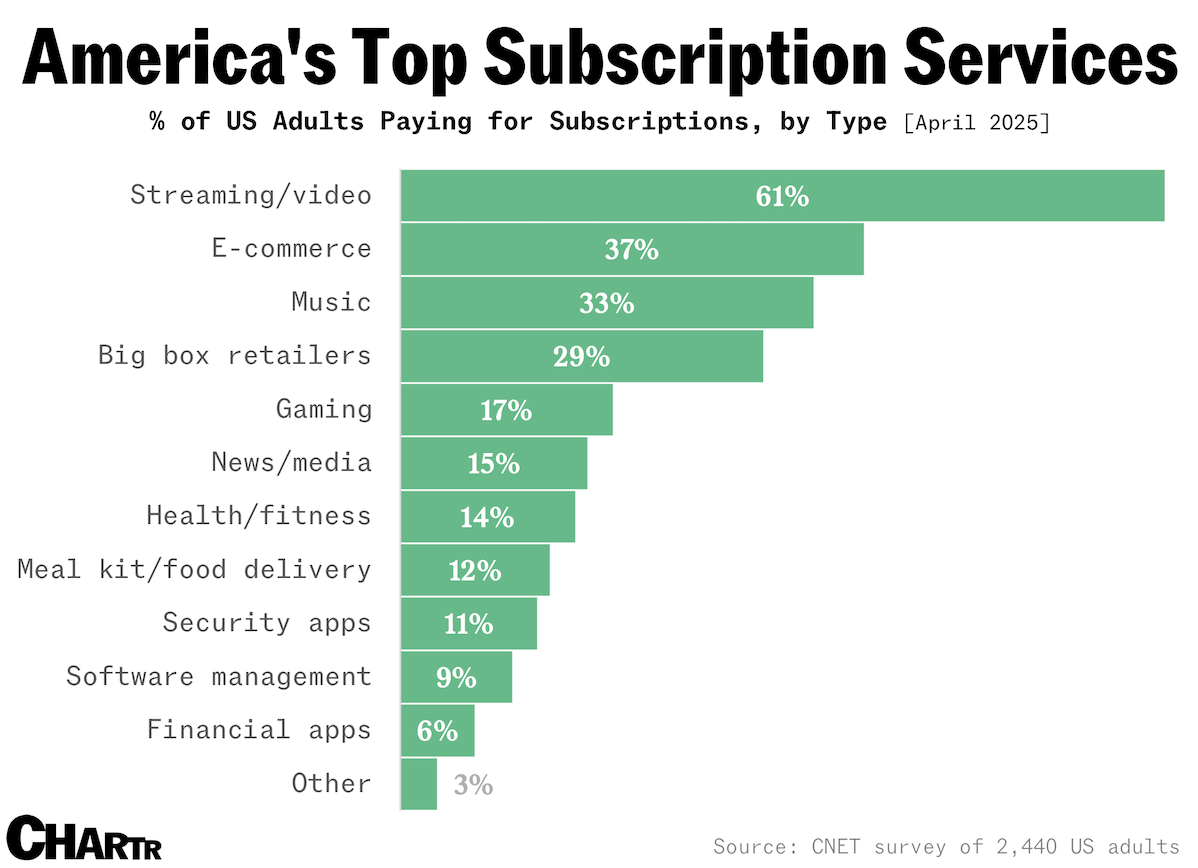
If the buyout does break through the wall of opposition it now faces — where even the president has weighed in to say the deal “could be a problem” — the lure of having the platforms’ combined content mega-libraries under one roof could help boost the share of Americans who pay for streaming/video subscriptions, which currently sits at 61% per an April CNET survey conducted by YouGov.
While that figure might seem low (looking at you, people who still sign in to their parents’/friends’/ex’s account), it still makes streaming services the biggest subscription category in 2025, ahead of e-commerce and music platforms. CNET found that four in five Americans had paid for a subscription service in the last 12 months, spending an average of $90 each month, though Gen Z and millennials had both pared back their outlays. |
Waymo says its robotaxis are involved in 80% fewer injury-causing crashes than human-driven cars |
After killing a beloved neighborhood cat a little over a month ago, Alphabet’s self-driving car company, Waymo, is once again having to defend its safety protocols.
Last Friday, Waymo said that it’s planning a software recall to prevent its vehicles from failing to fully slow or stop for school buses, in response to the NHTSA launching a probe into the company. The investigation follows several incidents of Waymo cars illegally passing school buses in freshly-fleeted cities Atlanta and Austin.
In an emailed statement, the company said it updated the software “as soon as the issue was identified” on November 17, per TechCrunch, with the autonomous vehicle giant also noting its “strong safety record.” |
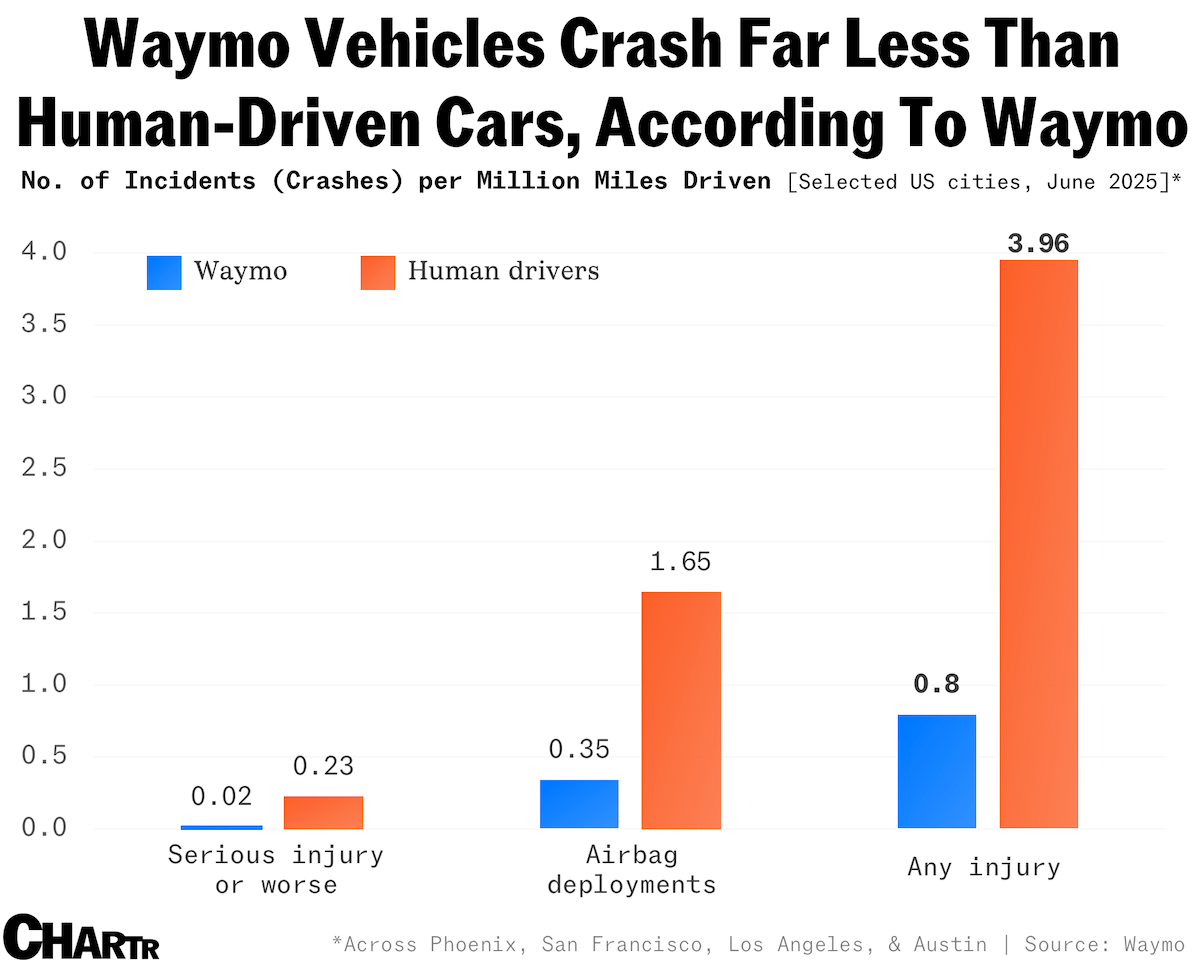
As detailed in a fascinating essay in The New York Times, data recently released by Waymo in its Safety Impact Report — which covers “nearly 100 million driverless miles” across four American cities — found that Waymo vehicles were involved in 91% fewer crashes causing serious injury or worse, and 80% fewer crashes causing any injury, than human drivers.
|
While it’s still a relatively small pool of results in very specific locations (and cynics may be quick to point out that the analysis was carried out by Waymo itself), the statistics are pretty staggering, with the NYTimes piece noting that “other autonomous vehicle companies don’t report or they report incomplete data.”
With Waymo, Tesla, and others making expeditious progress in the race for self-driving supremacy, arguably the biggest obstacle for autonomous vehicles remains psychological, rather than technological, as every headline-grabbing infraction weighs heavily on the minds of risk-averse would-be riders. |
|
|
Not just another AI play… |
As the world’s largest natural gas producer,1 the US stands to benefit from the growth of AI and data centers and their large, continuous power needs. But while much of the focus has been on data center power needs, the US natural gas sector is more than just an AI play.
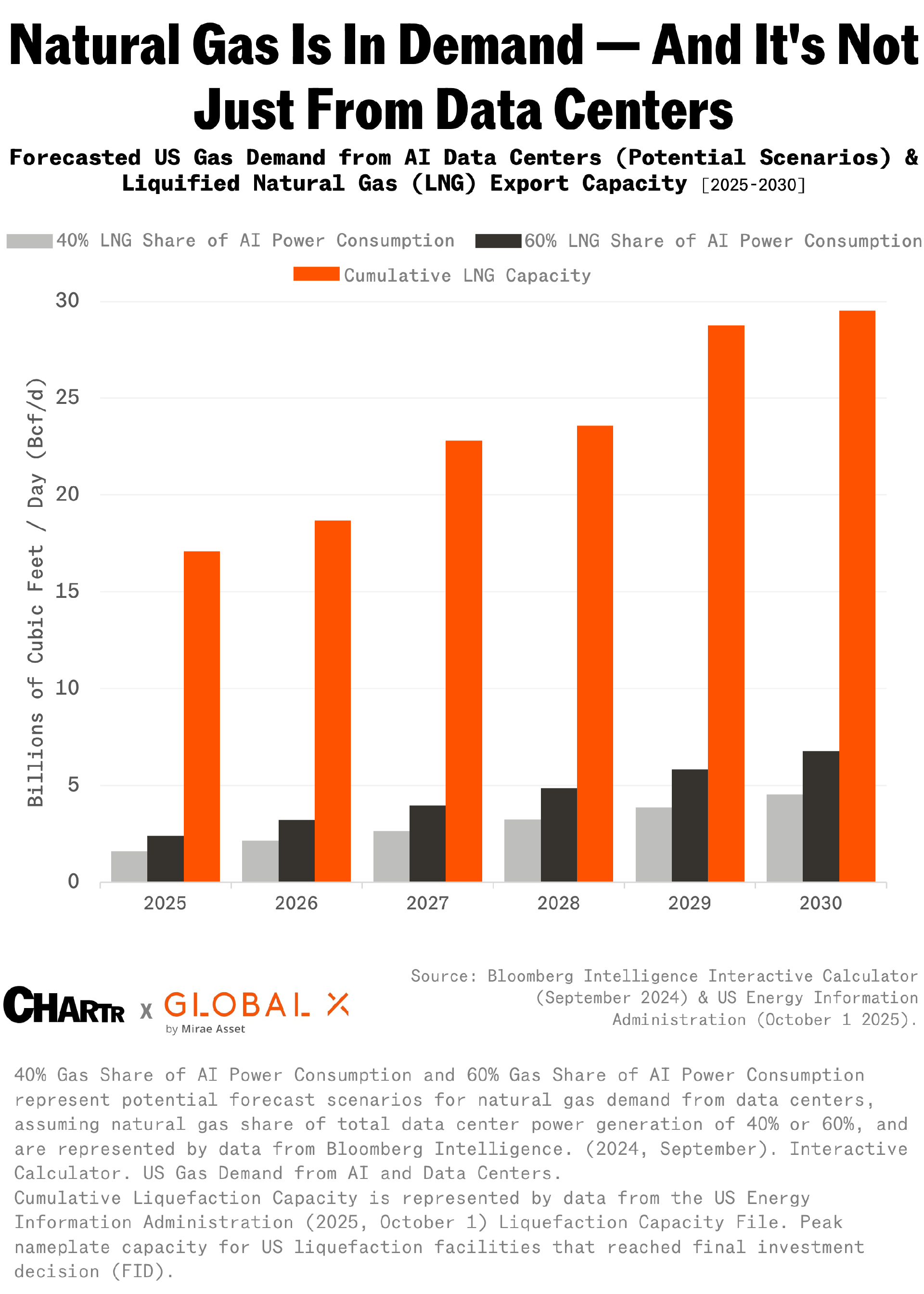
Global demand growth is expected to pick up in 2026, with global LNG supply expected to rise by 7%, its largest increase since 2019.2 The US has grown to feed global demand as the world’s biggest exporter of liquefied natural gas (LNG).3 While AI power needs are indeed forecast to add to that demand, US LNG exports remain the overarching driver of natural gas demand. |
Global X’s newly launched US Natural Gas ETF (LNGX) offers investors pure-play exposure to American companies with high natural gas and natural gas liquids exposure across the value chain, from upstream natural gas production to midstream processing, transportation, and exports.
For ETF investors, LNGX offers both a tactical opportunity and strategic structural growth potential to benefit from America’s rise as a global energy supplier. |
|
|
Magnum, the world's largest ice cream maker, just went public at a ~$9.2 billion valuation |
Ice cream may be the ultimate summer treat, but Magnum, the world’s largest ice cream maker that went public today, is trying to convince investors that it’s not a fair-weather business.
On Monday, shares of The Magnum Ice Cream Company — which was spun off from Unilever and is home to Magnum, Ben & Jerry’s, Cornetto, and more — opened at €12.20 in Amsterdam, valuing it at ~€7.9 billion ($9.2 billion), slightly below analysts’ expectations. The stock also began trading in London, with a New York listing to follow.
The ice cream business had been its parent company’s least profitable unit for years, dragged down by high cold-chain costs (tied to 3 million+ freezers globally) and its weather-dependent nature, with even a one-degree temperature rise “substantially” impacting sales forecasts.
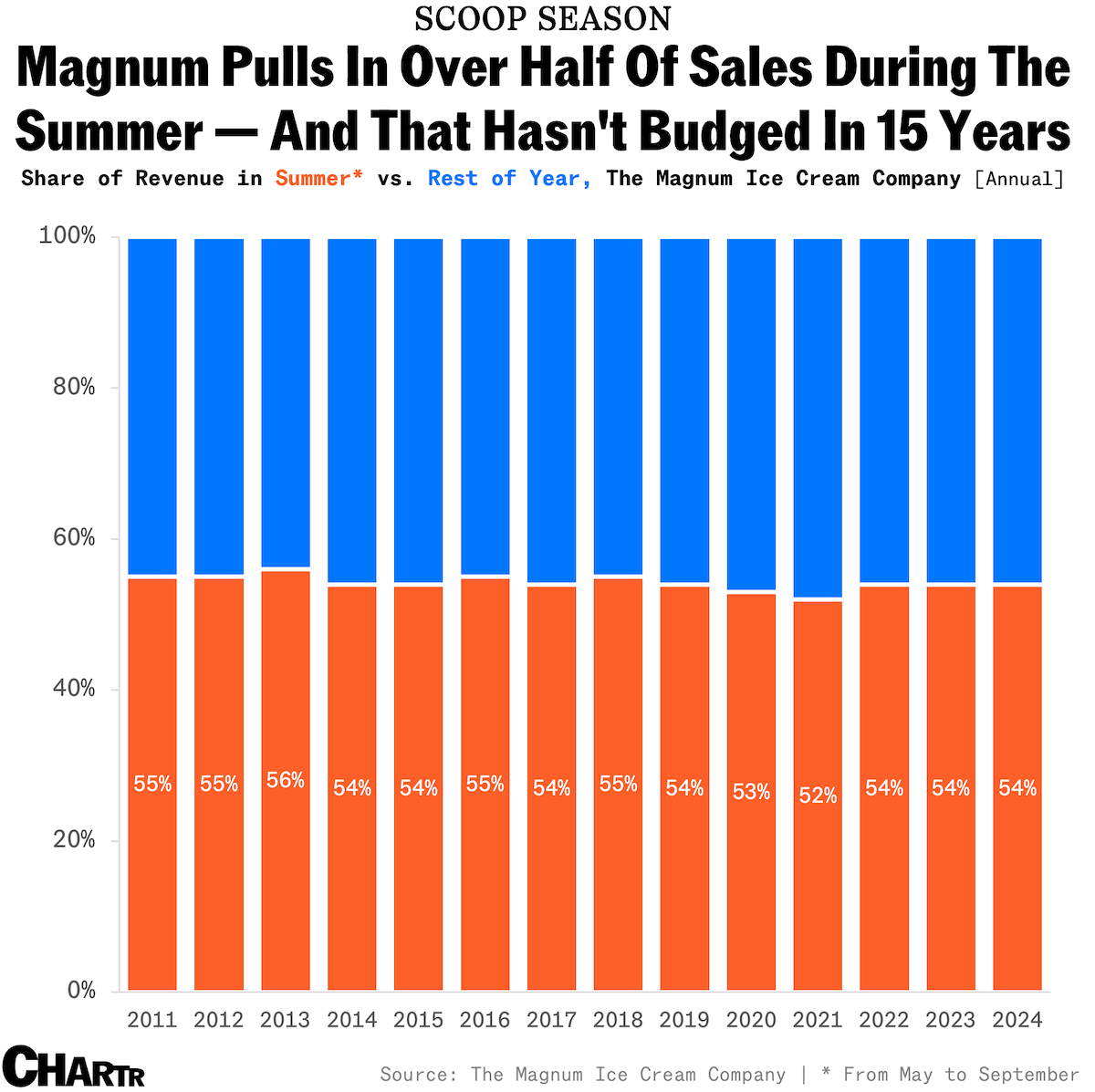
Yet according to Magnum execs, that seasonality doesn't necessarily make their business volatile. They might have a point: while sales do see a boost in warmer months, the seasonal revenue splits are pretty predictable. |
Over the past 15 years, more than half of the division’s annual sales have consistently come between May and September, the company recently disclosed at its Capital Markets Day. Indeed, from 2019 to 2024, its second-quarter revenues actually showed less growth volatility than several Unilever beverage peers. |
Still, the bigger question is how the ice cream giant will grow in a world where Americans are eating less ice cream than ever and GLP-1 drugs are reshaping their appetites. Magnum said its internal modeling shows rising US GLP-1 use would, at worst, trim ice cream volumes by just ~0.5% — though the company is doubling down on premiumization to counter the trend. That includes portion-controlled formats, such as bite-sized Bon Bons as well as high-protein, low-calorie offerings through brands like Yasso.
|
|
|
-
Made in China: China’s trade surplus has topped a record $1 trillion this year, per customs data released today.
-
After 152 races, 44 podiums, and 11 race wins, McLaren’s Lando Norris won his first F1 Drivers’ Championship at Abu Dhabi — the BBC charts this season’s competitive title race here.
-
From the ashes: Meta is reportedly delaying the release of its new mixed reality glasses, code-named “Phoenix,” to the first half of 2027 from its planned H2 2026 debut.
-
Today's Golden Globes nominations saw “One Battle After Another” top the list with 9 nods in film, while “The White Lotus” led with 6 nominations in TV.
-
Elon Musk’s SpaceX told investors that it’s planning an IPO in late 2026… but before that, the rocket-maker is considering a share sale that would boost its valuation to $800 billion, making it the most valuable private company again.
|
|
|
-
Reuters compares how much money has been invested in AI so far vs. the amount spent to land on the moon.
-
Beneath the surface: Beautiful Public Data charts the United States Geological Survey’s most detailed geologic data ever produced in colorful maps.
|
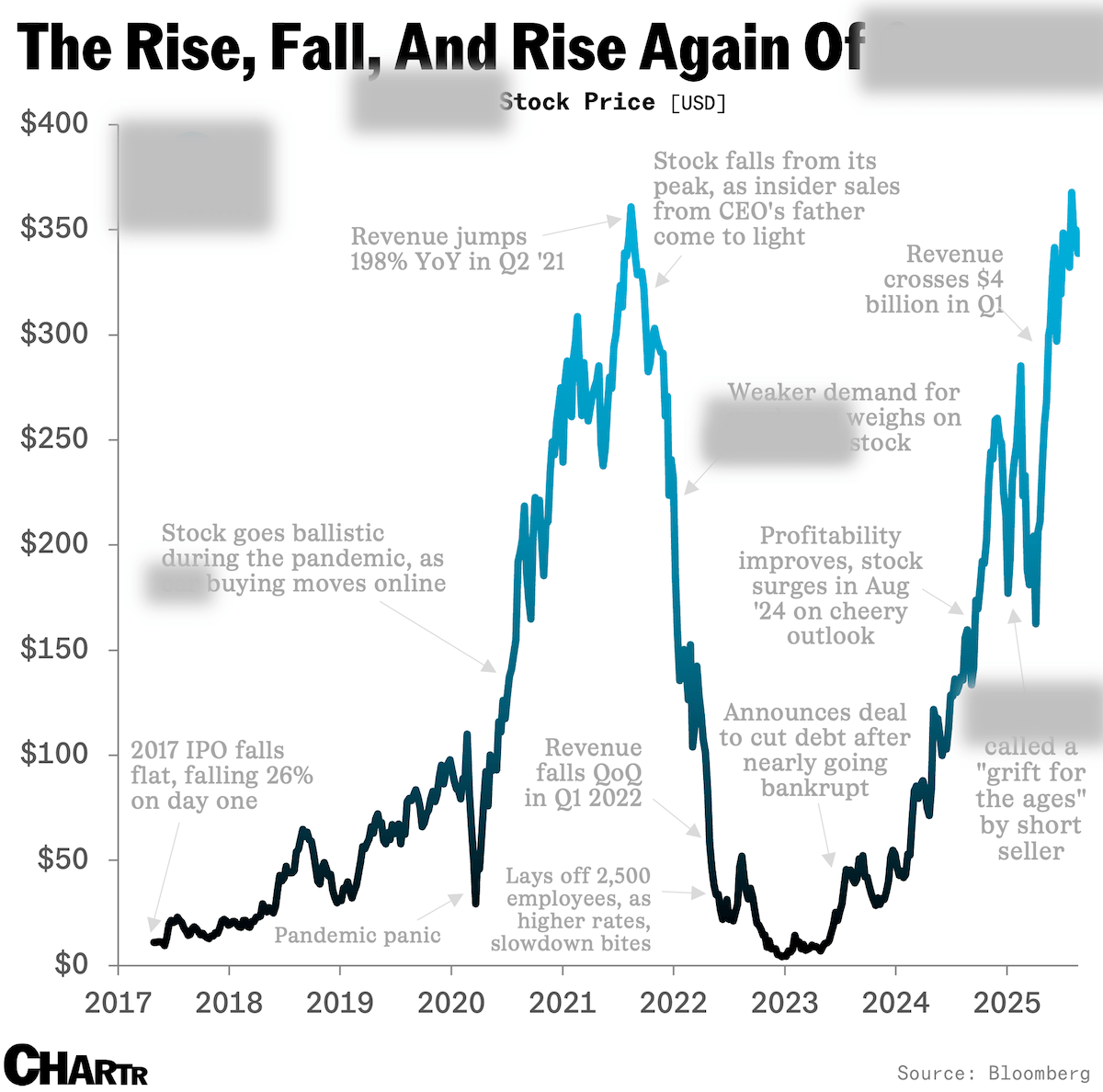
Off the charts: Which online retailer soared on Monday after it was included in the S&P 500 index, marking the latest jump in its turbulent, years-long recovery? [Answer below]. |
Not a subscriber? Sign up for free below. |
|
|
|