|
|
 
| Technology and the Water Industry |
|
|
The water industry is developing innovative and advanced technology and AI to reduce water and waste in various applications including data centers, water and wastewater facilities and municipalities. National and state regulators are working to sustainably expand data center growth, while researchers, startups and tech companies are working on innovative solutions to address water-use issues surrounding data centers and AI. But there is more to be done.
This Special Report, sponsored by Ecolab, takes a deeper look at the issues surrounding data centers, AI and advanced technology in the water industry.
|
|
|
Keep your data centers running at peak performance with cooling systems that support uptime and reduce resource use, cutting costs and reducing environmental impact. Ecolab brings the proven expertise and innovation to make it happen. Discover More |
|
|
| ADVERTISEMENT |  |
|

|
The rapid expansion of AI data centers is fueling a surge in demand for Ecolab's water treatment chemicals -- and it is moving fast to help support the industry at its Garyville, La., facility. The site ships 227 million pounds of chemical products annually, many of which help ensure efficient water usage at data centers and power plants.
|
|
Data centers are emerging as major drivers of economic development, comparable to the role once played by steel mills and manufacturing facilities, writes Jeff Jakubiak of Vinson & Elkins. However, utility commissions often maintain a conservative approach focused on cost limitation, which can hinder necessary grid investments. Jakubiak discusses the regulatory bottleneck and why change is needed to ensure states and consumers benefit from the data center boom. For more insights from Jeffrey Jakubiak, tune into his appearance on the most recent episode of the Renewable Energy SmartPod. |
|
| |
 |
| (John Macdougall/Getty Images) |
Amazon is set to make a $50 billion investment to expand its cloud infrastructure for US government clients, focusing on AI and high-performance computing. This investment will boost data center capacity by almost 1.3 gigawatts, offering government agencies enhanced AI capabilities and access to AWS and Nvidia hardware. This move aligns with Amazon's ongoing efforts to lead in the AI race, as evidenced by its recent data center expansions.
|
|
|
Data center developers near Reno, Nev., are increasingly adopting advanced cooling systems designed to minimize water consumption. The trend is moving toward closed-loop water systems, which reuse water repeatedly rather than relying on constant fresh water input. This shift mirrors a nationwide effort among AI data centers to reduce their water footprint.
|
|
|
As water scarcity becomes a critical factor in business location decisions, companies are increasingly integrating water management into their overall business strategies. Robert Kimball, industrial process water sector leader at WSP, highlights the importance of water reuse, advanced treatment technologies and the water-energy nexus in achieving sustainability goals. Kimball emphasizes the need for a fit-for-purpose approach to water treatment to minimize costs and carbon emissions.
|
|
 |
| Some recent data center projects... |
|
 |
|
|
|
|
Defend the health and performance of high-performance computing (HPC) servers and cooling systems. With Ecolab's 3D TRASAR ™ Technology for Direct-to-Chip Liquid Cooling, you can manage operational risk and critical equipment with confidence. Discover More |
|
|
|
| ADVERTISEMENT |  |
|

| |
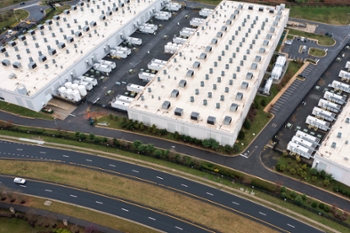 |
| Amazon Web Services data center in Ashburn, Va. (Bloomberg/Getty Images) |
The AI data center boom is dramatically transforming the global technology landscape, with tech giants like OpenAI, Meta, Amazon, and Google building massive, next-generation facilities. These data centers are much larger than traditional ones, often spanning areas comparable to Central Park, and are being constructed in both rural and urban locations to handle unprecedented AI workloads. The sector is attracting hundreds of billions of dollars in investment, doubling the number of hyperscale data centers worldwide in just five years. This rapid expansion is not only reshaping physical environments but also redefining economic priorities for both companies and governments worldwide.
|
|
|
Data centers are foundational for AI growth, but their expansion faces challenges such as energy and water consumption, costs, critical mineral requirements, permitting and workforce shortages. The United States is the global leader in the number of data centers, with Virginia, Texas and California serving as major hubs due to their proximity to government agencies and access to land and resources. However, tariffs on copper, steel and aluminum have increased construction costs, and White House policies on tariffs and immigration have created additional hurdles for data center development.
|
|
|
Estimates of power demand from data center projects vary widely and are growing due to many early-stage initiatives securing power. However, the actual realization of these projects is uncertain. Projects are on the rise in established hubs like Virginia, Texas, Georgia and Ohio, but also taking root in emerging markets like Pennsylvania and Louisiana. John Wilson of Grid Strategies notes that demand projections are uncertain because utilities are struggling to accurately forecast new loads.
|
|
|
|
Maxwell Labs, a Minnesota startup co-founded by Mike Karpe and Jacob Balma, is pioneering an innovative laser-based technology aimed at cooling computer chip hotspots in data centers. By leveraging photonics and advanced optics, the company's system can precisely target and cool micro hotspots on chips, converting excess heat into light and then back into electricity. This approach is more efficient and targeted than traditional air or liquid cooling methods, potentially unlocking higher chip performance and setting a new standard for thermal management in high-density computing environments.
|
|
|
Researchers at McGill University have demonstrated the feasibility of thermally driven reverse osmosis, a method of desalinating seawater using low-grade heat from renewables such as solar thermal and geothermal energy. The process, which uses a piston-based system to push seawater through a membrane, could improve access to water in remote areas w | | | | | |