| | In this edition, Palantir’s Alex Karp gets personal in a sitdown with Semafor, and TikTok’s odd sta͏ ͏ ͏ ͏ ͏ ͏ |
| |  | Technology |  |
| |
|
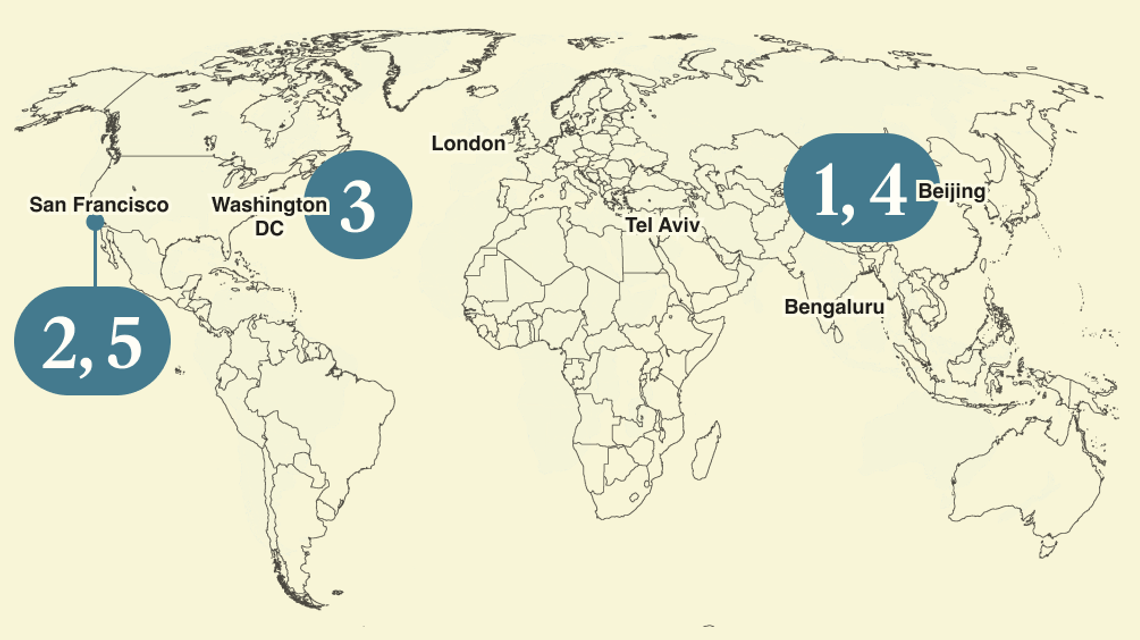 - A consortium of TikTok
- Instagram on the big screen
- Trump Media goes nuclear
- China’s ‘Manhattan Project’
- Tech’s carbon footprint fight
 Alex Karp opens up to Semafor about what motivates him, and UPS introduces AI tools to better track fraudulent package returns. |
|
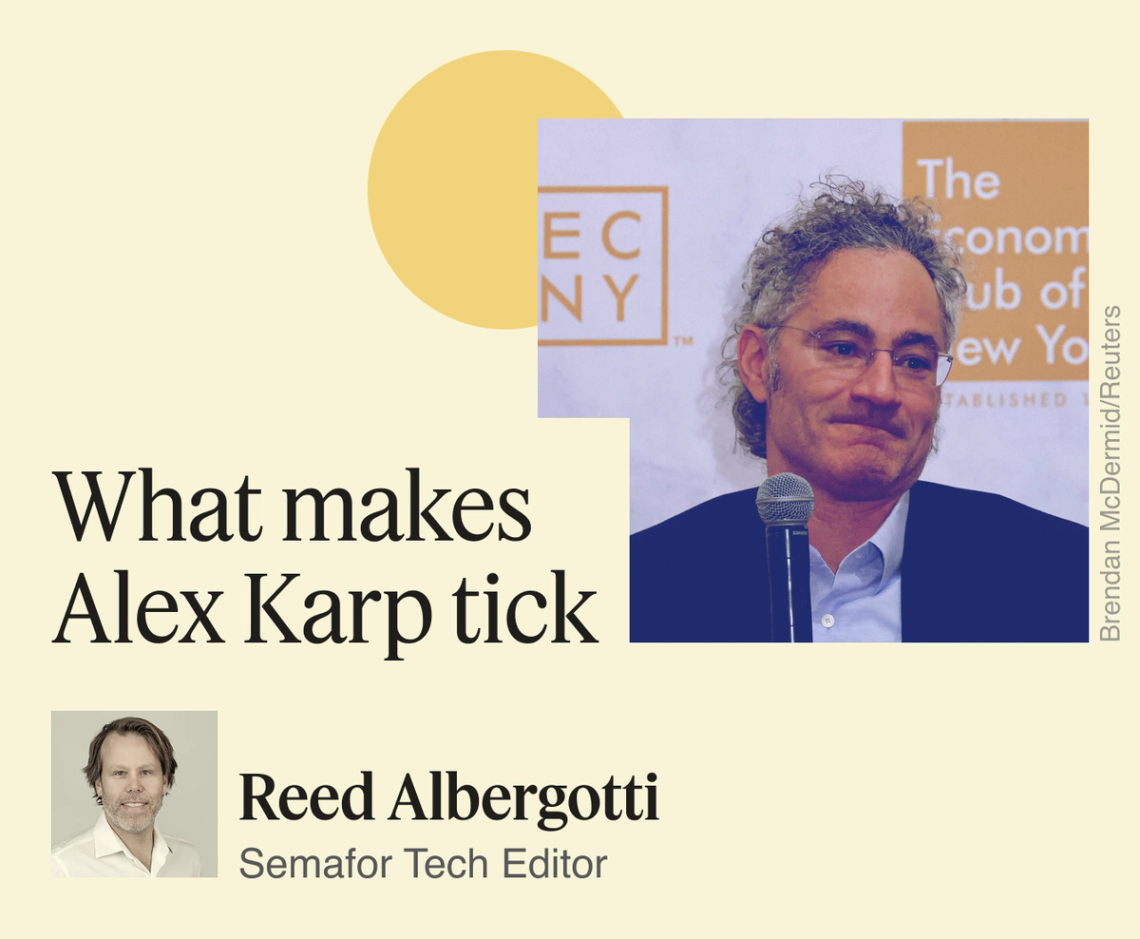 In 2012, a source invited me to a party hosted by Palantir. I briefly met its Co-founder and CEO Alex Karp but was admittedly more interested in political consultant James Carville, who was talking about how the company’s technology had been used to bring down the murder rate in New Orleans. I remember wondering: How does this mysterious technology actually work? Today, there are many companies that offer services similar to Palantir’s. Karp is the enigma. The CEO has thrust himself into the middle of a tribal battle between the left and right, and somehow managed to make enemies on both sides. I had been asking Palantir for an interview with Karp for months because I wanted to better understand what motivates him. Last week, I sat down with him, alongside his biographer, Michael Steinberger, a Haverford College classmate who spent six years interviewing his subject and published The Philosopher in the Valley earlier this year. We got into some of Karp’s personal life — an area he is less comfortable speaking about than the touchy political subjects most people shy away from. And Steinberger, a wine writer in his day job, offered an analogy for the company: “It’s like Pinot Noir, a very ornery grape.” A video of the interview will be published soon. In the meantime, you can read my story on Karp here. |
|
TikTok’s US sale still raises concerns |
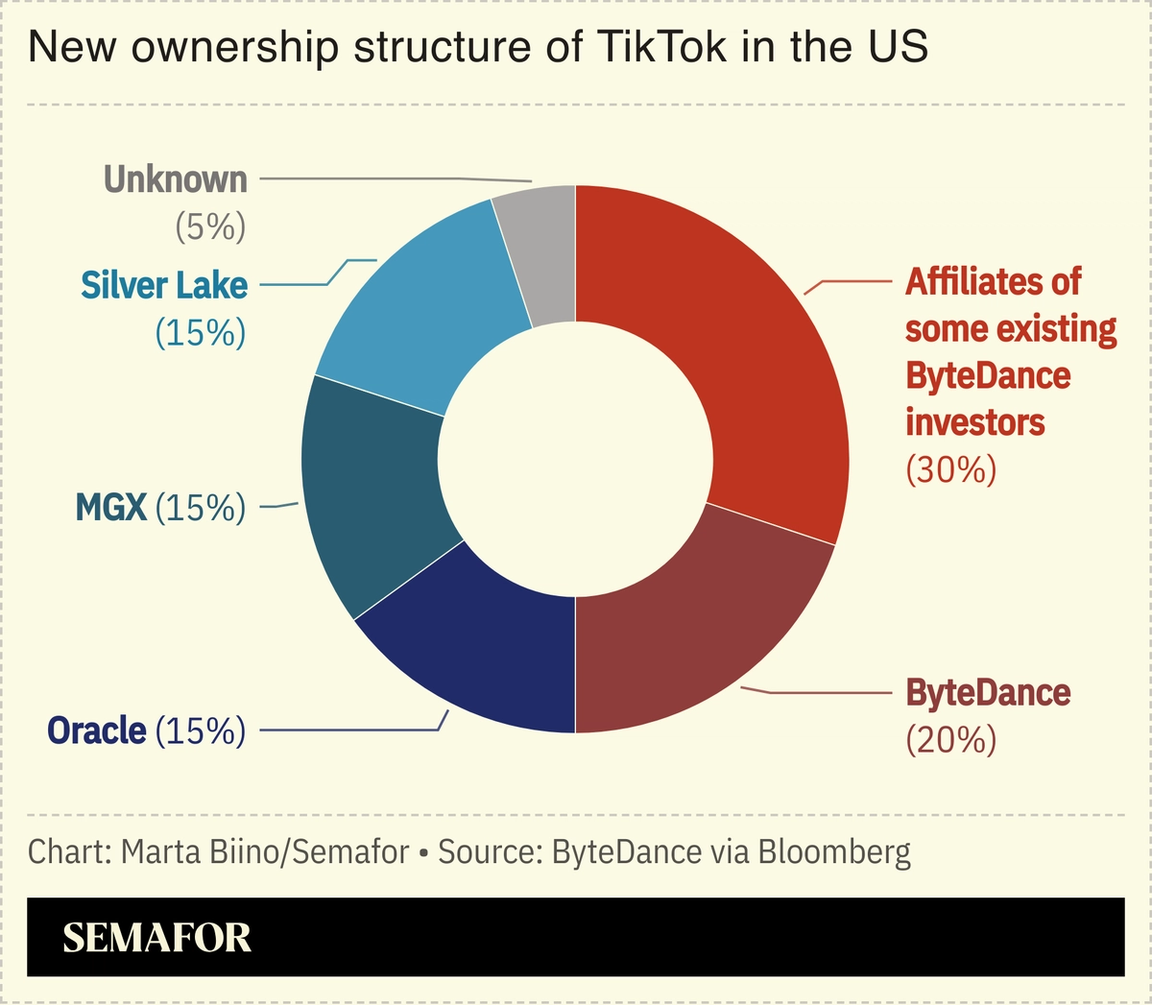 TikTok parent company ByteDance is finally selling a majority of the US version of the app to a consortium of investors that include the US’ Oracle and Silver Lake, Abu Dhabi-based MGX, and some mystery investors that haven’t been named. The deal, first reported by Axios Thursday, hasn’t satisfied China hawks who are taking issue with the fact that the content recommendation algorithm, TikTok’s secret sauce, will be licensed from ByteDance by the US consortium. That could still open the app up to manipulation by the Chinese government, they say. The Hollywood Reporter had an interesting tidbit: According to an internal TikTok memo, the algorithm would be retrained on US user data to ensure there is no outside manipulation. What this presumably means, according to sources familiar, is that Oracle will have the ability to interpret the outputs of the new recommendation algorithm, which will run on Oracle’s servers. In other words, if the Chinese government somehow tries to influence what people on TikTok are seeing, Oracle will be able to detect it. In the end, Oracle could just start from scratch and create its own recommendation algorithm, which would not be hard. The problem with that, though, is that the app wouldn’t know what to serve TikTok users for a while, which would probably reduce engagement and destroy a lot of the value that the joint venture is paying for. Oracle declined to comment. The other big question is who the mystery investors are. The $14 billion price tag for TikTok is incredibly low. It sounds like an AI startup’s Series B fundraising round, not an acquisition price for the hottest social media app around. |
|
Instagram’s Mosseri on TV, AI |
 Semafor/YouTube Semafor/YouTubeTelevision is experiencing a rebirth as social media apps scramble to win the big screen. Instagram launched its first TV app this week in an attempt to grab a larger share of eyeballs as forms of entertainment, from podcasts to social media, converge onto TV. “We’re late to the game,” Instagram’s Adam Mosseri tells Semafor’s Mixed Signals podcast, available today. “There’s an immense amount of time spent on TV, where some of our competition is showing up with force.” That’s a challenge for Instagram, which has already played catch-up to TikTok in short videos consumed on phones, a trend Mark Zuckerberg also admitted to missing. On Mixed Signals, Mosseri also shed light on how Instagram views AI content on its platform, suggesting it will eventually merge with man-made content, and that humans make “slop” too. “In any kind of content, AI or not, there’s gonna be slop and non-slop,” he said. “An important question is: Are we doing a good job connecting you to the content that you would find valuable or interesting, whether it’s about knowing that it’s AI-generated or not, or you’re just interested in the topic or not.” He added that its algorithms are still learning how to rank AI content because it’s new, but eventually users — and Instagram — may not be able to tell the difference. “As generative models get better and better, it’s going to be harder and harder to detect that it is AI-generated,” he said. That makes it difficult for users who don’t want AI content as part of their regular media consumption, of which there are many. Listen to Mixed Signals wherever you get your podcasts, or watch it on YouTube. |
|
Trump’s media empire tests fusion power |
 Evelyn Hockstein/Reuters Evelyn Hockstein/ReutersThe Trump family’s media company raised eyebrows when it announced a merger with nuclear fusion power company TAE Technologies. The company, like others in the field, has received federal grants from the Department of Energy, and it puts the president in a position to direct the federal government to aid the company. This isn’t the first deal of its kind. His administration has championed the idea of the federal government taking stakes in American companies. And Trump has contributed his own money alongside those taxpayer investments, purchasing, for instance, up to $5 million in Intel stock after the government acquired 10% of the company. The fusion industry is a little bit different, though, because it’s a technology that’s still in the R&D phase. The government continues to pay for research into fusion energy, even as venture investors pump money into private companies pursuing it. It will be interesting to see how Trump’s personal interest in TAE affects the rest of the industry. Will private investors shy away from betting on competitors, assuming the man in the Oval Office has anointed a winner? Will federal research dollars favor TAE’s type of fusion, called advanced beam-driven Field-Reversed Configuration? Fusion power is a critical technology that could someday provide clean, cheap, and abundant energy. It’s also in a very fragile stage of development where missteps could hold it back. |
|
China closing in on AI ‘Manhattan Project’ |
 Tingshu Wang/Reuters Tingshu Wang/ReutersChina appears closer to achieving the level of chip sophistication championed by the West than previously estimated, Reuters revealed. Chinese scientists have prototyped a version of the Dutch-invented machine capable of etching extremely small circuits onto chips that allow them to process bigger workloads. Many of the researchers work under fake names and previously spent time at the Dutch machine-maker ASML, Reuters reported. They haven’t yet produced working semiconductors, with that capability a few years away, but the advancement represents a breakthrough in China’s quest for semiconductor self-sufficiency — often called China’s “Manhattan Project.” Still, the development doesn’t change much in the near term. China was always going to pursue chip independence, and it was going to reach this point eventually. It still can’t produce Nvidia-level chips and will likely rely on a mix of the most powerful American processors available to them and domestic technology, while the government continues to pump investments into its semiconductor industry. Whether the US’ export controls have bought it strategic time or accelerated China’s tech independence remains unclear. |
|
Tech giants clash over carbon footprint |
 An Amazon data center. Noah Berger for AWS/File Photo/Reuters. An Amazon data center. Noah Berger for AWS/File Photo/Reuters.Big tech firms including Amazon and Meta are lining up against rivals like Google in a battle over ostensibly obscure rules on tallying emissions which could have huge implications for how — and where — clean energy projects are financed worldwide in years to come, Semafor’s Tim McDonnell writes. At issue are the accounting standards for Scope 2 emissions — those that come from a company’s purchased energy — which are currently being reviewed by a little-known nonprofit that administers them. An overhaul of the regulations is expected early next year, driving a wave of lobbying by Silicon Valley giants and major energy providers. Proponents of the changes say they will force large power consumers to be more honest about their carbon footprint. But doing so could come at the cost of drying up streams of capital for green power projects. |
|
 A worker processes a package at the Happy Returns hub. Daniel Cole/Reuters. A worker processes a package at the Happy Returns hub. Daniel Cole/Reuters.The season of gift-giving is also the season of returns, one in 10 of which in the US are fraudulent — often cheaper knockoffs, while the buyer keeps the refund and original product, according to the National Retail Federation. Software company Happy Returns, a subsidiary of UPS that handles its boxless returns, is testing an AI-powered fraud detection tool this holiday season on products from companies including Under Armour and Revolve, Reuters reported. It analyzes photos of returned items against a company’s catalog images, flagging minute details that could indicate a fake, like incorrect seams and a misplaced logo. The technology itself isn’t new — we wrote about luxury clothing brand Lacoste using AI to address return fraud last year — but UPS’ adoption of it brings new scale to the billion-dollar problem. It could help retailers protect their bottom lines and ensure fraudulent returns aren’t then resold to customers who pay full price. |
|
|


