In mid-November, the leadership of the U.S. National Institutes of Health argued that the best pandemic preparedness playbook is one that prioritizes making populations healthier and more resilient to novel pathogens by reducing the burden of chronic disease.
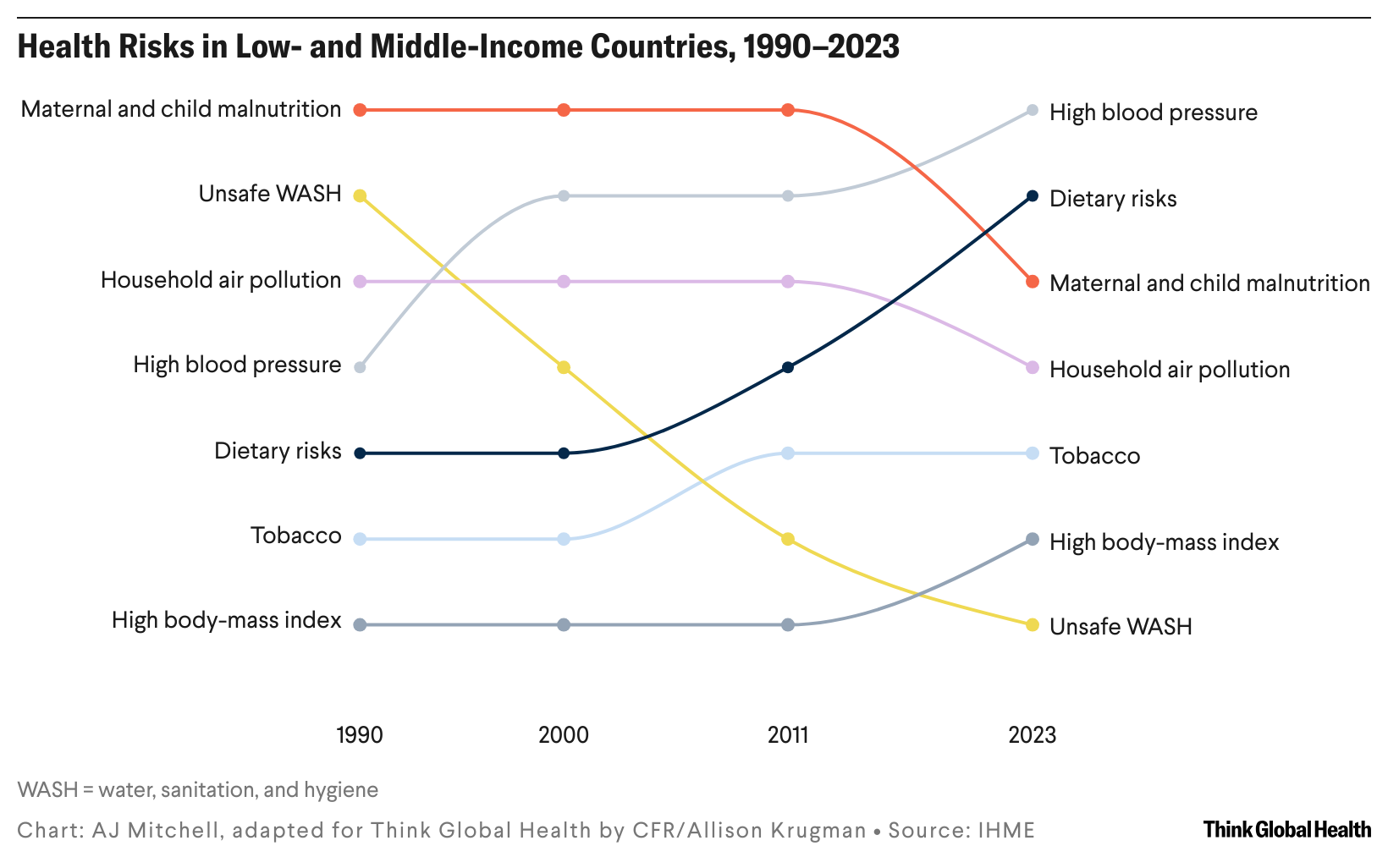
This week, Thomas J. Bollyky, Chloe Searchinger, and Elena Every from the Council on Foreign Relations and Joseph L. Dieleman and AJ Mitchell from the University of Washington’s Institute for Health Metrics and Evaluation assess where and how noncommunicable disease–focused programs could contribute to a broader strategy of pandemic preparedness and response.
Next, 1 in 4 people worldwide live in fragile contexts, primed to devolve into humanitarian emergencies. Maryada E. Vallet and Erin M. Sorrell from the Johns Hopkins Bloomberg School of Public Health and Arush Lal from LSE Health offer recommendations for buoying local preparedness to reduce gaps in global health security.
Last, as the calendar year draws to a close, TGH revisits several 2025 developments that could shape the global health landscape for decades to come. Of paramount importance was a sizeable drop in global aid funding, which disrupted health and food systems in the most vulnerable communities and compounded challenges in conflict zones. Still, bright spots remain: Countries that have traditionally received foreign assistance have used the moment to build health resilience without donors. Artificial intelligence offered new avenues for diagnostics and surveillance across high-, middle-, and low-income countries, and the World Health Assembly turned long-awaited momentum into the adoption of the Pandemic Agreement. To cover those developments, TGH published nearly 200 articles this year—a selection of which our editorial team has highlighted in our Best of 2025 feature.
Until next year!—Nsikan Akpan, Managing Editor, and Caroline Kantis, Associate Editor