Japan tops a global climate leadership ranking.

Audio Articles now available!

Download the Reuters App.


Sustainable Switch

Sustainable Switch

Climate Focus

By Sharon Kimathi, Energy and ESG Editor, Reuters Digital

Hello!

I wanted to end this week on a positive note, which is not an easy feat these days!

A recent global rating report by non-profit data tracker CDP and global professional services firm Oliver Wyman showed that a group of global companies are still prioritizing sustainability, in spite of the rise of geopolitical and economic uncertainty and the recent wave of environmental, social and governance (ESG) rollbacks in the U.S. and Europe.

I spoke to Sherry Madera, Chief Executive Officer at CDP, who was pleased to see that companies are still prioritizing transparency and not backing away from their climate targets.

“We have evidence that there are still companies maintaining the hard work which is the counter argument to the trend of people saying ESG is dead,” said Madera.

The report used data from 10,000 of the world’s largest organizations to assess how they are reducing their environmental impacts based on their science-based targets initiative (SBTi) disclosure, awareness, management and leadership.

Although sustainability is not a competition -  as the main winners are all of us - it’s still good to recognise and celebrate companies and countries driving change.

So which country came out on top?

Japan topped the global climate leadership rankings, while the United States fell behind with just 31% of U.S. companies reaching the top two performance tiers, according to the rankings.

That being said, there are U.S. companies that are still working on sustainability, including U.S. e-commerce giant eBay which has published its first climate transition plan. Click here for the full story.

Back to Japan where 22% of companies achieved climate leadership, followed by the UK with 17%, the European Union with 16% and India at 11%.

China and Southeast Asia stood at 8%, Brazil at 7% and the U.S. at 5%.

Why did Japan get the top spot?

Madera said that the reasons behind Japan taking this year’s top spot was down to its business culture “which focuses on attention to detail”, and having the highest number of SBTi verified companies.

But I’m afraid this is where the positivity ends as today’s top stories focus on the major sustainability rollbacks in the United States and elsewhere.

And before I go, please share your ideas for on-stage interviews by journalists at Reuters Responsible Business USA, May 5–6 in Boston, coinciding with Boston Climate Week. Register here.

My colleagues are lining up interviews with news‑making corporate executives and major policy voices, and we’d love your suggestions. Please let us know via this form who you'd be most excited to see us interview live.


Climate Buzz

1. Six dead as Gaza’s displaced struggle to hold ground in torrential rain

It’s another devastating week for families in the Gaza strip as a rainstorm swept across the enclave this week, flooding hundreds of tents, collapsing homes sheltering families displaced by two years of war and killing at least six people, local health officials said. Medics said five people, including two women and a girl, died when homes collapsed near Gaza City’s beach, while a one-year-old boy died of extreme cold in a tent in Deir Al-Balah in central Gaza.


A displaced Palestinian woman sits near damaged tents, amid a windstorm, in Gaza City. REUTERS/Dawoud Abu Alkas

2. Trump set to limit states' ability to block energy projects in water rule

Over in the United States, the Trump administration proposed a rule revising Biden-era pollution protections for waterways. The proposed change will lead to predictable permitting that would "unleash American energy dominance" and support emerging artificial intelligence infrastructure, according to Jess Kramer, assistant administrator for water at the Environmental Protection Agency.

The 2023 Biden-era rule had been praised by environmental justice groups concerned about pollution effects on waterways and communities depending on them. Click here for the full Reuters story.

3. US EPA rejects Colorado haze plan to retire coal plants early

In keeping with developments from the U.S. EPA, the agency rejected Colorado's plan to comply with regional haze regulations by shutting its coal plants, saying the state needs the plants to remain running to maintain reliable power.

4. US Justice Department seeks to block California limits on oil wells near schools, hospitals

Meanwhile, the U.S. Justice Department said it sued to block a California law requiring oil and gas drilling to be separated from schools, homes and hospitals by buffer zones of more than half a mile (1 km).

Republican U.S. President Donald Trump's administration, which favors fossil fuel development, and Democratic California Governor Gavin Newsom, who has positioned the state as a global leader in the fight against climate change, have been harshly critical of each other.

5. An unsustainable switch: Activist group urges BP, Shell to disclose plans if oil and gas demand declines

Elsewhere, climate activist shareholder group Follow This and more than 20 other investors have filed resolutions calling on BP and Shell to disclose how they will create value if global demand for oil and gas declines, the group said. The resolutions reflect a strategic shift in strategy from the activist group after a lack of investor appetite had forced it to suspend its nearly decade-long campaign of seeking stronger commitments from major oil and gas producers to cut emissions.


What to Watch

 
Play 
 

A severe storm in Australia’s Victoria state triggered flash flooding this week, forcing the country’s famed Great Ocean Road to close, sweeping cars out to sea and cutting power to thousands. Click here for the full Reuters video.


Climate Commentary

  • Does the narrative around climate change need to change? Is the term ‘net zero’ polarizing now? Click here to find out more in an article by Ethical Corp Magazine contributor Oliver Balch.
  • Click here to check the outcome of the growth markets and soft spots that will be closely eyed by the liquified natural gas sector in a comment by Reuters Global Energy Transition Columnist Gavin Maguire.
 

Climate Lens


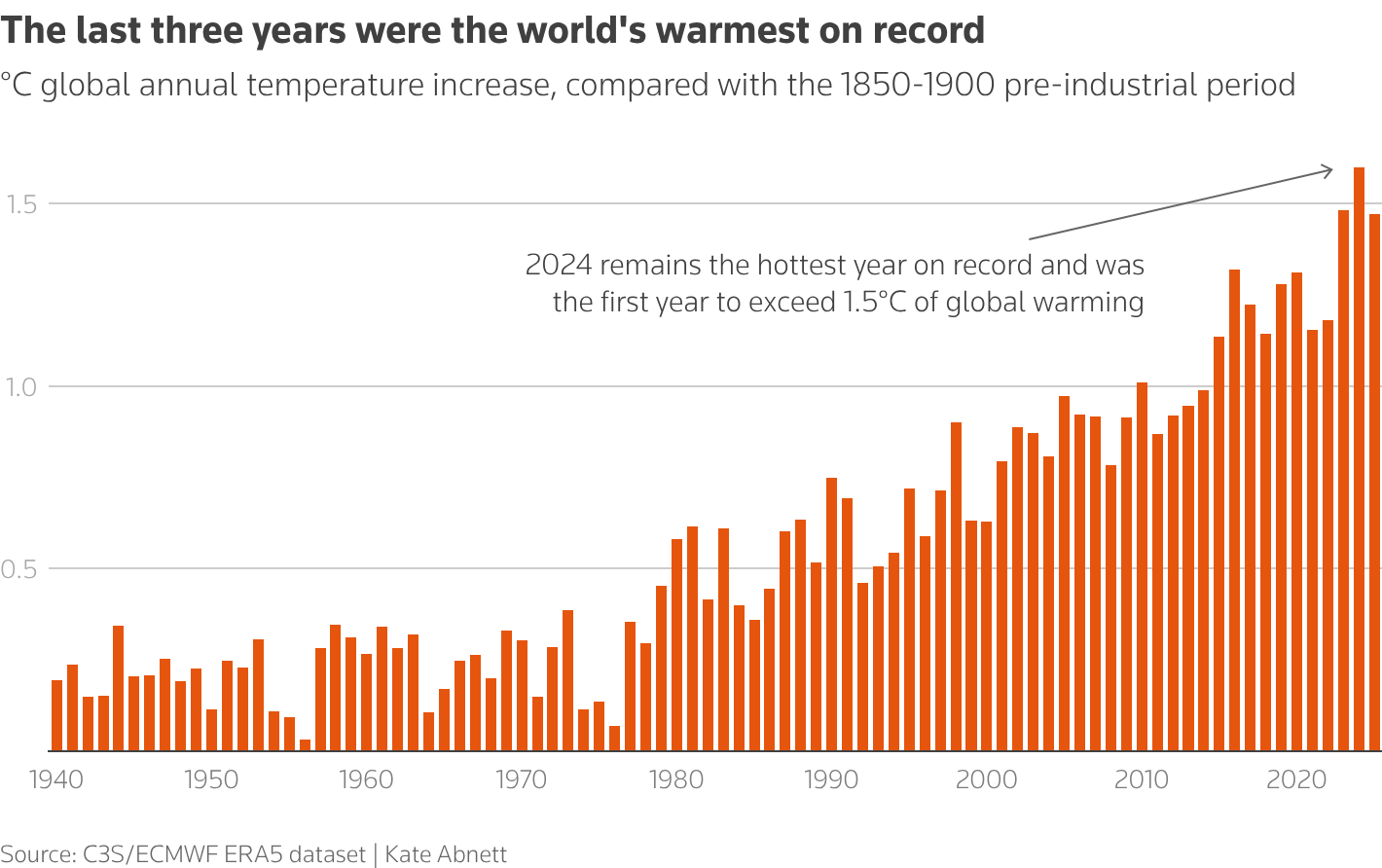
Climate scientists from around the world have confirmed that last year was among the planet’s three warmest on record. The European Union’s dataset confirmed average temperatures have now exceeded 1.5 degrees Celsius of global warming for the longest since records began, yet governments pledged under the 2015 Paris Agreement to try to avoid exceeding that level of global warming.

Their failure to reduce greenhouse gas emissions means that target could now be breached before 2030, the European Union's European Centre for Medium-Range Weather Forecasts (ECMWF).


Number of the Week