Policy changes, but facts endure. AP delivers accurate, fact-based journalism to keep the world informed in every administration. Support independent reporting today. Donate. |
|
|
By Holly Meyer and David Crary |
| |
|
By Holly Meyer and David Crary |
| |
|
Hi, World of Faith readers.
This week, we catch up with a very long walk to Washington, D.C. that a group of monks and their rescue dog are undertaking. The Associated Press also has an analysis of how today’s protests in Iran echo the run-up to the 1979 Islamic Revolution, and we check in with an internationally known DJ priest navigating concerns ahead of a recent performance in Beirut. |
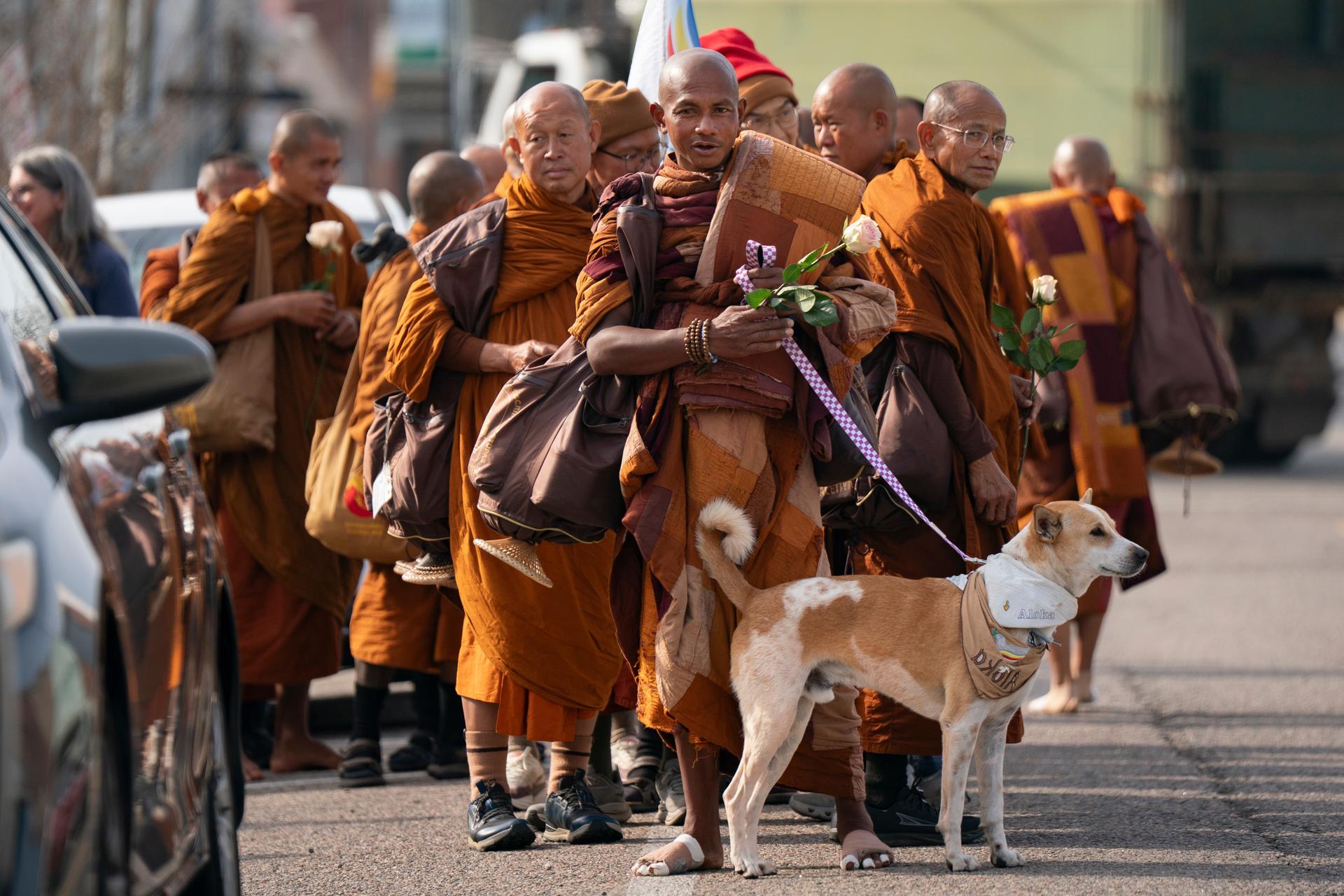
Buddhist monks who are participating in a walk for peace are seen with their dog, Aloka, in Saluda, S.C. (AP Photo/Allison Joyce) |
Buddhist monks and their dog captivate Americans while walking for peace |
A group of Buddhist monks and their rescue dog are striding single file down country roads and highways across the South, captivating Americans nationwide and inspiring droves of locals to greet them along their route. In their flowing saffron and ocher robes, the men are walking for peace. It's resonating in the U.S., seemingly as a welcome respite from the conflict, trauma and politics dividing the nation. Read more.
|
|
|
-
Their journey began Oct. 26, 2025, at a Vietnamese Buddhist temple in Texas, and is scheduled to end in mid-February in Washington, D.C., where they will ask Congress to recognize Buddha’s day of birth and enlightenment as a federal holiday.
-
Beyond promoting peace, their highest priority is connecting with people along the way. The monks have been surprised to see their message transcend ideologies, drawing huge crowds into churchyards, city halls and town squares across six states.
-
The monks practice and teach Vipassana meditation, an ancient Indian technique taught by the Buddha himself as core for attaining enlightenment. They don't aim to convert people to Buddhism; instead, their main goal is to help people achieve peace in their lives.
|
|
|
Analysis: Scale of protests and violence in Iran echoes chaos around its 1979 Islamic Revolution |
In just a few days, nationwide protests challenging Iran’s theocracy exploded into a crackdown and bloodshed that blew past reported casualty figures of decades of previous demonstrations. This new level of mayhem resembles the chaotic days surrounding the birth of the Islamic Republic in 1979. And that poses perhaps the greatest risk to Iran’s theocracy in the time since. It now faces a population increasingly willing to disobey a government long willing to use violence to suppress dissent. Read more.
|
|
|
-
In the run-up to the revolution, Iranians witnessed street battles and targeted attacks. Each fresh mourning for slain protesters expanded into a cycle of demonstrations. That ultimately ballooned to millions on the streets and pushed the monarch to flee.
-
Ayatollah Ruhollah Khomeini returned to Iran and soon seized all levers of power. The execution of thousands followed. So did an eight-year war launched by Iraq and the imposition of the mandatory hijab, or headscarf, for women.
-
It remains unclear why exactly the recent bloodshed has been so much greater than previous rounds of unrest. One factor may be that the protests touched on economic issues, and another may be the size and scope of the protests themselves.
|
|
|
Priest by day, DJ by night: Padre Guilherme’s rave in Beirut draws cheers and controversy |
In Beirut, a sold-out nightclub event featured an unusual DJ — Padre Guilherme, a priest from Portugal. He uses music to connect with youth and spread messages of peace. Guilherme Peixoto has gained global fame, performing at major events like World Youth Day. His recent show in Lebanon faced controversy, with some calling for its cancellation. However, a judge rejected the petition. Read more.
|
|
|
The priest broke onto the global stage after his performances at World Youth Day in 2023 before Pope Francis’ open-air Mass, and another featuring Pope Leo in 2025. What started as a way to fundraise for local churches has become a vital new way to evangelize.
Eighteen people, including Christian religious officials, petitioned the Lebanon's judiciary to cancel the show, saying it was an insult to the faith. The club where he performed opted not to display religious symbols to avoid offense, and the priest skipped wearing his cassock.
Christians make up around a third of Lebanon’s 5 million people, giving the small nation on the eastern coast of the Mediterranean the largest percentage of Christians in the Middle East. Maronite Catholics are the largest Christian group.
|
|
|
|