|
|
|
|
Good morning. What do we think of “five up” instead of “five files to follow” for the Monday edition? It feels livelier, but is it too abstract? Email me with your thoughts on this urgent matter: cws@globeandmail.com |
|
|
|
|
|
|
|
|
|
|
|
|
|
|
|
|
Manufacturing: A decade of upheaval and declining production in the Canadian automaking sector has highlighted the persistent strength of Japanese manufacturers in this country, even as the Detroit Three have retreated. |
|
|
|
|
Electric vehicles: Ottawa is facing increased pressure to abandon its policy requiring EVs to make up a growing share of Canadian car sales. A new national automotive strategy could be revealed as early as this week. |
|
|
|
|
Economy: Canadian university presidents will be in India this week as part of a delegation that hopes to strengthen ties between the two countries. |
|
|
|
|
|
|
|
|
|
|
|
|
|
|
|
A bear, a hawk and a Canadian walk into a bar chart. (That's Fed-chief-in-waiting Kevin Warsh walking next to Mark Carney at a central banking summit in 2010.) Reed Saxon/The Associated Press
|
|
|
|
|
|
|
|
|
|
|
|
|
|
|
|
|
1. A more stable job search: Slower population growth and a pullback in labour supply are reshaping Canada’s employment market. January’s report is expected to show a loss of 10,000 jobs compared with December, while the unemployment rate edges down to 6.7 per cent from 6.8 per cent. |
|
|
|
|
Population growth slowed sharply at the end of 2025, reducing the amount of job creation needed to keep unemployment steady, RBC economists Nathan Janzen and Claire Fan wrote in a client note on Friday. Hiring intentions are low and trade-exposed sectors continue to lag, though job postings have risen since the fall, pointing to stabilizing demand. |
|
|
|
|
|
|
|
|
“Leading indicators are starting to point to improvement in the labour market after a year of gradual cooling best characterized as a ‘low hire, low fire’ environment,” the economists said. |
|
|
|
|
2. All eyes on all-caps: U.S. President Donald Trump backed down from fully taking over Greenland, and he has named a Fed chief many see as more likely to keep lending rates stable or even higher over the long run. But Trump can’t take back his threat to harness the might
of the American military and economy to take from the world whatever he wants. He’s still just one Truth Social post away from threatening to destroy a global system of security and trade that has been in place since the Second World War. |
|
|
|
|
That dynamic will weigh on markets and the minds of global leaders this week and beyond. In a week of high-profile earnings, highly anticipated economic reports, and continued tensions between the U.S. and its allies – which were encouraged by the Trump administration to develop trade relationships elsewhere – the President will likely have Truth Social open and the all-caps button pre-locked. It is unlikely China will end hockey in Canada after Ottawa reached a strategic partnership with Beijing, as the President has warned. |
|
|
|
|
3. Currency chaos in Trump’s Warsh-ington: That volatility is one reason the prices of shiny metals have risen so sharply in recent weeks, following a months-long skyward trend. |
|
|
|
|
Investors have piled into gold to guard against a world of worries – including a potentially less independent Fed. But Kevin Warsh, Trump’s nominee to replace Jerome Powell when his tenure ends in May, is seen as “hawkish,” meaning he leans toward more restrictive monetary policy. Even if he makes an early trim to the central bank’s key lending rate, investors expect he will keep policy tighter over the longer term. |
|
|
|
|
Warsh is a surprising choice from a President who wants the bank to cut, cut, cut, and one viewed as supportive of more traditional, yield‑bearing investments like bonds and the U.S. dollar. Higher or more stable interest rates tend to boost those assets, while making gold less attractive by comparison. |
|
|
|
|
On Friday, markets followed that logic to the extreme. Investors sold off gold at a record pace and bought back into the greenback. After a month that saw investors selling U.S. stocks, bonds and the dollar all at the same time – a rare, sweeping shift away from the country’s assets - some analysts suggested the “Sell America” moment has passed. |
|
|
|
|
Still, the loonie is uncomfortably strong compared with its American counterpart – making imports cheaper, but exports less competitive. Where this path leads for Canada this week and beyond, Mark Rendell writes, will depend a lot on how renegotiations shape up over the USMCA. |
|
|
|
|
4(a). Digging for gold: With Warsh’s nomination, markets have one less potential existential crisis to fear. But here again, Trump’s campaign of public criticisms and threats toward Powell are the point. Global investors will still wonder whether Warsh will be acting with complete independence from the White House. And all of those other worries – of potential tariffs, of destroying NATO, of the decline of the U.S. dollar – haven’t gone anywhere. |
|
|
|
|
Gold plummeted on Friday, and might have further still to fall, but many analysts see it returning to a more stable climb as a hedge against those concerns. |
|
|
|
|
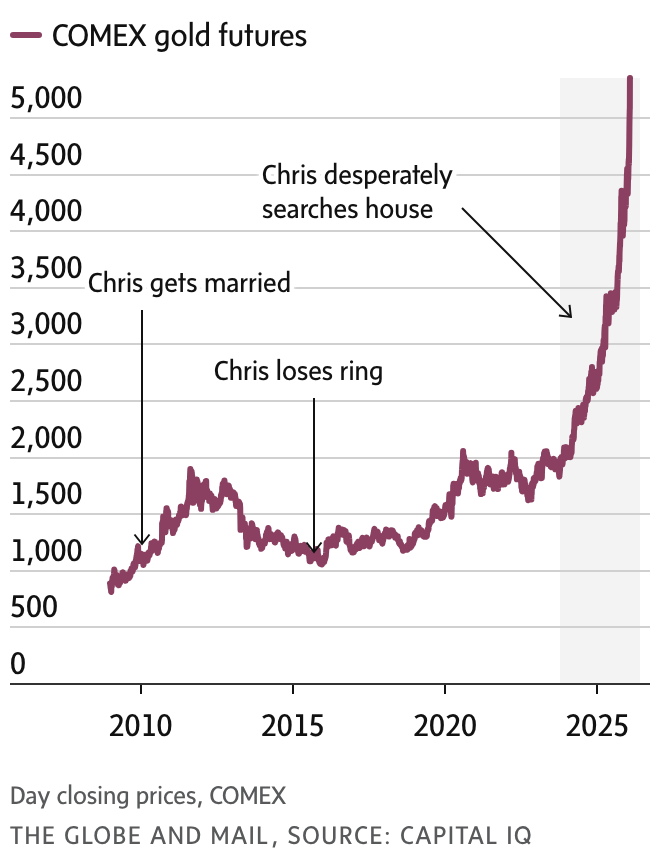
4(b). The metal detector: I’m not taking any chances. For me, the price of gold is personal – a story of love, loss and redemption. It opens on one of the greatest days of my life: Sept. 4, 2010. When I looked at my new wedding ring, I didn’t think about its monetary value. What I saw was a priceless reminder of commitment and eternal love, its circular shape representing a connection with no beginning or end, a symbol of the infinite nature of our promise. |
|
|
|
|
In 2016, when I lost that ring, I would argue to the judge-only trial (hi, Meghan! oh, beautiful and benevolent Meghan!) that it was none of those things. Who needs a metaphor, I contended, when these promises were held so deeply in my heart? And not that I’d ever consider parting with it, but in 2016, I’d be selling it at a minor loss. |
|
|
|
|
This is what happened next: |
|
|
|
|
|
|
From the time I got my ring, gold is up more than 300 per cent. If I had $400 worth of gold in 2016, it would cost more like $1,800 to replace today. A ring with $1,000 worth of gold a decade ago would be worth closer to $5,000. It’s enough to rekindle belief in metaphors, and to escalate search efforts in our house. (Motivated purely by love.) |
|
|
|
|
5. At the bell: A batch of corporate earnings, including from mega-caps Alphabet and Amazon, will test U.S. stock markets this week after a disappointing report from Microsoft dragged everyone down. |
|
|
|
|
Barrick’s results will draw attention as the miner works through a selloff of gold, and an activist‑driven plan to separate its North American assets, Amber Kanwar writes in her market setup. |
|
|
|
|
BCE will also be closely watched when it reports its latest quarterly earnings on Thursday, offering the first real look at how its U.S. acquisition and a softer wireless market are shaping its 2026 outlook. |
|