|
The Historic Records Center has moved to the third floor of the Fairfax County Courthouse at 411 Chain Bridge Road, Suite 317. While the Historic Courthouse remains closed for the foreseeable future, our new office is open, and we are assisting in person researchers again!
While We believe all the records at the Historic Records Center are valuable, one of our most prized documents is Martha Washington's Will. Unlike her husband's will, Martha's is not entirely written in her own hand. However, it is still a valuable document that we feel privileged to be able to preserve and hold in our collections.
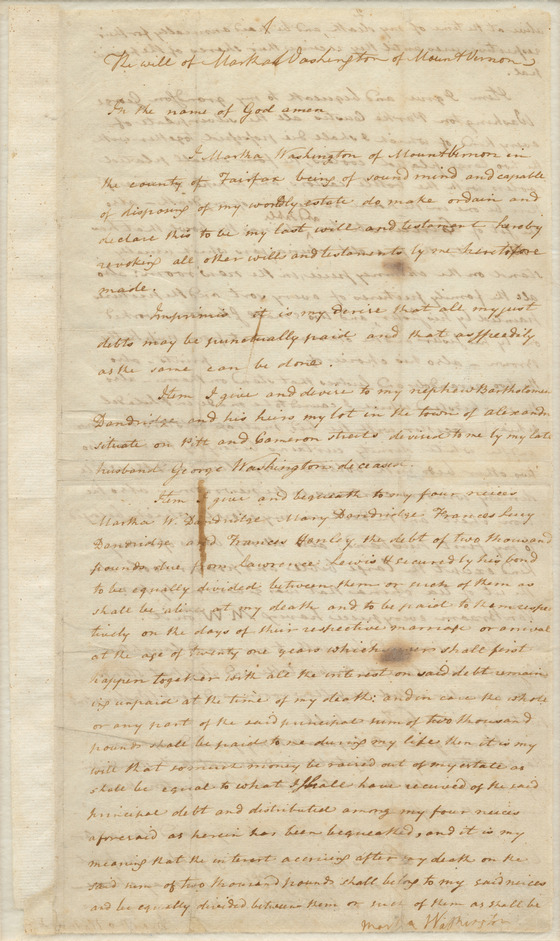
First Page of Martha Washington's Will
Writing the Will
Prepared by Charles Lee, the Washington family lawyer, Martha's will was written and signed on September 22nd, 1800. It is believed that Martha dictated the content of the will and Lee wrote the document for her. However, on March 4th 1802 Martha added a codicil leaver her "Mulato man Elish" to her grandson George Washington Parke Custis. Along with her signature at the bottom of each page, like her husband included in his will, this is believed to be the only portion of the document in Martha's own handwriting.
Martha Washington's Will page 5, codicil
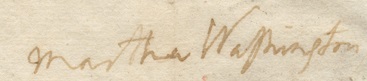
Martha Washington's signature, as seen in her will
At Seven pages long, Martha's will is much shorter than George's. It's contents mostly deal with personal property and household items which was customary for the time. Although Martha was much wealthier than George when they got married, much of her property was dower property from her first marriage to Daniel Parke Custis. As such, her enslaved remained in the Custis family after Martha's death.
Martha's Will During the Civil War
Similarly to George's will, Martha's also went on a journey around the time of the Civil War. Court staff left Martha's will in the clerk's office during the war, and in 1862 it was removed by union soldier David Thompson to be a keepsake for his family. After leaving the will to his daughter upon his death, she eventually sold the document to finance tycoon J.P. Morgan in 1903. After J.P. Morgan's death in 1913, members of the Falls Church chapter of the Daughters of the American Revolution caught wind that Martha's will was among his belongings, and they began writing letters urging the family to return the will to Virginia. The situation escalated until Virginia formally sued to receive the will back, and the case made its way through the legal system until it was set to be heard by the United States Supreme Court. Only after the dispute reached the highest level of the United States legal system did the Morgan family finally return the will to the Fairfax County Courthouse where it has remained since.
Conservation of Martha's Will
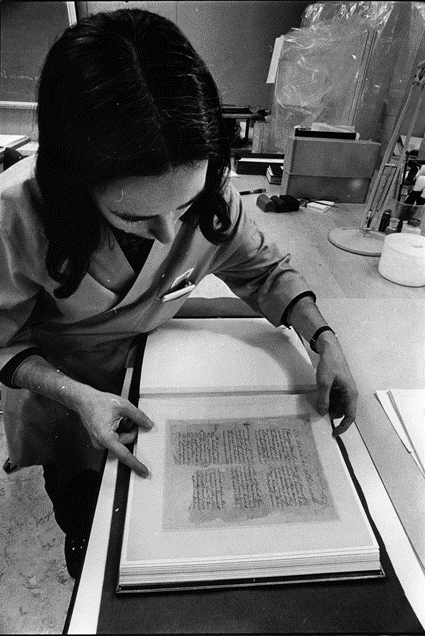
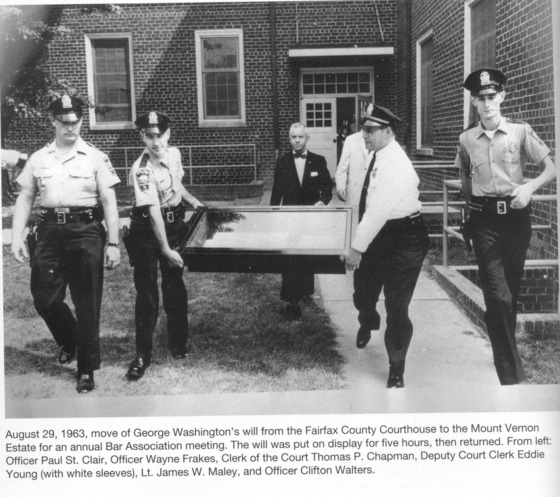
In 1999, both George and Martha's wills received extensive conservation treatment from the firm Conservation of Art on Paper Inc. Both Documents received repairs and were placed in the double-sided matting they remain encased in today. Currently ,George and Martha's wills are securely stored at the Fairfax County Courthouse and are only shown to the public on special occasions under the direct supervision of Historic Records Center staff with a Sheriff's Deputy escort.
Conservation being done on George Washington's Will
George Washington's Will being moved with Clerk of Court and law enforcement escort
|