|
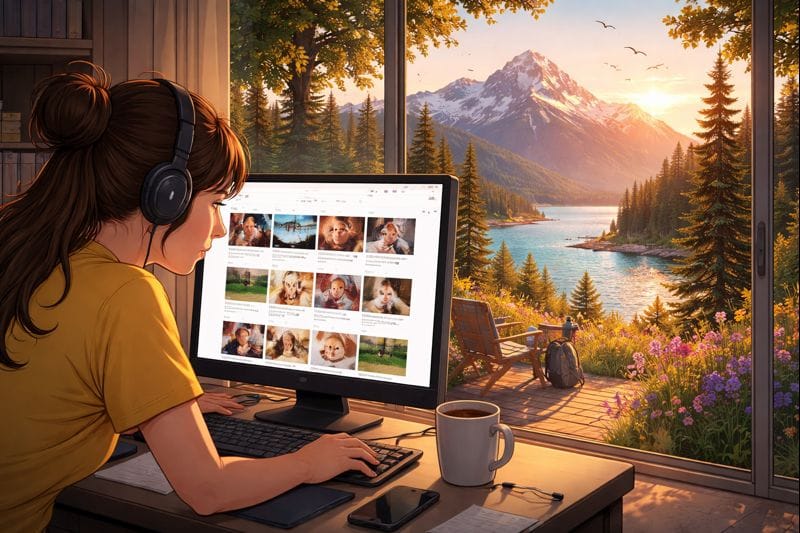
Years ago I read lines by a young mom who described being in the bathroom about to shower, searching for a podcast to listen to during her eight-minute routine. Just then, she had one of those moments we all occasionally have when we pull back, confront ourselves directly, and ask: “What are you doing?” She was so acclimated to consuming inputs that the idea of eight input-free minutes was unappealing. She was, in essence, an addict. I can relate to this. It used to be about eating. The word “consume” means “to eat or drink; to ingest.” It always meant taking physical material into your body and digesting it through your organs, and often the quantity was large (see: “to eat or drink especially in great quantity”). Eating a few pretzels is nibbling, but consuming is the whole bag. Today we use “consume” differently. Today it’s about interacting with digital content — visual or audial. Material goes in eyes and ears, not mouth, and is processed through brains, not organs. We consume videos, podcasts, posts, shows, articles. The material we “ingest” is sometimes learning-oriented and instructive (like a podcast) and sometimes entertainment-oriented and recreational (like Instagram reels or shows). Usually it’s a combination of the two. Consuming media isn’t new; it’s been occurring for a century. U.S. households got radios en masse in the 1920s and TVs in the 1940s. Taking in media is part of the fabric of modern life. What is new is the quantity. It has skyrocketed over the past twenty years. Outside of sleep, consuming digital media is the primary thing a modern person does with her time. On average, we now consume seven hours per day of digital media. Much of this happens while we’re doing other things: driving the car, cooking dinner, going for a run, doing laundry, taking (as noted) a shower, or using the toilet. Why do we do turn to digital media? Because it’s engaging, and it makes our lives more interesting. As humans we’re wired to pursue and enjoy story, knowledge, and humor … and digital media is the most direct route to all of these. The dopamine hijack process enhances this. And consuming media on a device can be a good thing. I spent 42 hours listening to Fyodor Dostoevsky’s The Brothers Karamazov on Audible last summer, and I’d say it a) felt like a great accomplishment, and b) was time well spent. I also listen to a dozen podcasts a week, grow in knowledge, learn a ton. I’ve enjoyed taking in great shows, too, while exercising, folding laundry, or hanging out with my family. (Favorite in 2025 PBS’s All Creatures Great and Small.) All have enhanced my life. You can probably relate. Taking in digital media, then, can contribute to flourishing. It can also be a bad thing. I would argue on balance that the outcomes — for me and for society at large — are more bad than good. Why? I’ll answer using the basic goods. 1. Knowledge is a basic good, but for a person to flourish the goods must be balanced. Spending seven hours a day taking in media — even in in the unlikely case that it were all knowledge-based — is the definition of imbalance. We are not brains in jars (or butts on couches) but full-orbed people whose lives need stewarding in full-orbed ways. Imbalance, even of goods, wrecks us. 2. Play is a basic good, but a life spent consuming is a life with little or no play. Most consumption is social media, which mimics play — watching videos, giggling, seeking laughs. But it isn’t real play. The cheap counterfeit produces none of the positives in a life that real play does. And the more you watch, the less you play. 3. Entertainment, the raison d’etre of modern media consumption, is not a basic good. Being entertained is pleasurable but necessarily passive and doesn’t itself lead to flourishing. For the modern person, the ratios are way, way out of whack. A life that’s 90 percent purposeful and 10 percent entertainment-filled may lead to thriving, but a life that’s 90 percent entertainment and 10 percent purposeful doesn’t and can’t. I’d argue the modern person more closely fits the second category. 4. A life of consuming is a life without beauty. This is perhaps the most important — and most overlooked — consideration. Beauty is a basic good, and we moderns are starving for it. I’m not talking about a Pinterest-worthy sunroom or an Instagrammable photo in gorgeous Santorini. I mean the simple beauty that comes with presence. The swirls of steam rising from your coffee cup, how light peaks through clouds when you leave your house in the early morning, the feel of toddler fingers curled around your own, the swell of heart when calling birds fly overhead. Beauty is the enlarger of the soul and the thing that brings us up and out of ourselves in an almost sacred way. It’s what links us to what’s transcendent, to what is noble and high and worthy — in the world and ourselves. And so entranced are we by our screen, we miss it entirely. You see there’s no way to consume media — in the entertainment-oriented, dopamine-heavy ways of today — and also engage with beauty. Why? To access it, presence and attention to surroundings are required, and these things evaporate when we consume media. Nor can we command beauty to appear in the moments between scrolling or watching, because beauty can’t be conjured at the moment one wants it. It is not a genie that jumps out of a bottle when we open it. Efficiency (and its cousin, multi-tasking) drives out the encounter with beauty as surely as entertainment does. So our addiction to our devices, and to consuming, is banishing beauty from our lives — moment by moment and day by day. It’s a tradeoff that’s terrible, and even tragic. Our souls shrivel and the meaning ebbs out of our lives. Because while your reels, your show, your Twitter habits, your game, your podcast while showering may appeal in the moment, they won’t save you or me. But beauty can. A call and a plea for beauty, then, and lives focused on pursuing it. May 2026 be the year of writing the poem, watching the sunset, tasting the tea, seeing the loved one, dipping toes into the babbling brook, inhaling fully. May we break our addictions, however we must. May we consume less and experience more beauty. Because as Dostoevsky said, “Beauty will save the world.” Amen. Susan Arico is a New Hampshire-based consultant and writer with focus in digital wellness and the intersection of faith and culture. You can follow her on her Substack, For the Sake of the Good, and at her web site, www.susanbarico.com.
|