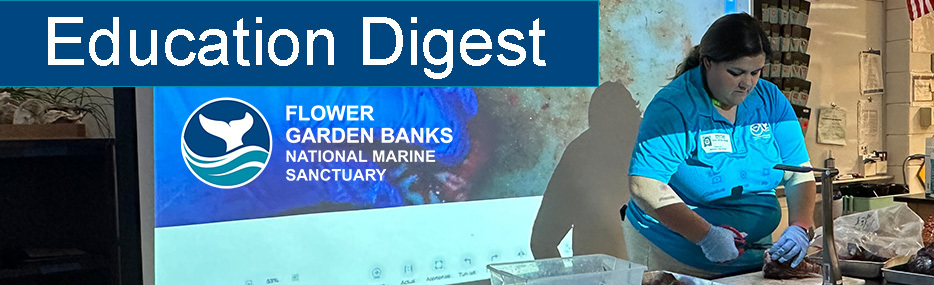
Coral reef monitoring through photography is a long-standing tradition at Flower Garden Banks National Marine Sanctuary, with data collected for over 30 years. As technology advances, the sanctuary’s research team is introducing modeling methods through photogrammetry to enhance their long-term monitoring efforts. Donavon French is leading up the effort to better understand the health of the reef by stitching photos together to get a 3-D view and larger-scale 2-D images of the reef.
Presented by Donavon French, Research Specialist, Cardinal Point Captains for Flower Garden Banks National Marine Sanctuary
Hundreds of data-collecting floats are currently deployed by the Global Ocean Biogeochemistry Array (GO-BGC) in oceans across every corner of the globe — and now, your students can claim one of these groundbreaking pieces of technology for themselves!
The Adopt-A-Float Program offers educators a unique, no-cost way to bring real-world ocean science into the classroom. By adopting, naming, and tracking a biogeochemical float, students engage directly with active research on ocean chemistry and climate change while interacting with world-class scientists.
Visit Texas Wildlife Association’s new Lesson Portal today to access FREE lesson plans—all lessons are Science TEKS-aligned and cover a wide variety of topics, methodologies, settings, and more. Get started today—browse lesson plans, create a free account, download, and repeat. Lesson plans are being added continuously, so be sure to check back often!
Impact Houston 26 is a collaboration between the FIFA World Cup 2026™ Houston Host Committee and the Sports Authority Foundation to ensure that this once-in-a-generation event creates a legacy that lasts for decades. The protection of the environment is one of the initiative’s three core pillars. Impact Houston 26’s Sustainable School Badge recognizes K-12 schools taking action on sustainability and civic engagement via student-led projects that make a difference in Southeast Texas communities. The K-12 Padlet and other qualifying projects focus on embedding sustainability into everyday learning. School projects are centered around Green Infrastructure and Nature-Based Solutions, Waste Reduction and Circular Economy, Water and Climate Resilience, Sustainable Mobility and Clean Energy, and Community Engagement and Storytelling. Schools and students can choose from a wide range of sustainability projects from the K-12 Padlet or design their own project(s) aligned with UN SDGs or the host committee’s sustainability goals.
Source: EEvengers
This is an electronic distribution list run by Flower Garden Banks National Marine Sanctuary (FGBNMS). The Education Digest provides the latest in information on coral reefs and marine science issues, educational resources, grant and scholarship opportunities, professional development workshops, job and internship opportunities, and more. To subscribe to this or any other FGBNMS email list, please visit https://flowergarden.noaa.gov/newsevents/subscribe.html
Postings made to this list are not the views of the Federal Government, inclusive of the U.S. Dept. of Commerce/NOAA/NOS/ONMS/FGBNMS. If you need additional assistance, please contact flowergarden@noaa.gov.
This email was sent to NP7epxb8a@niepodam.pl using GovDelivery Communications Cloud on behalf of: NOAA's National Ocean Service · SSMC4, Room 9601 · 1305 East-West Hwy · Silver Spring, MD 20910