In Chattanooga, Tennessee, a different type of curling championship took place, in which teams attempted to throw an iron skillet as close as they could to a piece of bacon on ice. With costumes, alcohol, and team names like “Wu-Tang Pans,” skillet curling is a fun and creative variant on a classic Winter Olympics sport. (For coverage of actual Olympic, college, and professional sports, subscribe to Scoreboard.)
The S&P 500 and Nasdaq 100 sank as Anthropic’s new tools for Cowork, a computer assistant on mental steroids, triggered a sell-off in software stocks. The Russell 2000 rose.
All of the BATMMAAN stocks fell except for Tesla, and tech was the worst-performing sector. Energy was the best-performing sector as crude oil prices climbed amid escalating tensions with Iran. Investors switched to a defensive stance, sending consumer staples and utilities up over 1%, along with materials. Gold and silver prices rebounded after their recent historic wipeout.
|
|
|
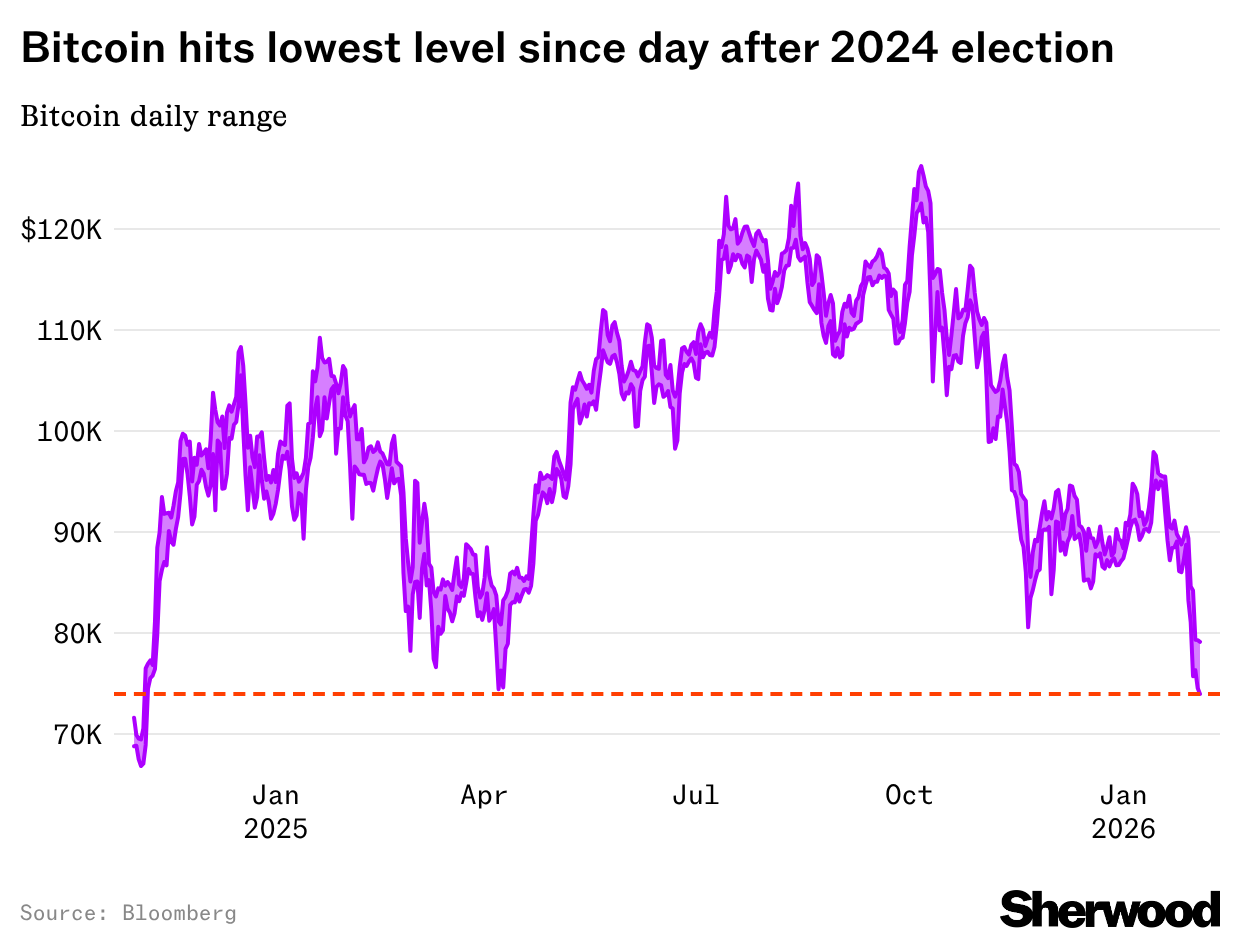
So much for Trump’s bitcoin bump: the cryptocurrency dipped below $74,000 on Tuesday, its lowest level since Donald Trump won the 2024 US presidential election on November 6, and an over $50,000 drop from its all-time high on October 6, 2025. But following that peak, the asset ended October down, and bitcoin hasn’t ended a month in the green since.
Is this a correction or something… more chilling? We think Bitwise CIO Matt Hougan hit the nail on the head when he wrote, “This is not a ‘bull market correction’ or ‘a dip.’ It is a full-bore, 2022-like, Leonardo-DiCaprio-in-The-Revenant-style crypto winter.”
How did we get here? What happened to the “crypto president” taking us all to the moon? |
- Hougan posits it was “set into motion by factors ranging from excess leverage to widespread profit-taking by OGs.”
-
Bitfinex analysts said that the broader flows picture suggests a clear risk-off rotation, with investors reallocating toward cash and gold amid rising uncertainty. “In this environment, the lack of ETF absorption has amplified downside volatility, reinforcing the importance of institutional spot demand as a stabilizing force during periods of market stress,” they said.
-
Glassnode analysts agree, writing, “Overall, conditions have shifted into a clear risk-off regime across spot, derivatives, ETFs, and on-chain indicators.”
|
It’s not just bitcoin: the broader crypto ecosystem is suffering. The overall crypto market cap now stands at $2.6 trillion, but before the October 10 liquidation event, it had soared above $4 trillion. |
|
|
Bernstein analyst Gautam Chhugani sees a light at the end of a tunnel, but he warns it’ll likely get worse before it gets better. He anticipates a reversal most likely in the first half of 2026, after bitcoin bottoms out “around its last cycle highs ~60K range.” The good news for bitcoin bulls is that Chhugani predicts following that bottom, the asset will enter its “sovereign cycle,” while Ray Youssef, CEO of crypto app NoOnes, said earlier this week that bitcoin’s potential downside is in the $69,000 to $71,000 range, pointing to the crypto president’s decisions “in both domestic and foreign policy… acting as a key downside catalyst.”
|
|
|
- The company had a good quarter, with revenues of $10.27 billion (beating the consensus estimate of $9.65 billion) and solid expectations for the current quarter: management expects revenues of $9.8 billion, give or take $300 million, more than estimates of $9.4 billion.
-
That revenue guidance for Q1 includes $100 million in sales of MI308 chips to China, as the chip designer was once again able to send some of its AI processors to buyers in the world’s second-largest economy.
- In Q4, AMD generated $390 million from sales of these chips to China. Without those revenues, sales would have been a lot closer to the consensus estimate.
|
The knee-jerk reaction for shares is lower, off nearly 7% in after-hours trading. |
|
|
|