Dear Educator,
In trying to relate the past to the present, details are often lost, muddled, or even changed. Instead of telling students how history informs today, why not let them reach their own conclusions? Encouraging them to identify vestiges of history (they are everywhere!) and to apply lessons learned will meaningfully strengthen their critical thinking skills.
The early 20th century marked a new chapter for the United States on the world stage, defined both by bursts of global engagement and periods of isolationist retrenchment. By the end of World War II, the United States emerged as a leading world superpower with an unambiguously global focus.
This newsletter explores the question How Did the United States Become a Global Power? by looking at topics such as: Keep an eye out for discussion checkpoints that can help your students make connections to the present. Happy learning,
Caroline Netchvolodoff
Vice President, Education
Council on Foreign Relations |
|
|
Setting the Scene: Before diving into a lesson on this topic, take a step back and ask your students to define a global power. Then have them consider whether and how the definition of global power has changed over time.
|
|
|
America Before 1917: Grappling with Isolationism
|
In its first hundred years, America was mainly focused inward, concerned more with developing its economy and expanding its borders westward than on dealing with matters abroad. But throughout the 1890s, as its economic might grew, America began to abandon those isolationist principles.
The Spanish-American War of 1898 marked a giant leap for the country toward global ambitions, and by the turn of the twentieth century, the United States controlled territory throughout 10,000 miles from Puerto Rico to the Philippines. Its economy had surpassed that of the United Kingdom to become the world's largest.
|
|
|
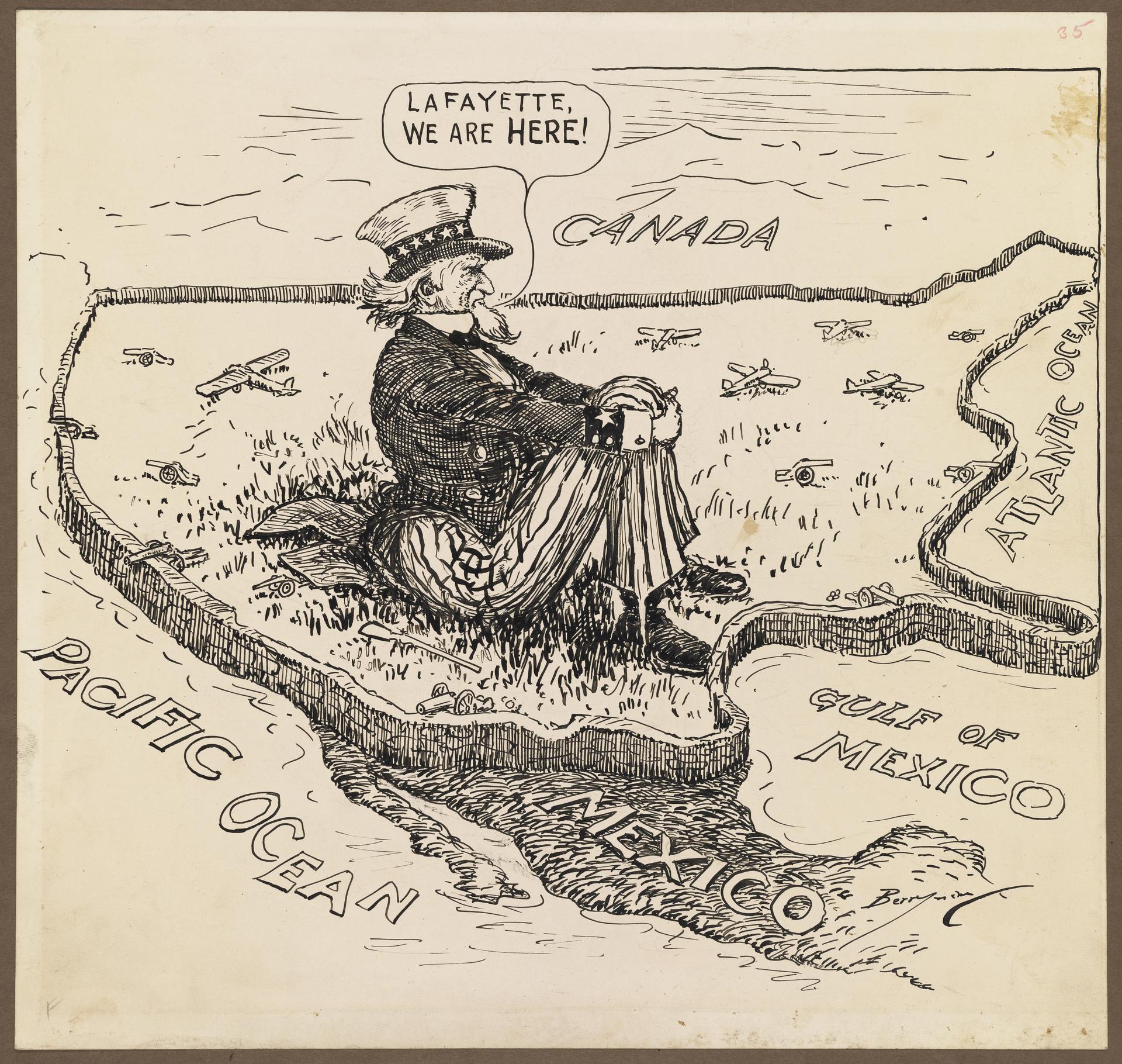
Test your students’ understanding of isolationism by having them analyze three political cartoons and decide whether each cartoon's message is isolationist or interventionist. |
| | |
America’s entrance into World War I in 1917 marked the first steps toward the United States becoming a superpower. Not only did its entrance help turn the tide in favor of the Allies, but the U.S. also played a leading role in the eventual peace talks, in which President Wilson sought to shape the postwar international order. Unlike its European counterparts, the United States came out of the war at an economic advantage, having sold war materials to its allies.
Despite these successes, many Americans wanted to return to isolationism, and the government agreed: America had done its part in Europe; it was time to turn inward. A prime example of this change can be seen in the American public and congressional rejection of Wilson’s international organization dedicated to peaceful diplomacy and collective security, the League of Nations. As unrest began to brew again in Europe in the 1930s, Congress passed a series of neutrality acts to ensure that the United States would remain neutral in foreign conflicts. The United States also embraced protectionist economic policies, which further distanced the country from the global economy. Discussion checkpoint: Ask your students what lessons the aftermath of World War I teaches about the dangers of isolationism.
What are the pros and cons of isolationism? Ask them to explain whether they think it is possible for a country to 'mind its own business’.
|
Interwar Period: Why Did World War II Happen?
|
World War I was referred to as the “war to end all wars,” so what happened? What caused World War II, and why did the US abandon isolationism once again? Below are three resources to share with students in preparation for a lively class discussion: - The Treaty of Versailles
- The Rise of Hitler
- Japanese Imperialism
Discussion checkpoint: In the lead-up to WWII, what were some of the reasons Germany and Japan felt 'cheated' or excluded by the rest of the world?
Take the discussion to the next level by asking students whether they can think of any other historical moments in which countries have felt ‘cheated’ or excluded.
|
When the U.S. joined the war, it was on the tail of a series of German military successes. France had fallen, and the Soviet Union had been invaded (despite signing a nonaggression pact), leaving Britain isolated and outnumbered. Whether it was the timing or the might, US support helped turn the tide, and its invasion of France marked the closing phase of the war.
At the end of World War II, the United States possessed unprecedented power. Its military might, including newly developed nuclear capabilities, was clear to the rest of the world. What’s more, the U.S. dollar became the currency to which all other major currencies were fixed, and the country’s economy nearly doubled in size.
As was the case after World War I, the U.S. was uniquely positioned to promote postwar peace and prosperity. But unlike after World War I, the United States took the lead in creating a series of international institutions to promote cooperation on global issues.
Discussion checkpoint: Having studied some of the historical events that made the United States a global power, ask students to consider which countries are global powers today and to describe why they are perceived as such.
Finally, ask your students to apply their historical knowledge to predict whether U.S. foreign policy is likely to lean more toward engagement or isolationism, in both the short and long term. |
|
|
Partner Spotlight: C-SPAN Classroom |
|
|
Middle and high school teachers: Looking for summer professional development opportunities? Apply now for C-SPAN’s Virtual Teacher Fellowship or in-person Summer Educators’ Conference! Visit C-SPAN’s website for details: Teacher Opportunities. Questions? Email the team at educate@c-span.org.
|
| |
|
Council on Foreign Relations. All rights reserved. |
58 East 68th Street – New York, NY 10065 1777 F Street, NW – Washington, DC 20006 |
|
|
|