Welcome to CFR’s Daily News Brief. Today we’re covering snap elections in Japan and Thailand, as well as... - Portugal’s presidential election
- Iran’s stance on nuclear enrichment
- Saudi investments in Syria
Our daily coverage of the 2026 Milan-Cortina Olympics begins today! Scroll to the bottom to read more. |
|
|
|
Incumbent conservative parties won sweeping victories in Japan and Thailand’s snap elections yesterday, strengthening their respective mandates. In Japan, Prime Minister Takaichi Sanae’s Liberal Democratic Party (LDP) clinched a supermajority in the lower legislative house. In Thailand, preliminary results showed Prime Minister Anutin Charnvirakul's Bhumjaithai Party winning around 194 seats in the country’s 500-person lower house, while opposition progressives secured only around 116.
In Japan, Takaichi took a gamble by holding a snap election just 110 days after taking office. The LDP’s congressional strength had lagged in recent years, forcing it to rely on coalition partners to form a government. Ahead of the weekend vote, Takaichi had pledged tougher policies on immigration and China, a boost in government spending, and efforts to change Japan’s constitution to empower the country’s self-defense forces. Takaichi has underscored the importance of the U.S.-Japan relationship, and U.S. President Donald Trump endorsed her and celebrated her party’s victory.
In Thailand, the conservative Bhumjaithai Party defied polls that favored the progressive opposition People’s Party, which is popular among young voters and has surged in recent years. Bhumjaithai promotes Thai nationalism and respect for the monarchy. Its popularity rose following Thailand’s military clashes with Cambodia last year, paving the way for Anutin to run on a platform of military strength. Bhumjaithai’s conservative allies won enough legislative seats to enable a governing coalition.
|
| |
|
“[In Japan, Takaichi] can set the legislative agenda and decide what comes up and what doesn’t…This is a Takaichi win, but it’s not necessarily an LDP win.” |
|
|
| Audrey Richardson/Reuters |
If politicians, tech leaders, and national security experts do not quickly adapt to growing public concerns about artificial intelligence (AI), a populist backlash could derail America’s AI ambitions, CFR expert Rebecca Lissner writes for TIME. |
| |
|
|
Portugal’s presidential vote. Center-left candidate António José Seguro defeated far-right André Ventura by at least 30 percentage points in yesterday’s presidential runoff election. Portugal’s presidency is largely a ceremonial position, as the prime minister retains more power. Nevertheless, yesterday’s election saw high turnout as parties across the political spectrum united to defeat Ventura’s anti-immigrant party.
Iran’s nuclear stance... Iran will not accept a ban on nuclear enrichment inside the country, Foreign Minister Abbas Araghchi said yesterday following indirect talks with the United States Friday. He added Iran is prepared to build trust that its enrichment is for peaceful purposes. Trump is due to discuss the results of the talks with Israeli Prime Minister Benjamin Netanyahu on Wednesday.
…and post-protest crackdown. Iran’s judiciary sentenced activist and Nobel Peace Prize Laureate Narges Mohammadi, who was detained in December and was reported to be on a hunger strike, to at least another seven years in prison on charges including collusion and propaganda, her lawyer wrote on social media yesterday. Additionally, local Iranian media reported at least four members of the reformist movement were arrested in an apparent crackdown. On Friday, the U.S. State Department announced new sanctions on actors it said illegally transported Iranian oil and indirectly funded the country’s repression at home and “terror organizations” abroad.
Jimmy Lai’s sentencing. A Hong Kong court sentenced pro-democracy media mogul Jimmy Lai to twenty years in prison today, after he was convicted on charges of sedition and conspiracy in December. Lai, a British citizen, pled not guilty to all charges. He is one of the most high-profile figures to have been prosecuted under the territory’s national security laws. Reporters Without Borders said his sentence signified a curtain fall “on press freedom in Hong Kong.”
Saudi investments in Syria. A new Saudi fund will invest around $2 billion to develop two airports in the Syrian city of Aleppo, Saudi Arabia’s investment minister Khalid al-Falih said Saturday. The Saudi Telecom Company also said it will invest $800 million in a telecommunications infrastructure project in the country. These and other new investments represent a “qualitative leap” in their bilateral relations, Al-Falih said. They follow more than $6 billion of Saudi investment pledges in Syria last year.
Ukraine peace deadline. The United States wants Russia and Ukraine to reach a peace agreement by June, Ukrainian President Volodymyr Zelenskyy told reporters Friday, adding that Washington would likely pressure both sides to do so. Kyiv will participate in the next round of U.S.-proposed trilateral talks this week in Miami, Zelenskyy said. Moscow did not immediately publicly confirm its participation.
Haiti’s shaky transition. The mandate for Haiti’s transitional presidential council expired Saturday. It transferred acting executive authority to Prime Minister Alix Didier Fils-Aimé, whom the United States has endorsed. Haiti has not had an elected president for almost five years. The council’s nearly two-year mandate was originally designed to hand over power to the victor of new elections, but those have been repeatedly delayed.
|
| |
|
|
Whether the United States tries to out-compete China or leapfrog it, allies are going to be critical to success, CFR President Michael Froman writes in The World This Week. |
| |
|
|
Today, Israeli President Isaac Herzog visits Australia. Today, African mining conference Mining Indaba begins in Cape Town. Today, the United Kingdom’s Prince William begins a visit to Saudi Arabia. - Tomorrow, Sweden and Finland hold a high-level security dialogue in Espoo, Finland.
|
| |
|
|
What You Missed: 2026 Milan-Cortina |
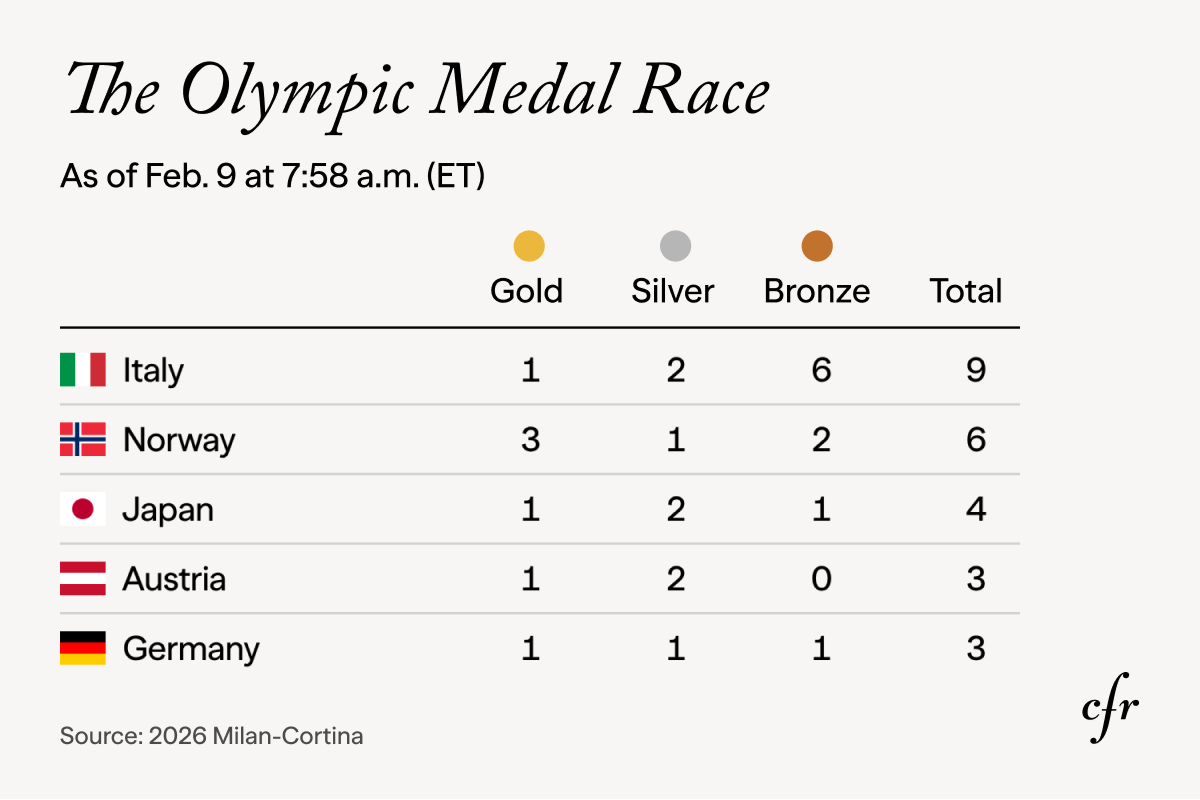
Every morning the Daily News Brief team will share the latest highlights from the 2026 Winter Olympics! Here’s what you might have missed over the first weekend of the Games.
Italy’s cultural parade. Italy’s opening ceremony featured cultural touchstones including the stovetop espresso maker, opera icons, and fashion houses like Giorgio Armani, who designed this year’s Team Italy uniforms shortly before passing away in September. Dancers in the opening ceremony performed routines beneath giant tubes of paint, a nod to the country’s long history at the forefront of visual arts. Check out photos here.
Early U.S. standouts. Following U.S. skier Lindsey Vonn’s dramatic crash during a competition Sunday—ending a closely followed comeback story that saw the forty-one-year-old return from retirement—teammate Breezy Johnson won the country’s first gold medal in a downhill race. Johnson finished less than a tenth of a second ahead of her nearest competitor. On Saturday, U.S. husband-and-wife ice dancing pair Madison Chock and Evan Bates took the top slot in the free dance event of the team competition. (Watch their routine here.) Together, the U.S. figure skating team clinched the gold medal after U.S. skater Ilia Malinin pushed their collective score past that of Japan by one point.
Surrounding the Games. Some train lines around Olympic sites suffered delays over the weekend in what Italian authorities called a deliberate attempt at sabotage. Meanwhile, demonstrators in Milan challenged the social and environmental cost of the Games, reigniting longstanding debates about how mega-sporting events shape their host countries.
|
| |
|
58 East 68th Street, New York, NY 10065 |
1777 F Street, NW, Washington, DC 20006 |
|
|
|