|



Sonar Summit: global conversation building software in the AI era (Sponsored)
 |
Join us for Sonar Summit on March 3rd, a global virtual event, bringing together the brightest minds in software development.
In a world increasingly shaped by AI, it’s more crucial than ever to cut through the noise and amplify the ideas and practices that lead to truly good code. We created Sonar Summit to help you navigate the future with clarity and knowledge you need to build better software, faster.
OpenAI recently launched ChatGPT Atlas, a web browser where the LLM acts as your co-pilot across the internet. You can ask questions about any page, have ChatGPT complete tasks for you, or let it browse in Agent mode while you work on something else.
Delivering this experience wasn’t trivial. ChatGPT Atlas needed to start instantly and stay responsive even with hundreds of tabs open. To make development faster and avoid reinventing the wheel, the team built on top of Chromium, the engine that powers many other modern browsers.
However, Atlas is not just another Chromium-based browser with a different skin. Most Chromium-based browsers embed the web engine directly into their application, which creates tight coupling between the UI and the rendering engine. This architecture works fine for traditional browsing, but it makes certain capabilities extremely difficult to achieve.
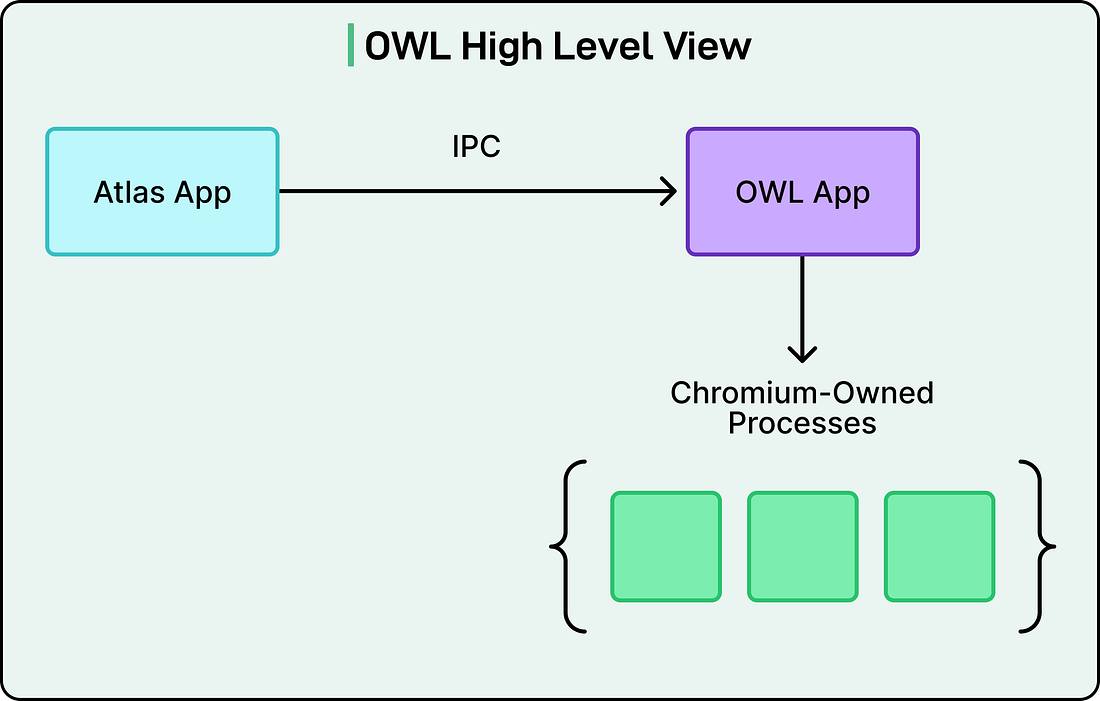
Therefore, OpenAI’s solution was to build OWL (OpenAI’s Web Layer), an architectural layer that runs Chromium as a separate process, thereby unlocking capabilities that would have been nearly impossible otherwise.
In this article, we learn how the OpenAI Engineering Team built OWL and the technical challenges they faced around rendering and inter-process communication.
Disclaimer: This post is based on publicly shared details from the OpenAI Engineering Team. Please comment if you notice any inaccuracies.
Why Chromium?
Chromium was the natural choice as the web engine for Atlas. Chromium provides a state-of-the-art rendering engine with strong security, proven performance, and complete web compatibility. It powers many modern browsers, including Chrome, Edge, and Brave. Furthermore, Chromium benefits from continuous improvements by a global developer community. For any team building a browser today, Chromium is the logical starting point.
However, using Chromium comes with significant challenges. The OpenAI Engineering Team had ambitious goals that were difficult to achieve with Chromium’s default architecture:
First, they wanted instant startup times. Users should see the browser interface immediately, not after waiting for everything to load.
Second, they needed rich animations and visual effects for features like Agent mode, which meant using modern native frameworks like SwiftUI and Metal rather than Chromium’s built-in UI system.
Third, Atlas needed to support hundreds of open tabs without degrading performance.
Chromium has strong opinions about how browsers should work. It controls the boot sequence, the threading model, and how tabs are managed.
While OpenAI could have made extensive modifications to Chromium itself, this approach had problems. Making substantial changes to Chromium’s core would mean maintaining a large set of custom patches. Every time a new Chromium version was released, merging those changes would become increasingly difficult and time-consuming.
There was also a cultural consideration. OpenAI has an engineering principle called “shipping on day one,” where every new engineer makes and merges a code change on their first afternoon. This practice keeps development velocity high and helps new team members feel immediately productive. However, Chromium takes hours to download and build from source. Making this requirement work with traditional Chromium integration seemed nearly impossible.
OpenAI needed a different approach to integrate Chromium that would enable rapid experimentation, faster feature delivery, and maintain their engineering culture.
Your Trusted Source for Cloud Solutions, AI Apps, and Agents (Sponsored)
 |
With the largest catalog of AI apps and agents in the industry, Microsoft Marketplace is a single source of cloud and AI needs. As a software company, Marketplace is how you connect your solution to millions of global buyers 24/7, helping reach new customers and sell with the power of Microsoft.
Publish your solution to the Microsoft Marketplace and grow pipeline with trials and product-led sales. Plus, you can simplify sales operations by streamlining terms, payouts, and billing.
Expand your product reach with Microsoft Marketplace
The Solution: OWL Architecture
The answer was OWL, a new architectural layer that fundamentally changes how Chromium integrates with the browser application.
 |
The key tenet