|


 |
AI is changing the world very quickly right now, having just radically altered the entire software industry just in the last few months. It’s a time of dizzying technological change, and it’s easy to feel a lot of future shock right now.
So I thought I’d repost something I wrote back in 2023, when LLMs were just starting to have a big effect on the world. Reflecting on the changes in my lifetime, I realized that the internet, social media, smartphones, and other digital technologies had already altered the world of my childhood into something almost totally unrecognizable. AI is changing how we think, learn, and work, but the internet already wreaked deep, lasting, confusing changes on how we socialize with each other and how we present ourselves to the world. Humans are fundamentally social creatures, so to be honest I’m not sure which has been the more wrenching change (though of course AI is just getting started).
Anyway, here’s the original post.
In 1970, Alvin Toffler published Future Shock, a book claiming that modern people feel overwhelmed by the pace of technological change and the social changes that result. I’m starting to think that we ward off future shock by minimizing the scale and extent of the changes we experience in our life. I tend to barely notice the differences in my world from year to year, and when I do notice them they generally seem small enough to be fun and exciting rather than vast and overwhelming. Only when I look back on the long sweep of decades does it stun my just how much my world fails to resemble the one I grew up in.
Back in March, Tyler Cowen wrote a widely read (and very good) piece about the rapid progress in generative AI. I agree that AI will change the world, usually in ways we’ve barely thought of yet. And I love Tyler’s conclusion that we should embrace the change and ride the wave instead of fearing it and trying to hold it back. But I do disagree when Tyler says we haven’t already been living in a world of radical change:
For my entire life, and a bit more, there have been two essential features of the basic landscape:
1. American hegemony over much of the world, and relative physical safety for Americans.
2. An absence of truly radical technological change…
In other words, virtually all of us have been living in a bubble “outside of history.”…Hardly anyone you know, including yourself, is prepared to live in actual “moving” history.
Paul Krugman made a similar case back in 2011, using the example of how few appliances in his kitchen had changed in recent decades:
The 1957 owners [of my kitchen] didn’t have a microwave, and we have gone from black and white broadcasts of Sid Caesar to off-color humor on The Comedy Channel, but basically they lived pretty much the way we do. Now turn the clock back another 39 years, to 1918 — and you are in a world in which a horse-drawn wagon delivered blocks of ice to your icebox, a world not only without TV but without mass media of any kind (regularly scheduled radio entertainment began only in 1920). And of course back in 1918 nearly half of Americans still lived on farms, most without electricity and many without running water. By any reasonable standard, the change in how America lived between 1918 and 1957 was immensely greater than the change between 1957 and the present.
But when I look back on the world I lived in when I was a kid in 1990, it absolutely stuns me how different things are now. The technological changes I’ve already lived through may not have changed what my kitchen looks like, but they have radically altered both my life and the society around me. Almost all of these changes came from information technology — computers, the internet, social media, and smartphones.
Here are a few examples.
Screen time has eaten human life
If you went back to 1973 and made a cheesy low-budget sci-fi film about a future where humans sit around looking at little glowing hand-held screens, it might have become a cult classic among hippie Baby Boomers. Fast forward half a century, and this is the reality I live in. When I go out to dinner with friends or hang out at their houses, they are often looking at their phones instead of interacting with anything in the physical world around them.
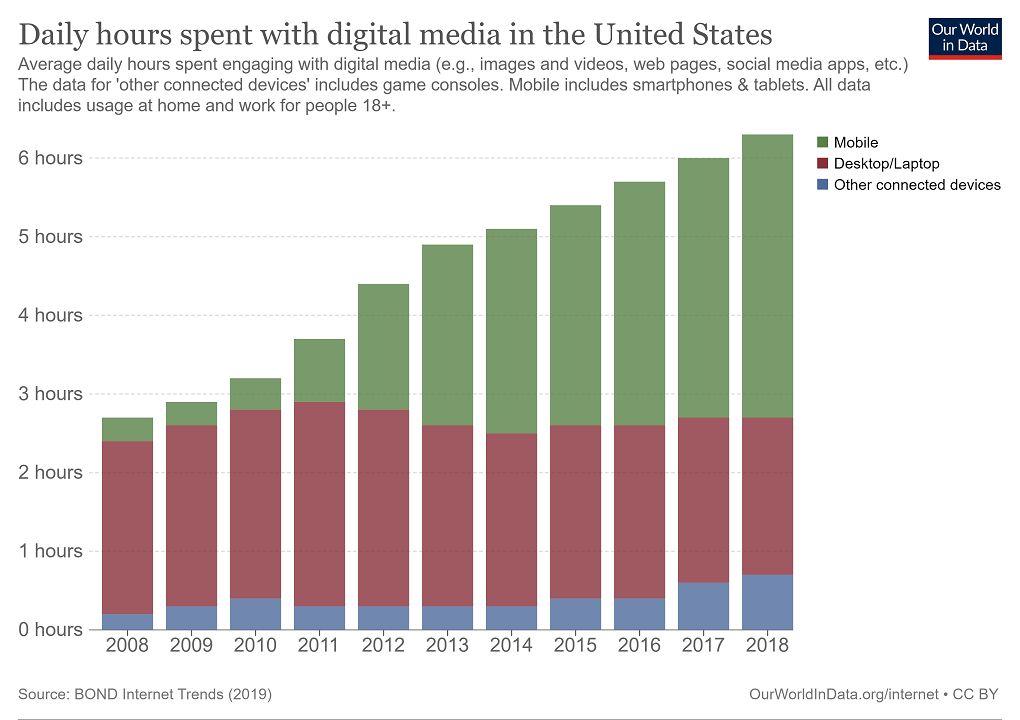
Nor is this just the people I hang out with. Just between 2008 and 2018, American adults’ daily time spent on social media more than doubled, to over 6 hours a day.
 |
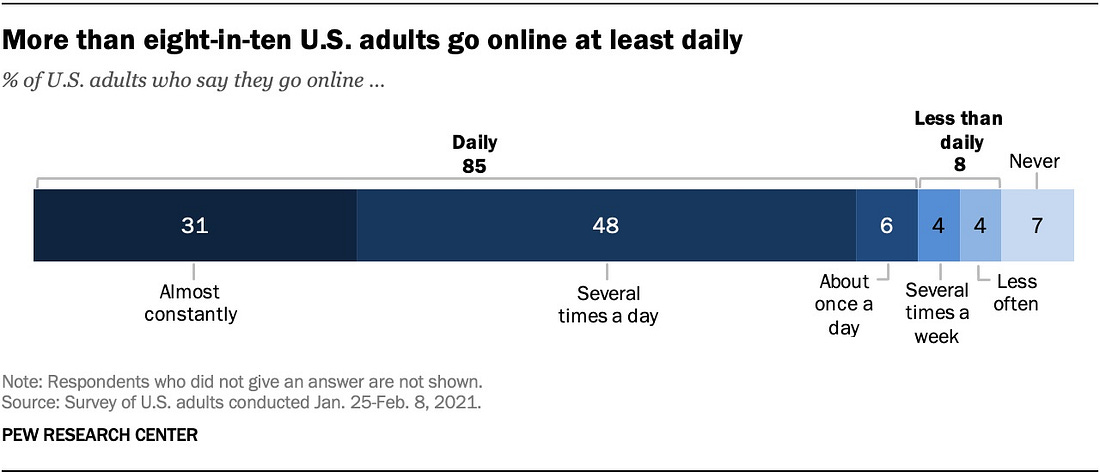
About a third of the populace is online “almost constantly”.
 |
All this screen time doesn’t necessarily show up in the productivity statistics — in fact, it might lower measured productivity, by inducing people to goof off more on their phones during work hours. But the reorientation of human life away from the physical world and toward a digital world of our own creation represents a real and massive change in the world nonetheless. To some extent, we already live in virtual reality.
The shift of human life from offline to online has profound implications for how we interact with each other. One example is how couples meet in the modern day. Dating apps have taken over from friends and work as the main ways that people meet romantic partners:
 |