Partner Updates
50 Bags of Trash Removed From River in Guam in Response to a Coral Disease Outbreak
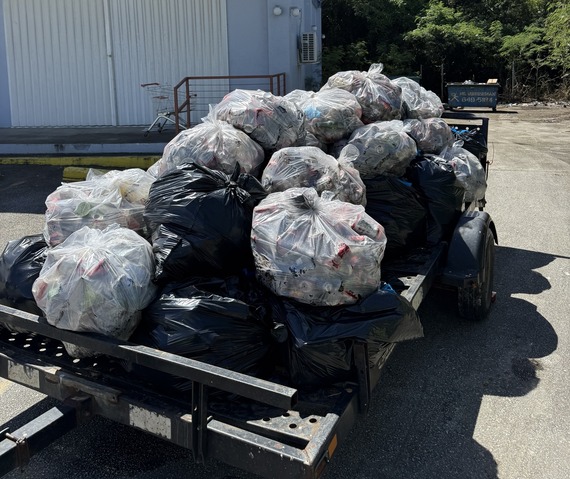 A trailer full of trash collected during an inter-agency river cleanup. (Photo Credit: Reilly Keven)
Submitted by: Reilly Kleven, Guam Coral Reef Initiative
On October 24, 2025, the Guam Department of Agriculture’s Coral Reef Initiative (GCRI) led a cleanup of the Taguag River in Piti, Guam, removing over 50 bags of trash with help from the Guam Environmental Protection Agency, Piti Mayor’s Office, University of Guam Marine Lab, and Department of Public Works. Cans and bottles comprised most of the debris, forming what volunteers called, “a carpet of drink cans” near the rivermouth.
The cleanup was prompted by severe water quality declines in July 2025 in the Piti Bomb Holes Marine Preserve, which caused a coral disease outbreak killing hundreds of corals. Testing showed that the Taguag River had ammonia and nitrogen levels seven times higher than other nearby rivers, indicating it as the source. GCRI is planning additional cleanups, and encourages preventing pollution and reporting illegal dumping.
Learn more about the Guam Coral Reef Initiative.
Marine Debris Map for Micronesia Goes Live
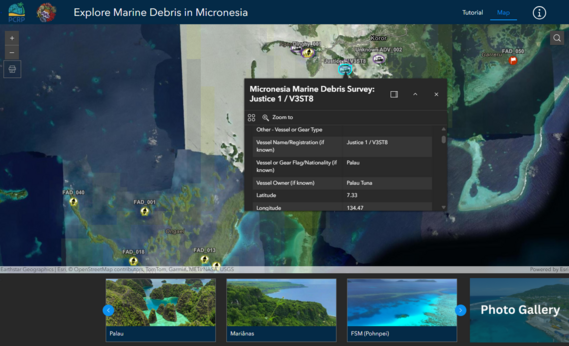 Screenshot of Micronesia Marine Debris App in action, publicly available at www.pacificprp.org. (Photo Credit: Catherine Atalig)
Submitted by: Robbie Greene, Pacific Coastal Research & Planning
The Micronesia region encompasses hundreds of islands in a space characterized by industrial fishing operations and roughly one-third of the world’s tropical cyclones. This results in a substantial amount of large marine debris scattered throughout small communities that have little capacity for removal. In 2023, a location-aware field survey and removal prioritization framework was deployed by Mariana Islands-based Pacific Coastal Research and Planning (PCRP) and Palau-based Coral Reef Research Foundation. Now set to expand across the region, the survey enables partners to collect standardized information related to vessel and buoy wreckage, and hazards to the environment. The publicly available dataset currently includes marine debris in the Marianas, Palau, and Pohnpei, and can be visualized through PCRP’s geoplatform.
Fagaitua High School's The Ocean Is The Heart of The Earth Upcycled Sculpture
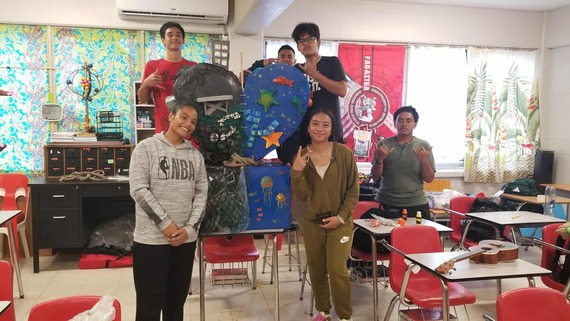 Students pose with their completed upcycled sculpture. (Photo Credit: Lauie Laban-Ilalio)
Submitted by: Vera S. T. Peck, Fagaitua High School
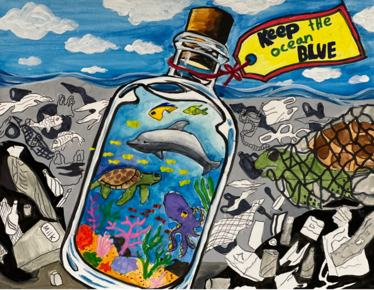
Ms. Lauie Laban-Ilalio and Vera Peck secured a grant through the Arts In Education program that supported their students in turning trash to treasure. The sculpture was created by Averson Masui, Charianna Savaii, Eunice Calara, Pule Fiaui, Robert Barber, and Tavita Augafa of Fagaitua High School. These sophomore students used trash and marine debris collected from Tutuila’s east coast. Students demonstrated teamwork, creativity, problem solving, and environmental stewardship by transforming marine debris into art.
The heart-shaped sculpture symbolizes the ocean as the planet’s lifeline and reflects human impact. The left half, dark and damaged—made from aluminum cans, plastic bottles, and debris—represents pollution’s harmful impact on marine life and Earth’s systems. The right half, bright and vibrant—created from repurposed plastics, polystyrene egg cartons, and cardboard—symbolizes hope and environmental recovery. Together, the two halves deliver a powerful message: the future of our planet depends on the choices we make today, inspiring collective action for ocean conservation.
Is Marine Debris a Viable Alternative to Polymer Binders Used in Hawai‘i Roads?
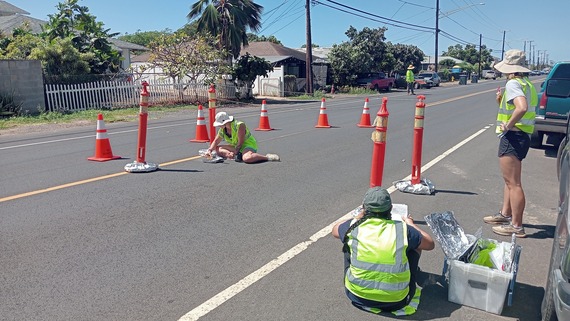 CMDR researchers collect road dust from an experimental section of asphalt on Fort Weaver Road in ‘Ewa Beach, Oʻahu, to test for microplastics and plastic additives release. (Photo Credit: CMDR)
Submitted by: Jeremy Axworthy, Center for Marine Debris Research
In collaboration with the Hawaiʻi Department of Transportation and the University of Hawaiʻi, Hawaiʻi Pacific University’s Center for Marine Debris Research (CMDR) is investigating potential environmental benefits and impacts of replacing standard polymer modified asphalt with asphalt made with derelict fishing gear (DFG) collected in Hawaiʻi. In early 2025, CMDR collected road dust samples from experimental sections of road in ‘Ewa Beach, Oʻahu, made with DFG, post-consumer recycled plastic, or standard polymer modified asphalt. Using novel methods, we are quantifying microplastics and plastic additives released from the different pavements. If roads made with DFG do not leach more pollutants than the other roads, and the state implements their use, then less DFG would be incinerated or landfilled and less virgin polymers would be imported for use in asphalt. Results are expected in mid-2026, stay tuned!
A Children’s Book About Marine Debris Drifting Across The Pacific Ocean
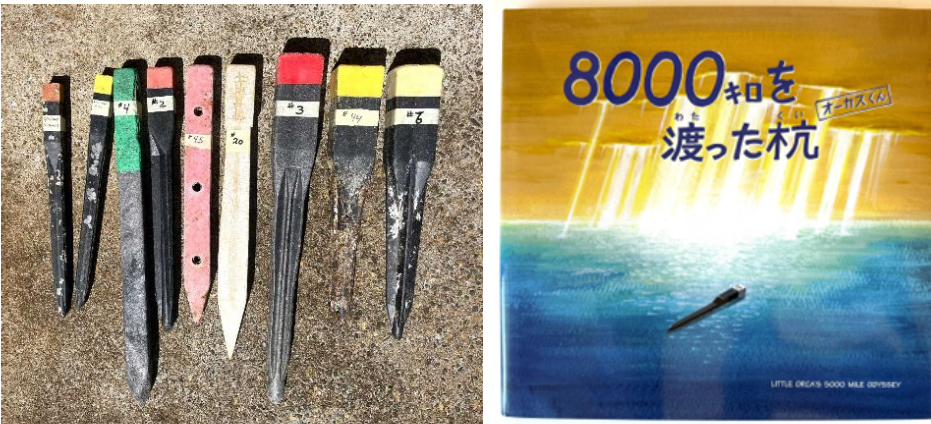 Survey stakes are among the debris that makes it way from Japan to Hawai'i. (Photo Credit: Dr. Carl Berg)
Submitted by: Dr. Carl J. Berg, Senior Scientist, Surfrider Foundation-Kaua‘i Chapter
Surfrider Kaua‘i has been collecting hundreds of plastic property survey stakes that washed from Japan following the 2011 Tōhoku tsunami. We worked closely with Kengo Okada, president of RIPRO (the company that manufactures these stakes), to identify the exact site they came from in Japan and to verify if they were a result of the tsunami, along with Japanese eel traps and fish boxes.
Mr. Okada wrote two wonderful children’s books (in English and Japanese) illustrating how marine debris from Japan floats across the Pacific and ends up on west coast shores. Surfrider Kaua‘i uses these books in community education programs to teach how debris floats all around the Pacific Ocean. Mr. Okada donated copies to pass on to marine debris education programs. Request free copies from Dr. Carl J. Berg: cberg@pixi.com.
MINA and NPS Implement Recycling Events for Saipan Community Volunteers
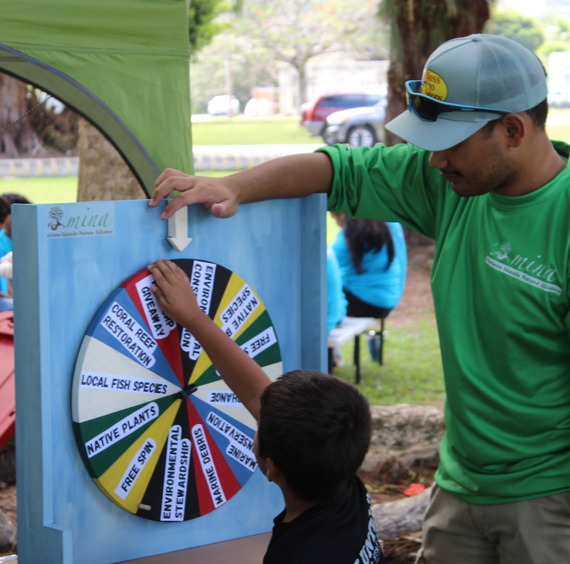 Youth volunteer engaged in Community Recycles Plastics learning activity with a MINA Tasi Watch community ranger. (Photo Credit: Mariana Islands Nature Alliance)
The Mariana Islands Nature Alliance (MINA), in partnership with the National Park Service (NPS), continues to tackle the waste stream through the Community Recycles Plastics program. Recycling bins were placed within American Memorial Park and Micro Beach. Since the initiative started in March, monthly recycling events were hosted at Micro Beach. Community volunteers learn about the impact of recycling, engage in hands-on sorting of recyclable plastics, and participate in a beach cleanup. Sorted plastics are processed through 3-in-1 upcycled machines into reusable items such as pendants, rulers, and coasters. MINA aims to promote a circular economy, reduce marine debris, and build local capacity in conservation. For more information about MINA’s conservation efforts, visit: minapacific.org.
This program was made possible in part by a grant from the National Park Foundation and The Coca-Cola Company.
West Hawaiʻi Fishing Line and Cigarette Butt Recycling Program Reaches 40 Kilometers of Line!
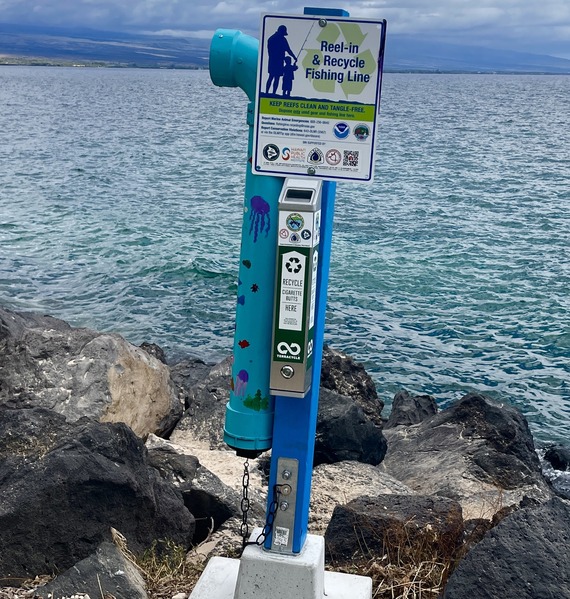 West Hawaiʻi Fishing Line and Cigarette Butt Recycling Program bin location at Pua Ka ‘Ilima ‘O Kawaihae Cultural Surf Park. (Photo Credit: Laura Jim)
Submitted by: Laura Jim, Hawai‘i Preparatory Academy Marine Studies Program
The West Hawaiʻi Fishing Line and Cigarette Butt Program—run by Hawaiʻi Preparatory Academy’s Marine Studies Program, Keep Puakō Beautiful and Ala Kahakai National Historic Trail—launched in April 2022 with just two recycling bins. Today, the program maintains 13 fishing line recycling bins across West Hawaiʻi, 11 of which are in South Kohala.
As of December 2025, the program collected and processed 40 km (24.8 miles) of discarded fishing line (monofilament and braided), along with 793 hooks, 362 weights, 241 lures, and 368 swivels.
This effort is made possible by supportive land stewards and dedicated volunteers, including Wendy Noritake (Kapaʻa and Māhukona County Beach Parks) and Rosanne Shanks (Keauhou). For more information on the program please visit the West Hawaiʻi Fishing Line and Cigarette Butt Program website.
|