The son of “the Mooch” just paid a record $16.5 million to buy the ultrarare Pikachu Illustrator “Pokémon” card from wrestler, boxer, and “Law & Order: Special Victims Unit” guest star Logan Paul. Paul acquired the card for nearly $5.3 million five years ago, a world record at the time. The sale has riled up the crypto community, as Paul had announced in 2022 that the card would be tokenized and listed on his digital collectibles platform, Liquid Marketplace.
Stocks bounced back from morning losses on Tuesday and all three major indexes basically finished where they started. The real estate sector was the best performer while consumer staples was the worst performer. |
|
|
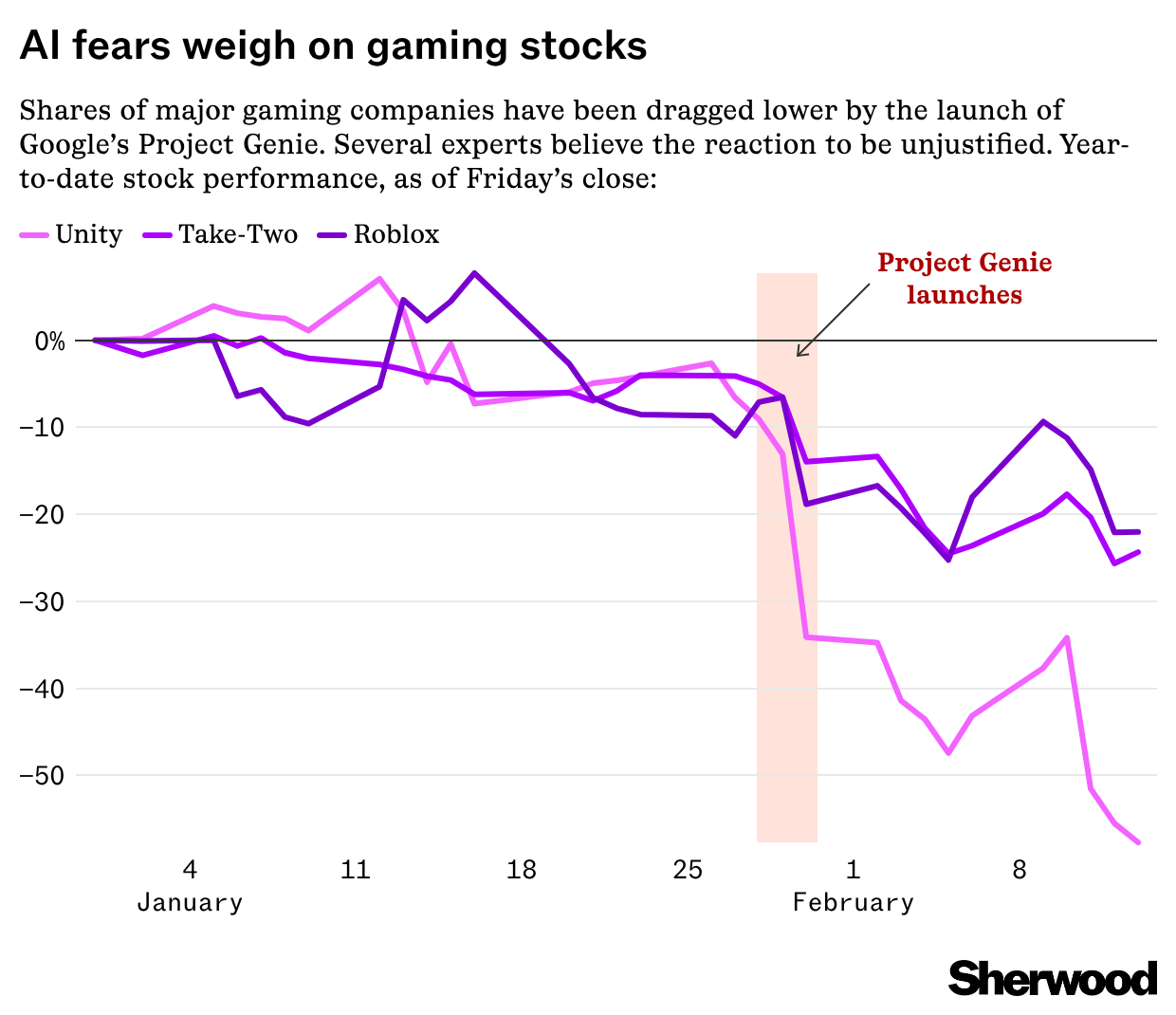
Video game stocks have been getting repeatedly KO’d recently, following the launch of Google’s new generative-AI tool, Project Genie, which lets users create interactive, “playable” worlds with a text or image prompt for just $125 a month.
It’s the latest aggro move from a villain Bloomberg’s Matt Levine calls the “AI Whateverpocalypse,” wherein newly announced AI applications trigger steep losses in whatever market they happen to focus on (be it enterprise software, financial data, or trucking).
|
-
Gaming giants have shed billions of dollars since Project Genie launched on January 29, with companies including Unity Software, Take-Two, and Roblox experiencing sharp sell-offs, as we charted here.
-
This blow follows high memory costs already weighing on hardware makers (also due to AI, in a different way), which is driving console makers like Sony to delay product launches — possibly by years for its PlayStation 6.
- Investors see Google’s world model as a potential silver bullet for the gaming industry, dramatically lessening costs and increasing the supply of interactive games.
-
But experts note that Project Genie can only generate one-minute-long experiences at 720p resolution and 24 frames per second that lack depth and rip off popular intellectual property.
-
Meanwhile, gaming companies are powering up their own AI efforts: Roblox launched the open beta of its “4D” AI creation tool, and Unity has said AI-driven authoring is a major focus for the company in 2026.
|
|
|
Lost in the chatter is how much the broader gaming community really, really hates AI-generated anything in games. In December, game publisher Running With Scissors scrapped a planned game over negative reactions to AI-generated graphics in its trailer. In the same month, the Indie Game Awards revoked its Game of the Year award for “Clair Obscur: Expedition 33” after it discovered the developer, Sandfall Interactive, had launched the game with AI-generated textures.
Finally, many of the biggest games succeed not only because of the quality of the games themselves, but because they generate deeply rooted player communities — something AI can’t conjure. |
|
|
How SRFM Plans to Become Aviation's Platform Play |
As the air mobility industry evolves, a platform approach can unify the fragmented ecosystem. Surf Air Mobility (NYSE: SRFM) operates real-world flights, navigates regulatory complexity, and is building SurfOS — its AI-enabled software operating system powered by Palantir.
SRFM is extending its platform capabilities to better serve core participants across the aviation industry: aircraft manufacturers deploying next-generation electric aircraft, brokers optimizing pricing and sourcing, and operators improving unit economics and service quality.
In a market estimated to grow 25% CAGR toward $100B globally by 2035,1 SRFM is positioning its platform at the center of the electric and regional aviation transition. Visit investors.surfair.com. |
|
|
The companies most likely to let you work from home are the newest ones… or at least those helmed by the youngest leaders. |
- According to a National Bureau of Economic Research working paper published last week, employees at companies founded after 2015 are roughly twice as likely to work from home relative to firms that got their start before 1990.
-
Leadership age tells a similar story, as younger firms and CEOs tend to be more comfortable adopting new technologies and flexible ways of working. Firms run by CEOs under 30 have an average of 1.4 work-from-home days per week, compared to 1.1 days for those with CEOs who are 60 or older.
-
Companies born in 2020 — the ones that had no choice but to build themselves around remote work from day 1 — had the highest remote working days on average, at 1.74 per week.
-
Still, post-lockdown cohorts (2021-25) allowed employees to work from home an average of 1.6 days, well above the average of ~0.9 days per week for those founded before 1980.
|
Still, that gap fades once firm age is factored in, suggesting it’s the birth year of the company — not its leader — that matters more. Who could have possibly guessed that the main thing forcing the end of remote work was buyer’s remorse on those 10-year leases signed in 2019? |
|
|
Even as big incumbents keep doubling down on returning to the office, the study finds that WFH rates could tick higher over time as older firms cycle out: indeed, roughly half of US startups don’t survive past five years, per the latest Bureau of Labor Statistics data, and the companies that replace them tend to be more remote-friendly from the start.
|
|
|
|