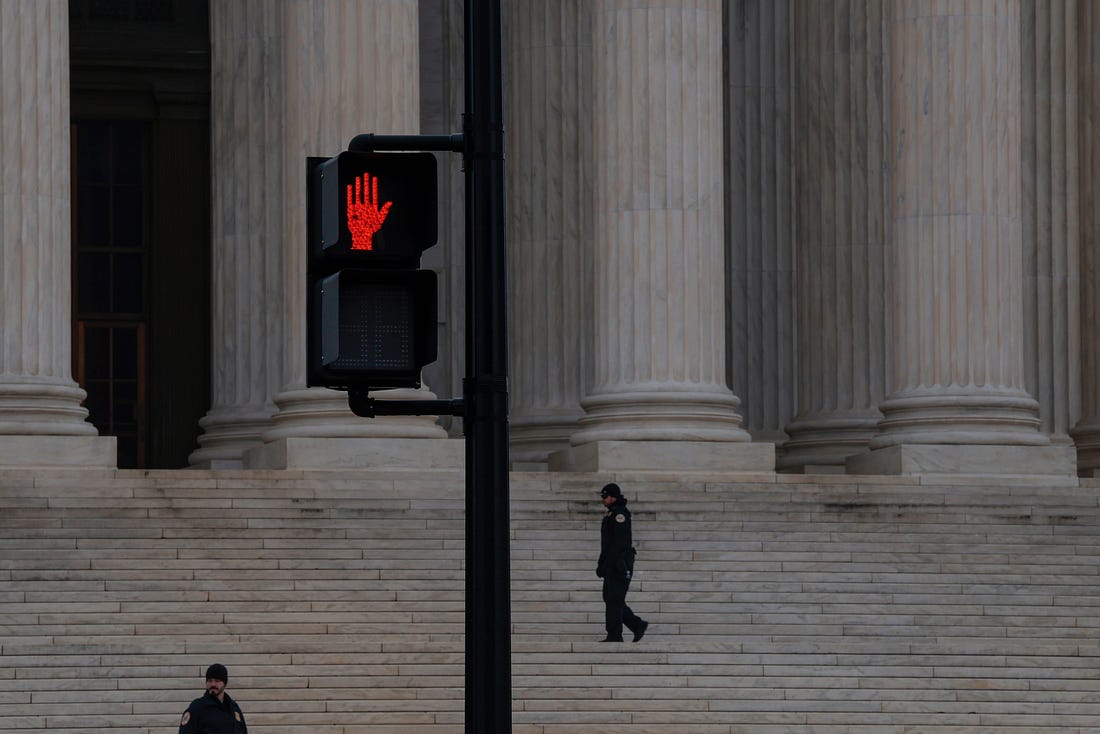
If you’re trying to make sense of the Supreme Court’s decision last Friday in Learning Resources v. Trump, well, good luck. It’s a fractured mess, and what you’re reading is much more a fight between nine very powerful people about the scope of their power than a legal opinion that can give meaningful guidance going forward.
Out of the 170 pages that are here, very few represent the actual holding of the Court, or what the “majority decision” is. That’s because while there were six justices who agreed that President Donald Trump does not have the authority under the International Emergency Economic Powers Act (IEEPA) to simply yell “emergency!” and impose any tariffs he wants, any time he wants, in any amount he wants, those six couldn’t agree on how to get there.
The three conservative justices in the majority, Chief Justice John Roberts and Justices Neil Gorsuch and Amy Coney Barrett, wanted to get there by saying that there are some things so important that only the Supreme Court can determine what Congress meant, big “major questions” that require ethereal divination from the folks in robes.
The three liberal justices, Elena Kagan, Sonia Sotomayor, and Ketanji Brown Jackson, wanted to get there by saying that this isn’t some big special question, but rather a run-of-the-mill — albeit still very high stakes — job for the Court: a close reading of the actual statute. And of course, the three dissenters — Justices Brett Kavanaugh, Samuel Alito, and Clarence Thomas — see their job as making sure that nothing gets in the way of the executive branch. (That worldview applies only as long as a Republican is president, of course.)
A lot of this can feel somewhat beside the point, angels dancing on the heads of pins sort of stuff, lawyers arguing for nearly 200 pages over what a handful of words and laws mean in a way completely divorced from the real world. But at root, these three views are locked in an existential struggle about checks and balances and the separation of powers. And unfortunately for all of us, even though this particular case turned out correctly, it highlights that the six conservative justices have extremely radical anti-constitutional ideas about how American democracy works.
The conservative justices in the majority wanted this case to be decided under the major questions doctrine, and that’s no real surprise. It’s a new fave of theirs, a “doctrine” they invented out of whole cloth a couple of years ago.
Essentially, it says that there are some issues that are just so gosh-darn big that Congress is required to include some sort of extra super-duper-special language when it delegates certain authority. If that magic language isn’t there, then the Court gets to decide that Congress didn’t really mean what it said.