Lumina Foundation is working to increase the share of adults in the U.S. labor force with college degrees or other credentials of value leading to economic prosperity.
A year ago, something historic happened when the Trump administration planned to claw back billions of dollars in federal funds from the nation's research universities. Lawyers and policy wonks at one of the nation’s most influential higher ed associations scrambled to file lawsuits to block that effort. This was a watershed moment for the American Council on Education. In its more than 100-year history, the council has only once before been a plaintiff in a lawsuit.
But even if the courts block the Trump administration, is the long-standing relationship between the federal government and higher education forever broken? Ted Mitchell, a former undersecretary of education in the Obama administration who now leads ACE as its president, offers insight in this interview.
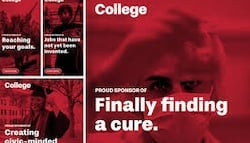
You won’t see students studying together in a library, images of grand campus buildings, or crowded athletic events in a new campaign promoting higher education. There are no logos, no mascots, and no official colors. Instead, an elderly couple walks arm in arm smiling, with the statement, “Proud sponsor of a better life for everyone," printed across the image. Another image shows a masked nurse holding an infant with the words, “Proud sponsor of goodbye nursing shortage."
The ads are part of “College: Proud Sponsor of America at Its Best,” a national campaign that is explicitly not promoting a single institution. Its goal is to remind Americans of higher education's impact on bolstering national security, developing the economy, and building the workforce.
The Massachusetts Institute of Technology has cut ties with a national nonprofit focused on diversifying university faculties following pressure from the Trump administration.
The Cambridge school is one of 31 institutions that have agreed to end their association with the PhD Project, according to a recent announcement made by the U.S. Department of Education. Founded in 1994, the nonprofit supports underrepresented students pursuing a doctoral degree in business.
As Black History Month marks its 100th anniversary, Lumina Foundation's Jamie Merisotis reminds us that talent is everywhere, even when opportunity is not.
In this perspective piece, Merisotis describes why all Americans—especially Black Americans, who too often still face systemic barriers—deserve a revamped higher education system that is affordable, accessible, transparent, and valuable. They deserve pathways that equip them with the skills and credentials that lead to meaningful work, economic mobility, and a stronger society.
An estimated 5.5 million young Americans between the ages of 16 and 24 are neither enrolled in school nor participating in the workforce—a crisis of disconnection that a new report says requires far more than the piecemeal policy responses that have characterized the nation's approach for decades.
The report, published by the American Enterprise Institute, offers a sweeping analysis of what researchers and practitioners call "opportunity youth"—a population that cuts across race, geography, and circumstance but shares a common condition: disconnection from the two institutions most likely to launch a young person into a stable adult life.
An abandoned prison in Goldsboro, North Carolina, is getting a new lease on life thanks to a former inmate.
After spending 11 years behind bars, Kerwin Pittman started a nonprofit organization called Recidivism Reduction Educational Program Services. His newest endeavor, The Recidivism Campus, is to turn the former Wayne County Correctional Center into transitional housing for those recently released from prison. The effort will include education and training, life skills courses, community spaces, and more.


.jpg?width=500&upscale=true&name=istockphoto-1011983658-612x612%20(1).jpg)
.jpg?width=500&upscale=true&name=istockphoto-1405682983-612x612%20(3).jpg)