Hi! The house always… loses? FanDuel owner Flutter just released a disappointing set of Q4 earnings, citing gamblers’ bets flopping more often than usual — which is quite a different story to how “customer-friendly” results hit its bottom line only three quarters before. Today we’re exploring:
|
- Taurine de force: Red Bull is still the leader of the growing energy drink market.
- Fit check: Wait, is Urban Outfitters cool again?
- Learning machines: More teens are using AI for studying, but not all of them feel great about it.
|
Energy drink sales are soaring — but Red Bull’s still fly the highest |
As the cost of America’s go-to caffeine fix surges to new highs, consumers appear to be replacing their long-brewed coffee breaks with the instant boost of a fizzy, canned alternative.
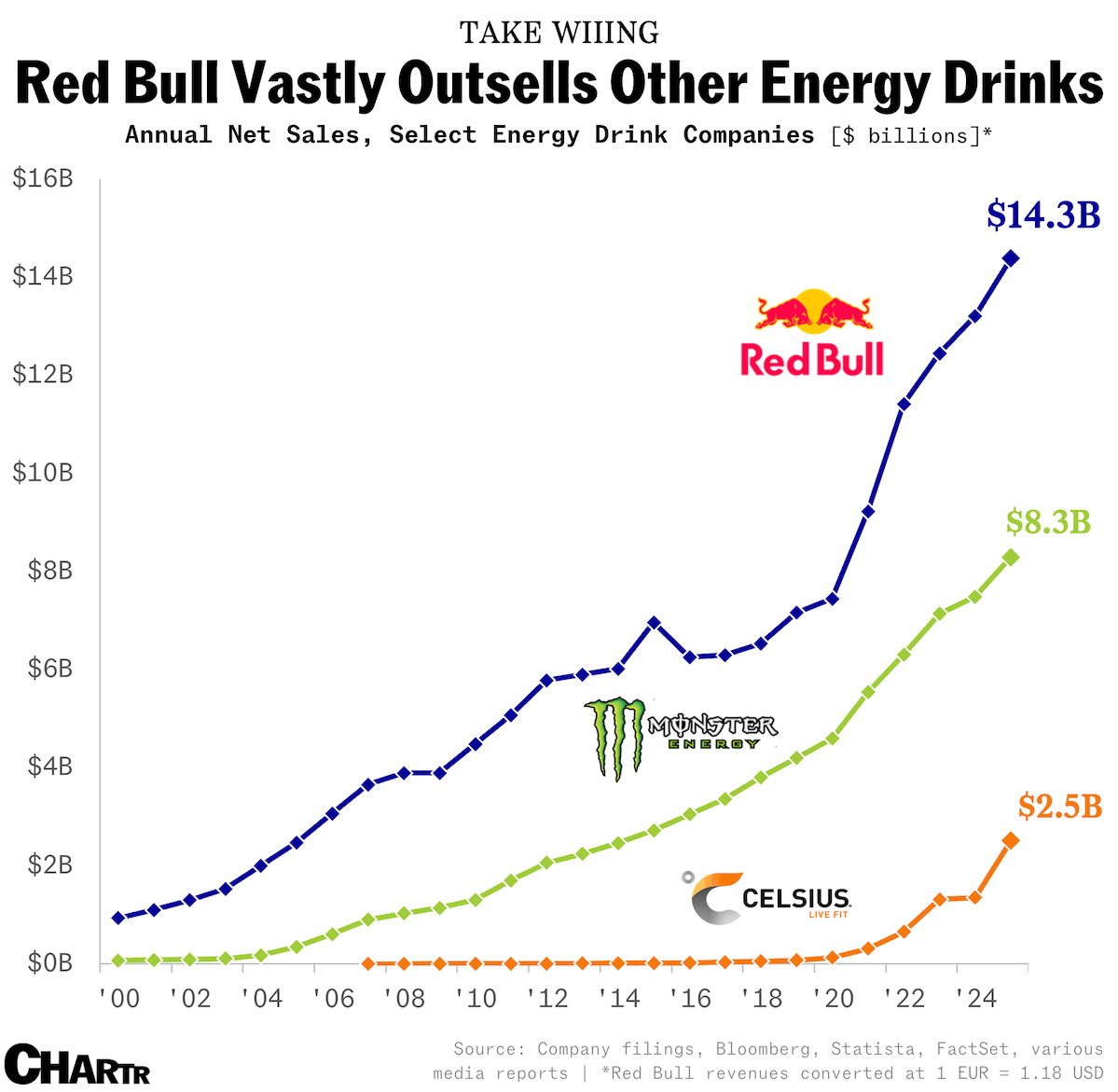
On Thursday evening, energy drink giant Monster Beverage released its fourth-quarter and full-year results, and reported net sales of $8.3 billion for 2025 — an all-time high, up ~11% from the year before. Monster’s gross margin also edged up as price changes and supply chain efficiencies offset rising aluminum costs, per Reuters.
Earlier that day, fast-growing energy drink brand Celsius also reported some boosted figures, with sales rocketing 86% to $2.5 billion in FY2025. Still, even as rivals shift cans at record rates, these numbers pale in comparison to the astronomical revenues posted by global market leader Red Bull. |
Back in January, the Austrian beverage giant reported that net sales grew 8.6% to a record €12.2 billion (~$14.3 billion) in 2025 — nearly double the revenues that Monster, the next biggest energy drink brand, posted. |
While Red Bull’s primary growth driver remains the beverage segment, having sold almost 14 billion cans of its core product last year, the company is looking to keep expanding its portfolio of sports sponsorships, with its logo already stamped across sports teams from ice hockey and soccer to Formula 1.
However, recognizable branding in spectator-dense spaces may not stop health-conscious consumers from switching to sugar-free, lower-calorie options like Celsius. According to data cited by Bloomberg, the buzziest energy drink on the block took market share from both Monster and Red Bull last year as it won over some untapped demographics.
|
Urban Outfitters might have worked out how to sell clothes to young people again |
In recent years, Urban Outfitters hasn’t found much joy in its efforts to get younger generations buying its namesake brand’s clothes, accessories, and homeware, having, by its CFO’s own admission in 2024, missed “rapid and seismic shifts” between Gen Z and millennials during the pandemic. |
How do you do, fellow kids? |
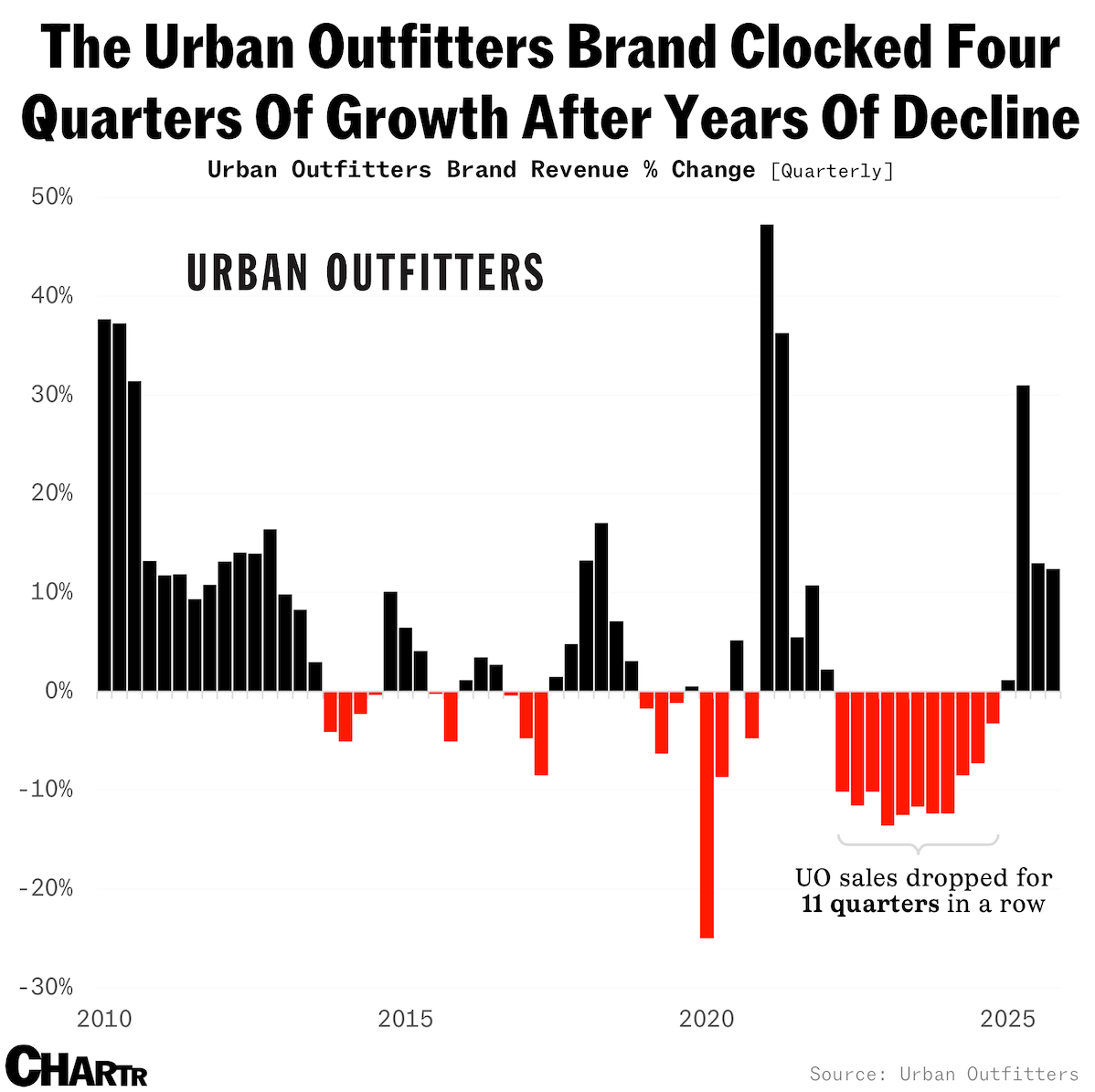
A little under two years on from that statement, however, something seems to have shifted. The brand has now notched four consecutive quarters of sales growth for the first time since 2021, helping the overall Urban Outfitters group — which also houses Anthropologie, Free People, and the fashion rental subscription service Nuuly — achieve record quarterly ($1.8 billion) and full-year ($6.17 billion) sales in its report earlier this week.
Clearly, the UO brand’s youth-focused clothes are fitting into 2026 wardrobes a little better than they have for a while. |
Until the first quarter of 2025, the Urban Outfitters brand saw sales drop for a staggering 11 quarters in a row, even as some of the fashion group’s other major brands grew bigger, with Anthropologie — which accounted for 42% of the company’s total sales last year — praised for straddling the Gen Z-millennial vibe divide more comfortably than the group’s namesake brand.
So, what changed for UO? |
Frankly, it seems to be trying a lot harder to woo America’s youngest shoppers: the company’s been redesigning stores with a “highly localized approach,” hosting events and immersive experiences with zoomer creators and celebrities, and launching national campaigns, all with “the brand’s community of highly engaged Gen Z shoppers” in mind.
While there are, of course, other factors in the Urban Outfitters revival, like its decision to turn away from its “traditionally alternative sensibility,” maybe, just maybe, the millennial mainstay might have finally gotten a little bit of its cool back. |
|
|
More US teens are using AI for studying. Not all of them feel great about it. |
With investors’ opinions about the future of AI diverging, new research suggests that views about the tech’s impending outcomes are also mixed among some of its youngest users.
A new survey from Pew Research Center, published Tuesday, asked US teens aged 13 to 17 about their AI use, and found that more than half (54%) reported using chatbots to help with schoolwork in 2025 — second only to searching for information (57%) as the top reason, and ahead of using it for fun or entertainment (47%).
Overall, the share of American teens who report using AI for studying has risen significantly in just a few years. Back in 2023, Pew found that 13% of students said they ever used ChatGPT for schoolwork; in 2024, it was 26%. Now, only one year later, that share has more than doubled. Still, even as more teens are turning to chatbots for help researching, editing, or problem solving, that doesn’t mean they all feel entirely happy about the overall impact that AI might have in the coming decades. |
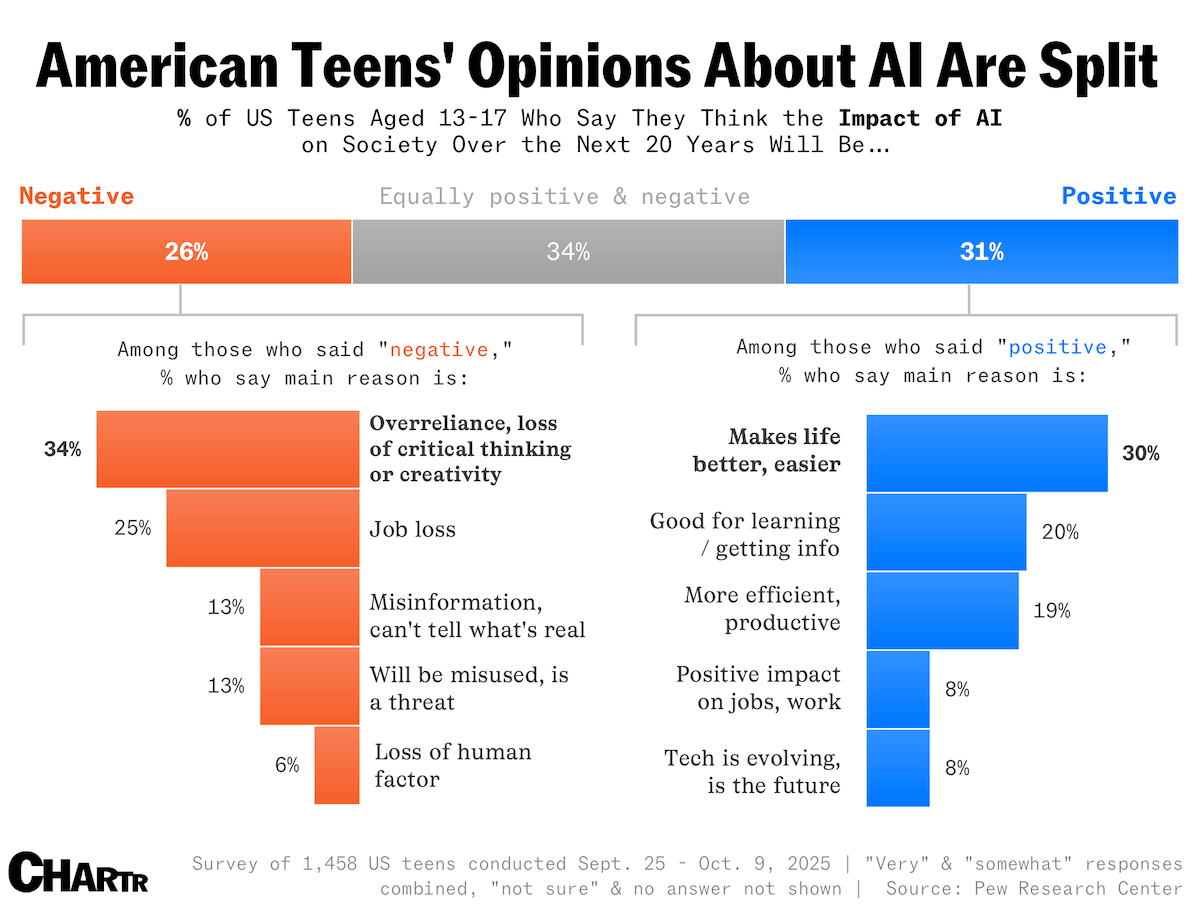
While almost a third of respondents said they think that AI will have a positive impact on society over the next 20 years — with 30% of that cohort citing that it “makes life better, easier” as their top reason — there was still a 26% share that said it would have a negative impact.
Why? Well, besides a history of AI-linked mental health crises, and ignoring the countless hours spent speaking to imaginary characters, the top reason listed in the survey was “overreliance, loss of critical thinking or creativity.” With student test scores slumping in real time, and 1 in 10 teens reporting using chatbots for “all or most” of their schoolwork, could those concerns already be coming into view?
|
|
|
-
Netflix has withdrawn its offer for Warner Bros., seeing Paramount Skydance’s improved $31 per share bid finally finally emerge victorious. And, scene.
-
Chopping Block: Jack Dorsey’s payments company yesterday announced plans to cut 40% of its 10,000-person workforce, adding almost a fifth of its value on Friday morning as its stock surged.
-
The memory shortage might cause global smartphone shipments to dip by 12.9% in 2026 — the biggest single-year drop in more than a decade — per analyst firm IDC.
-
Americans are leaving America in droves: earlier this week, the WSJ reported that the US saw net negative migration of ~150,000 people in 2025, with in-migrations down ~55% from a 2023 peak.
-
Going bananas: Google has rolled out the second version of its viral Nano Banana image generation model, which helped catapult Gemini to the top of the app store last year.
|
|
| -
Go to your happy place… The Pudding mapped out more than 100,000 moments of human happiness.
-
Researchers developed this tool to reflect ChatGPT’s regional biases across US states.
|
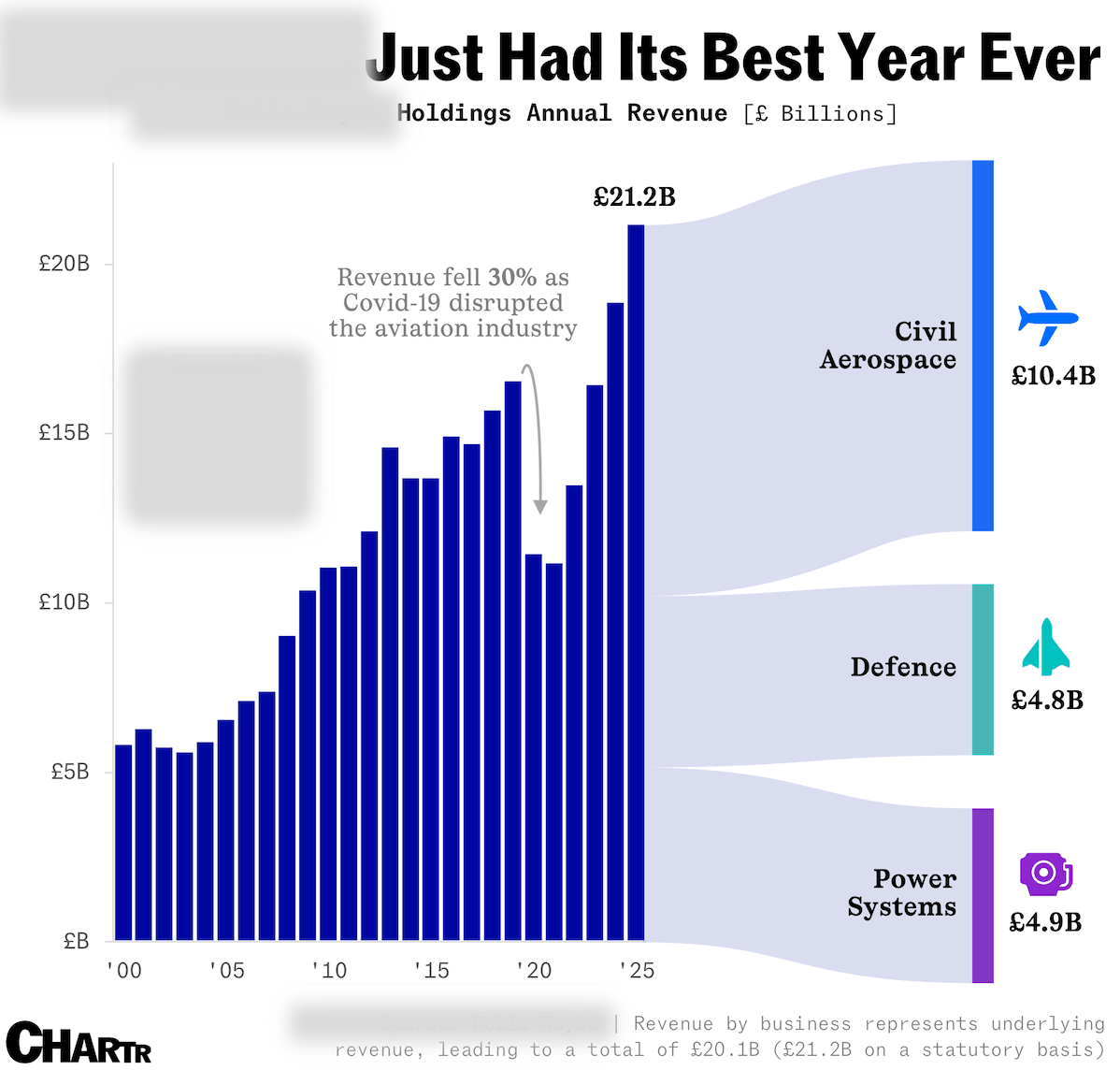
Off the charts: Which British engineering giant just posted its best year on record, only ~5 years after Covid threatened to upend the business? [Answer below]. |
Not a subscriber? Sign up for free below. |
Sherwood Media, LLC produces fresh and unique perspectives on topical financial news and is a fully owned subsidiary of Robinhood Markets, Inc., and any views expressed here do not necessarily reflect the views of any other Robinhood affiliate... See more |
|
|
SHERWOOD MEDIA, LLC, 85 Willow Road, Menlo Park, CA 94025 |
|
|
|