|
🎙️ This week on How I AI: 5 OpenClaw agents run my home, finances, and code & How Coinbase scaled AI to 1,000+ engineers
Your weekly listens from How I AI, part of the Lenny’s Podcast Network
|

| |||||||||||||||


 |
Every Monday, host Claire Vo shares a 30- to 45-minute episode with a new guest demoing a practical, impactful way they’ve learned to use AI in their work or life. No pontificating—just specific and actionable advice.
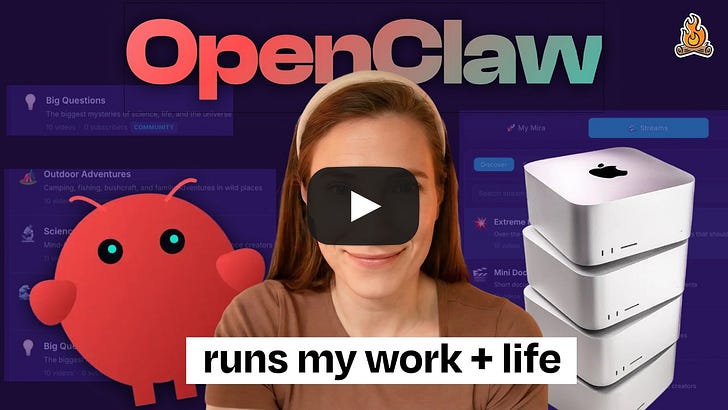
5 OpenClaw agents run my home, finances, and code | Jesse Genet
 |
Brought to you by: Optimizely—Your AI agent orchestration platform for marketing and digital teams
Jesse Genet is a homeschooling parent and entrepreneur who operates five specialized OpenClaw agents, each on its own Mac Mini, to manage homeschool curriculum, family finances, scheduling, development projects, and household operations. She treats each agent like a new hire: defined role, scoped access, decision log, and progressive trust. In this episode she shares how she photographs curriculum books to auto-generate lesson plans, builds custom apps with zero prior terminal experience, partitions sensitive data across machines, and bridges the digital and physical world by inventorying every toy and supply in her house.
Detailed workflow walkthroughs from this episode:
• How I AI: Jesse Genet’s 5 OpenClaw Agents for Homeschooling, App Building, and Physical Inventories: https://www.chatprd.ai/how-i-ai/jesse-genets-5-openclaw-agents-for-homeschooling-app-building-and-physical-inventories
• Automate Homeschool Lesson Planning and Material Creation with an AI Agent: https://www.chatprd.ai/how-i-ai/workflows/automate-homeschool-lesson-planning-and-material-creation-with-an-ai-agent
• Build a Custom ‘Slop-Free’ Kids’ TV App Without Coding Experience: https://www.chatprd.ai/how-i-ai/workflows/build-a-custom-slop-free-kids-tv-app-without-coding-experience
• Create an AI-Powered Inventory of Your Physical Items: https://www.chatprd.ai/how-i-ai/workflows/create-an-ai-powered-inventory-of-your-physical-items
Biggest takeaways:
Treat your AI agent like a new hire, not an extension of yourself. Jesse’s entire agent management philosophy comes from her experience hiring employees. She gives agents their own identities, separate data access, and communication channels—never full access to her email or accounts. Progressive trust is the model: start limited, expand as the agent proves reliable.
Physical partitioning is a real security strategy. Running each agent on its own Mac Mini sounds extreme, but it solves a real problem: preventing one agent from accidentally leaking sensitive data through another agent’s communication channel. The finance agent can read bank statements but can’t text anyone. The scheduling agent can text, but has no financial data. This is a practical framework anyone managing multiple agents should think through.
Photos are the most underrated input for AI agents. Jesse’s core workflow is shockingly simple: take a photo, send it to the agent, get structured output. She photographs lesson activities, book pages, physical supplies, and curriculum materials. The agent handles all the heavy lifting of logging, categorizing, and connecting that information. No typing, no structured input—just photos.
You don’t need to be technical to build real software with a coding agent. Jesse had never opened a terminal before six months ago. With Cole, her coding agent, she built a custom kids’ TV app, iterated over four days, and deployed it to a Google TV Streamer. Her approach: describe what you want, push back when the agent says something isn’t possible, and keep going.
Inventory your physical world so AI can reach into it. One of Jesse’s most powerful moves was photographing all her educational supplies and having Sylvie build an inventory. Now when she asks for a lesson plan, the agent can say, “Also, pull out the tracing board from the cupboard.” This bridges the gap between the digital agent and the physical world in a way that’s immediately useful.
Use “decision files” to prevent agents from relitigating settled questions. Jesse maintains a decisions file in Obsidian that each agent knows about. When she makes a final call, she flags it, and the agent knows not to revisit it. This is a simple, powerful pattern for anyone dealing with agents that keep second-guessing or re-asking about things you’ve already resolved.
▶️ Listen now on YouTube | Spotify | Apple Podcasts
How Coinbase scaled AI to 1,000+ engineers | Chintan Turakhia

 |