Hello! The seismic geopolitical shift that occurred when joint US-Israeli forces launched a series of attacks against Iran on Saturday continues to dominate headlines, as the conflict unfolds further and its impacts reverberate around the world. Today we’re exploring: |
-
Iran: The early markets fallout from conflict in one of the world’s top oil producers.
- Vertically challenge: Instagram’s TikTok rival Reels is paying off for Meta.
- On the same page? America’s favorite book genres, by gender.
|
Oil surges after US military strikes against Iran |
It’s a risk-off tone in markets to start the week after the US launched a series of attacks against Iran, beginning Saturday.
The campaign, known as “Operation Epic Fury,” is intended to destroy Iran’s military capabilities and spur leadership change, according to US President Donald Trump, who cited “imminent threats” from its regime as the rationale behind the action. Iranian Supreme Leader Ayatollah Ali Khamenei was killed in the strikes, the president wrote in a Truth Social post on Saturday.
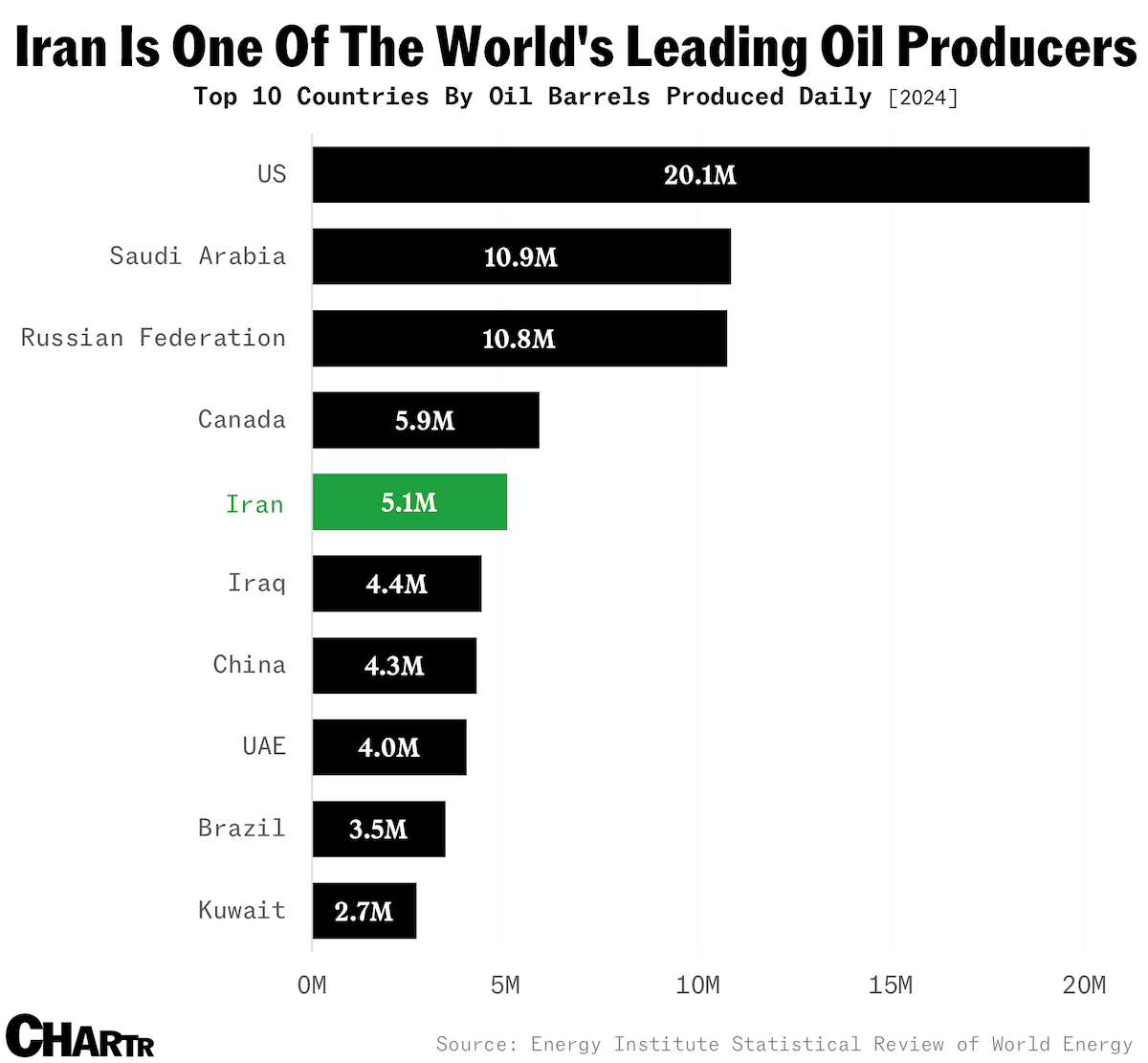
At least for markets today, it’s most relevant that the country is the fifth-largest oil producing nation in the world, according to 2024 Energy Institute data, producing just over 5 million barrels per day on average. Front-month West Texas Intermediate crude oil futures spiked 7% in premarket trading this morning, with analysts like Macro Hive’s Viresh Kanabar expecting prices to “rise further for longer rather than falling after the fact.”
|
Oil will likely remain the most sensitive asset throughout the conflict, as Iran also borders the Strait of Hormuz — a key chokepoint for global energy flows, with around 20% of petroleum liquids consumption moving through it in any given year. Early reporting on Monday suggests that Iran told vessels not to pass through the crucial strait, with international shipping coming to a near standstill at its entrance.
Defense and oil stocks were rising this morning as the conflict and its impacts on various industries unfold further, while fuel-reliant travel assets across the cruise and airline industries spiraled. |
First Snapchat, now TikTok: Instagram has mastered the art of borrowing features |
Facebook wasn’t really even close to being the first name in social media, with MySpace, Friendster, and a long list of now-defunct companies creating platforms before Mark Zuckerberg launched his network. However, it was Facebook that won out, building on existing ideas by focusing on college campuses like the one where its 19-year-old creator found himself in 2004. The Meta CEO hasn’t been shy to borrow, or simply buy, good ideas ever since.
When Instagram first blew up, Zuck and co. saw a potential threat to Facebook, eventually acquiring the app when it had just 13 employees for $1 billion. When Snapchat’s “Stories” proved wildly popular, it wasn’t long before Instagram had the same feature... with the same name. More recently, after Elon Musk relaunched Twitter as X, Meta was quick to push out Threads, another alternative.
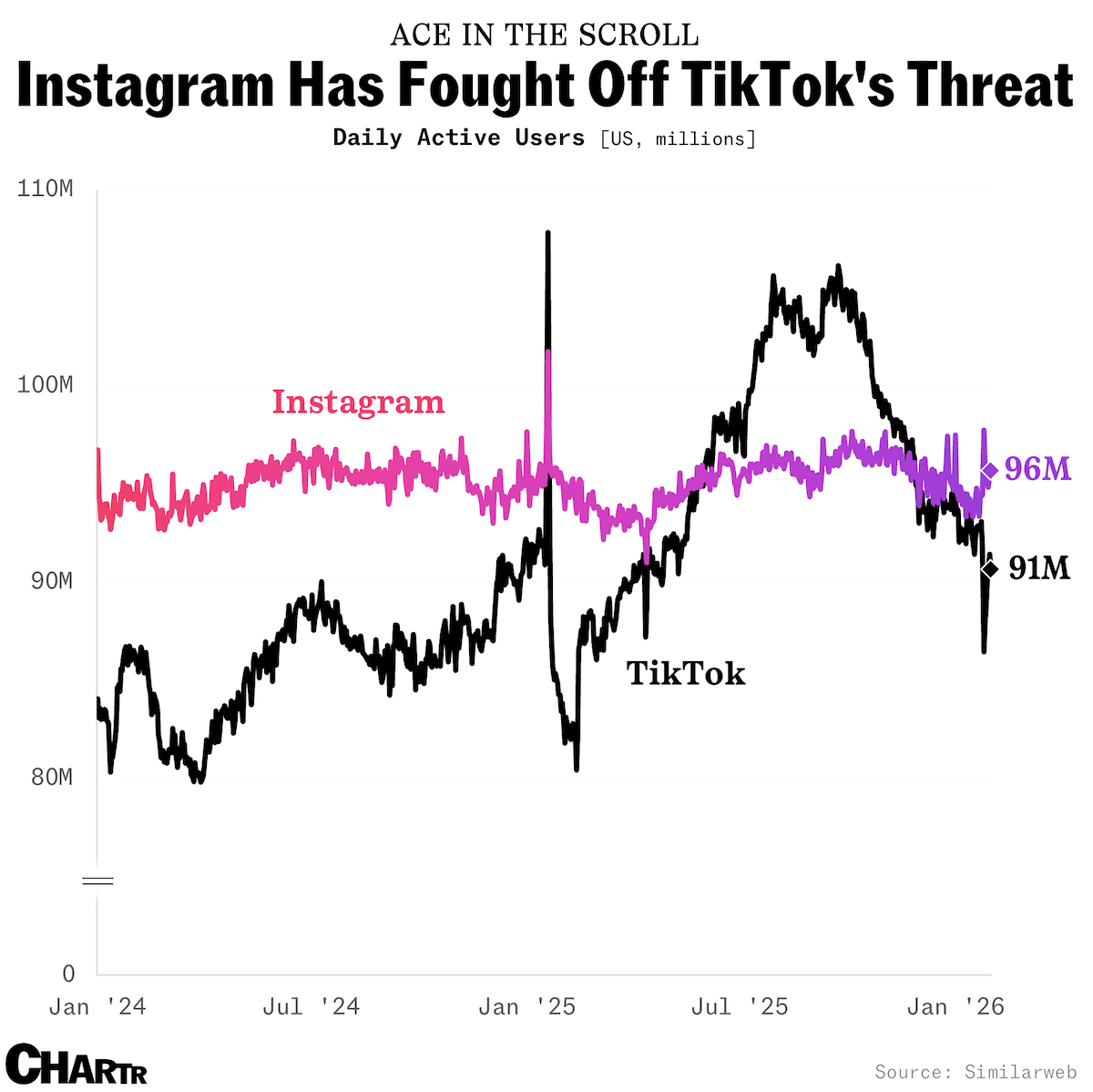
And, as one might predict, when a new challenge emerged from TikTok, Instagram replied with Reels, its own vertical feed, in August 2020. Now, more than five years later, Meta’s copycat seems to have prevailed again. |
While it's true that if you see a funny TikTok video, you can expect to see the same content recycled on Reels weeks later, for Insta users (and Meta’s mighty advertising machine), it doesn’t really matter. The app’s daily user count overtook TikTok’s in the US once more, according to data from Similarweb. |
Today, the algorithmic content feeds that dominate the time and attention of people the world over are so powerful that not a week goes by without policymakers, scientists, and millions of everyday doomscrollers wondering about the negative effects they might have. Indeed, the “infinite scroll” concept, made popular by TikTok, is considered so addictive that the European Union is looking to kill the feature entirely.
|
|
|
A new playbook for gold — and its miners |
VanEck believes the drivers of gold’s 2025 breakout aren’t just last year’s news. Gold’s strength, in their view, is underpinned by forces that look structural rather than cyclical, reinforcing confidence that the current environment is not a short-lived spike.
From the makers of the first U.S. gold equity fund, VanEck offers the Gold Miners ETF (GDX). But why gold miners? |
-
As gold prices increase, miners’ revenues can grow faster than operating costs, creating operating leverage and potential for expanding margins.
- Higher costs don’t negate the opportunity when prices are materially higher. The magnitude of gold price moves can more than offset cost increases, preserving miners’ earnings leverage.
-
Despite gold’s strength and improved capital discipline, they think miners still appear undervalued relative to the metal, a disconnect that creates the potential for a re-rating.
|
|
|
1 The VanEck® Gold Miners ETF (GDX), launched in 2006, is the first gold miners ETF in the U.S. It seeks to replicate as closely as possible, before fees and expenses, the price and yield performance of the MarketVector Global Gold Miners Index (MVGDXTR), a pure-play, global index, tracking the performance of the largest publicly-traded companies in the gold mining industry. |
Happy Read Across America Day — 40% of US adults didn’t read a single book last year |
Today is Read Across America Day, an event launched by the National Education Association almost three decades ago to encourage reading on Dr Seuss’ birthday every year. However, it’s now much more likely that you’ll find Americans sitting on their own with a phone than snuggled in a nook with a book.
|
As literacy rates among US students continue to decline, a recent YouGov survey suggests that American adults might also have turned the page on reading, with 40% of respondents saying that they didn’t read a single book in 2025. Although the poll found that the median American read two books, the average number of books read per person was 8... largely owing to the top 4% of readers, who got through 46% of all books consumed.
But of the remaining Americans that dabble in literature at all, which genres have them hooked? |
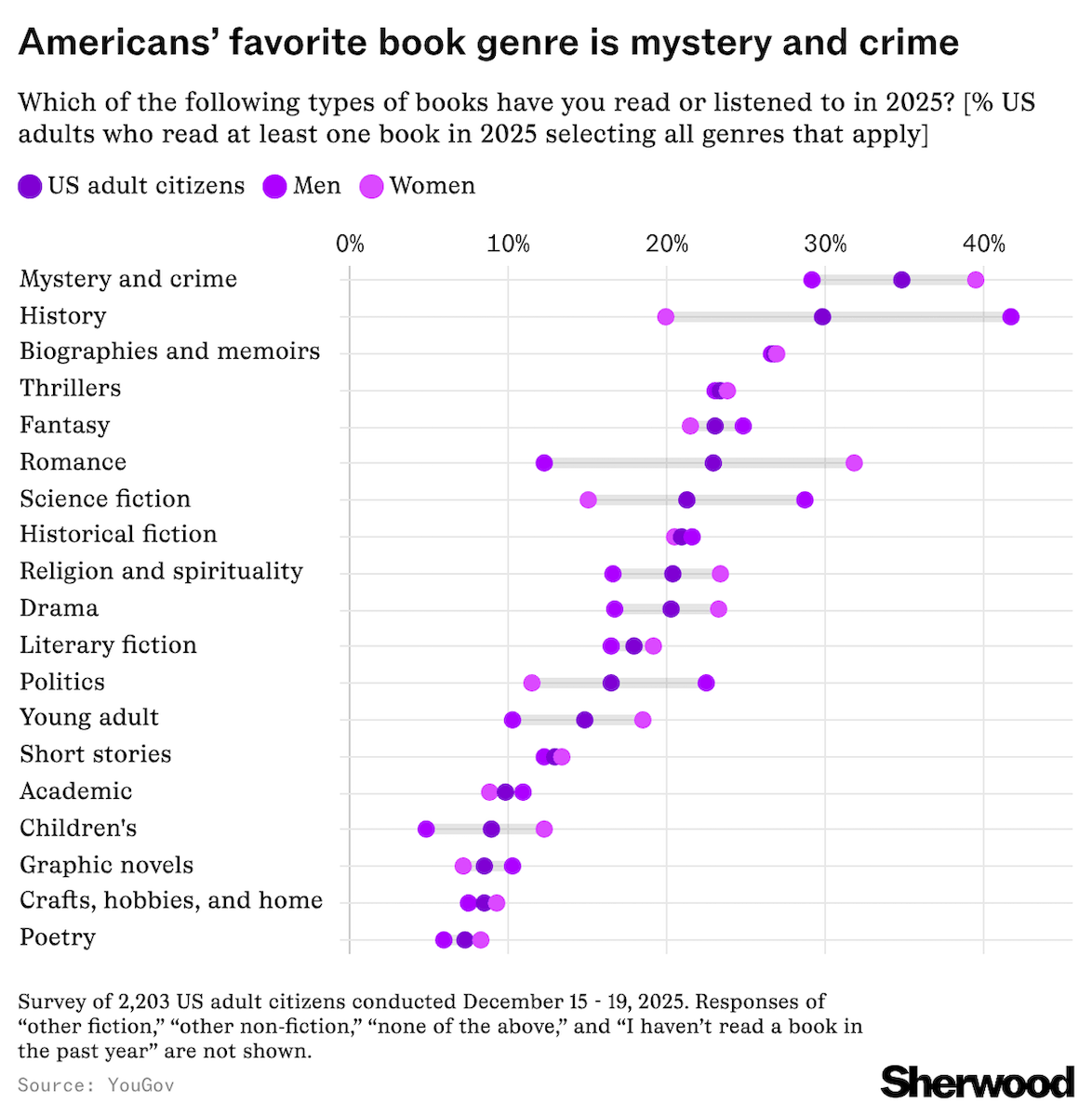
According to the YouGov figures, the most popular genre overall — with physical, digital, and audiobook formats taken into account — was mystery and crime, with 35% of American adults saying they read something from the category.
Still, no cohort enjoyed a genre as much as male readers did history books, with 42% of male readers leafing through the genre in 2025, which is at least 13% more than the share of men who said they read any other style.
Turns out, having a “roman empire” could actually be a greater force for forging bookworms than romance-heavy trends on #BookTok. According to data from the American Time Use Survey, even as reading for pleasure dropped more than 40% across the last 20 years, the time that men spent reading increased by ~25% in 2024 — though women still out-read men by some 36 minutes per day.
|
|
|
-
Star, galaxy, universe? Ahead of its IPO targeting a $1.75 trillion valuation, SpaceX is planning to offer broadband-level mobile coverage through its Starlink products.
-
Read CEO Greg Abel’s first letter to Berkshire Hathaway shareholders, picking up the pen from Warren Buffett, who’d written the legendary annual missives for 6 decades before retiring in 2025.
-
Despite being around 30 years and ~693 minutes into the cinematic universe of “Scream,” the 7th movie in the horror series just took a $64 million franchise record in its domestic debut.
-
Second screening: An in-depth look at the Motorola Razr Fold, an impressive new folding model that will reportedly set customers back about $2,350 when it lands.
-
Meanwhile, Apple just unveiled its new $599 iPhone 17e, which is set to be released on March 11 and comes with 2x the storage of last year’s value model.
|
|
|
The drivers behind gold’s 2025 breakout appear durable into 2026. As the flagship gold miners ETF, the VanEck Gold Miners ETF (GDX) offers diversified exposure to the world’s leading gold miners, providing an institutional-quality gold equities investment. |
|
|
-
Reuters mapped the areas of Iran that were struck by joint US-Israeli forces on Saturday, as well as the areas in the Middle East where Iran retaliated.
-
Axios charted the post-Covid decline of infectious disease doctors in the US.
|
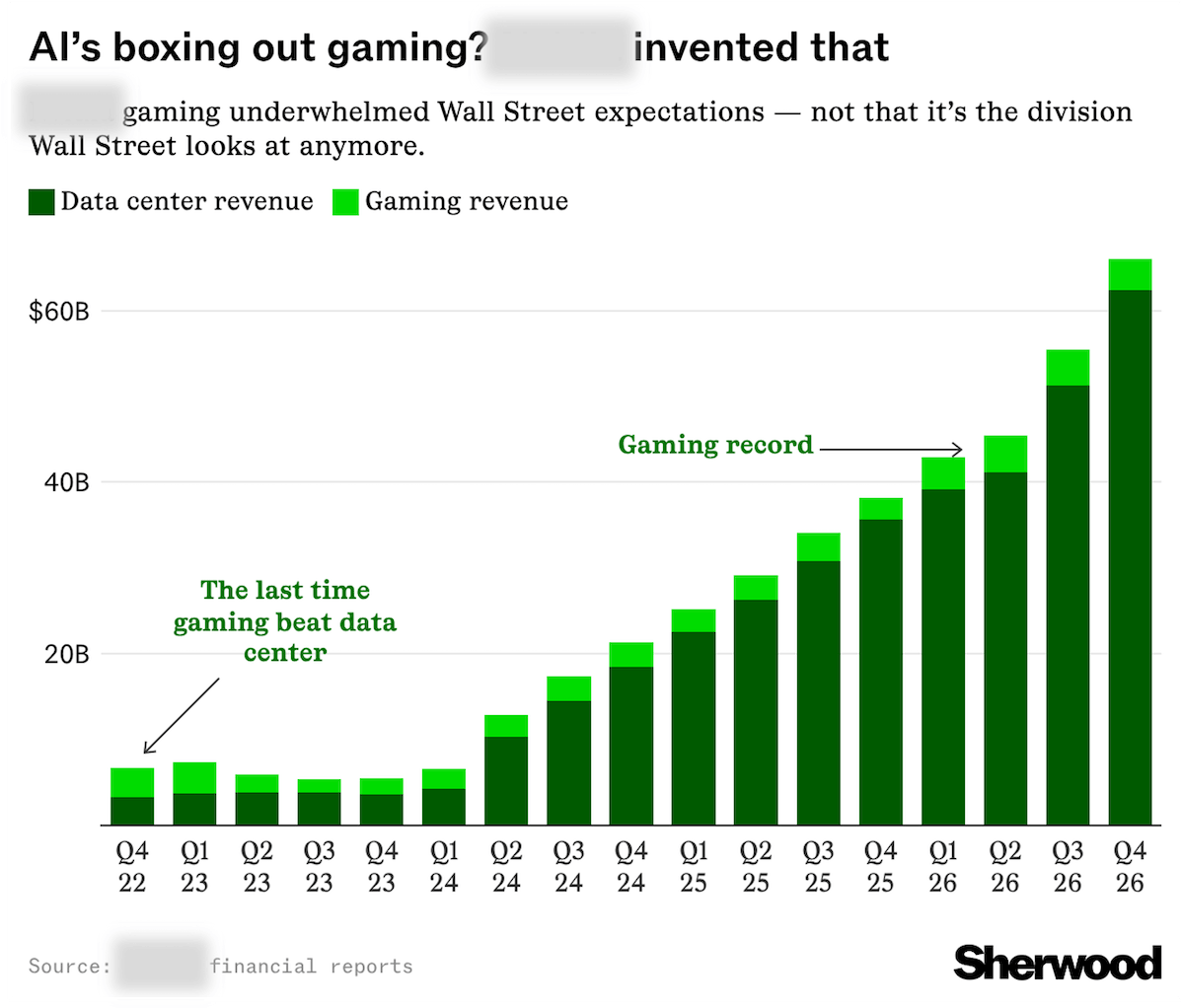
Off the charts: Which corporate behemoth has seen its multi-billion-dollar gaming division fade slightly into the background in recent years? [Answer below].
|
Not a subscriber? Sign up for free below. |
|
|
|