|
 |



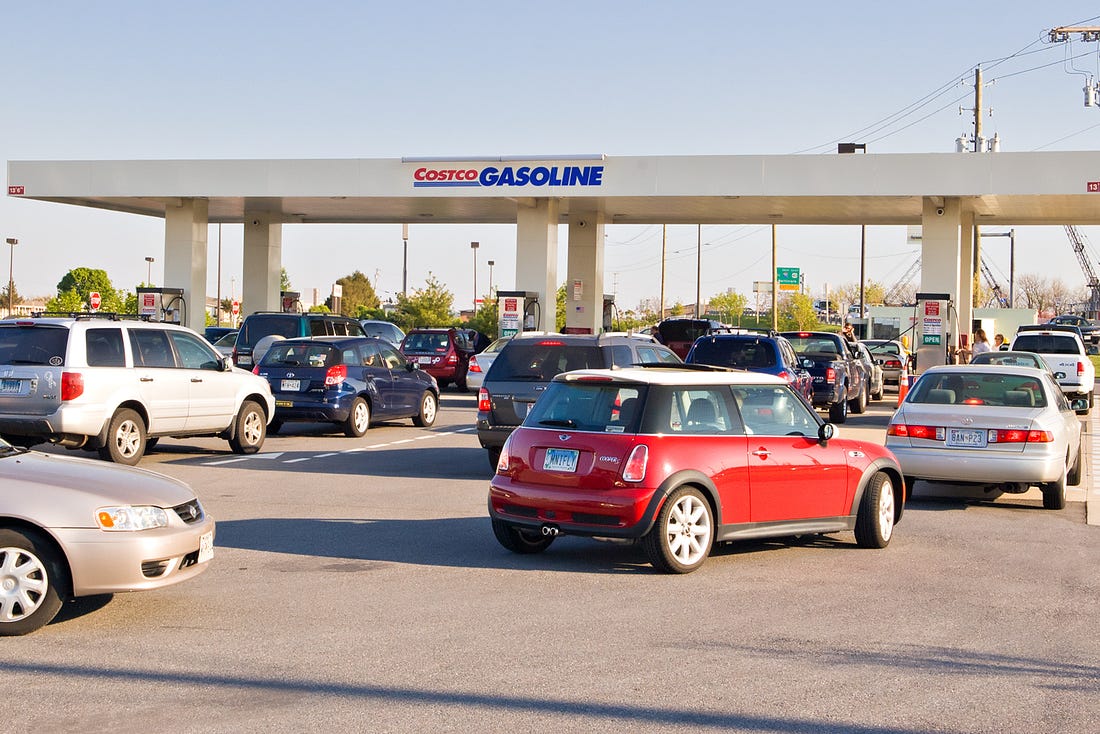 |
If the U.S.-Israel-Iran war does not end soon – either via ceasefire or regime change in Iran – we’re looking at a global energy shock unlike anything the world has ever seen.
Pray the war ends quickly.
As I write this (late afternoon on Monday, March 2nd), the world is on the cusp of a massive global energy shock.
Despite all the misleading claims on social media regarding the Strait of Hormuz (i.e. Iran doesn’t have the capability of shutting the Strait of Hormuz), as long as the Iranian regime remains in power, they can significantly hinder the free flow of oil and LNG exports traveling through the Persian Gulf.
In fact, right now the Strait of Hormuz is effectively closed.
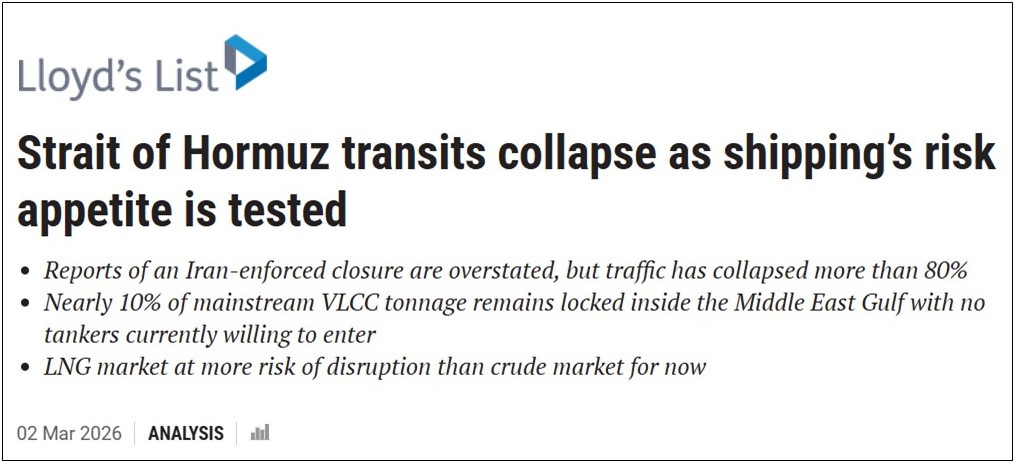 |
As reported in Lloyd’s List:
“THE STRAIT of Hormuz has effectively been closed, not by Iran, but by shipping itself.
Transits of all vessel types were down 81% on Sunday, March 1 compared to Sunday, February 22. Just over 1m dwt worth of traffic was tracked passing through the chokepoint on March 1. The average figure in January was 10.3m dwt.
Of the 23 transits recorded on March 1, a total of 21 were eastbound, that is away from the Middle East Gulf region.
Just one crude oil tanker transited the strait on Sunday, and no LNG carrier transits were recorded.”
Again, many people continue to parrot the idea Iran is incapable of shutting the Strait. They say, “The U.S. has bombed the Iranian Navy. They don’t have the ability to mine the waters or enforce a blockade.”
Correct. I’m not aware of any credible person who has claimed they have that ability.
Yet, I continue to hear “The Iranian Navy is no match for the U.S. Navy and its allies.” Here’s an example 👇
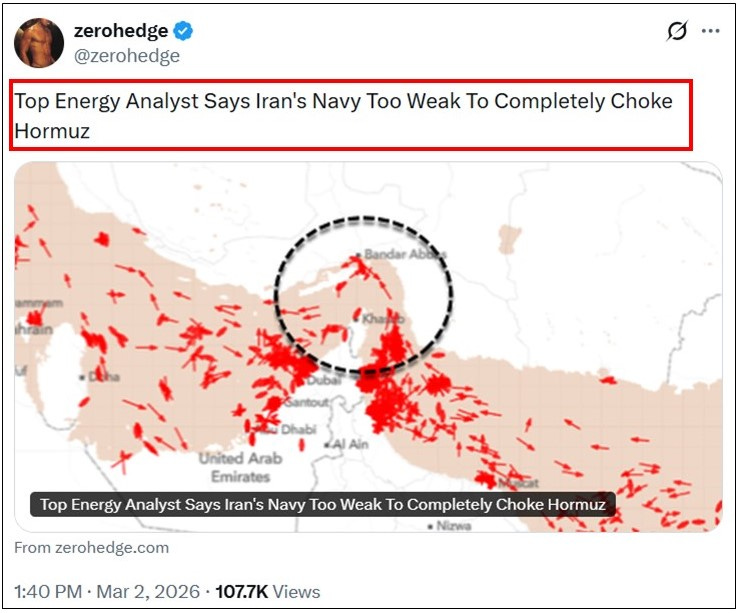 |
Again, that’s correct. But guess what?
The Houthi Navy is also too weak to completely choke the Red Sea. The Houthi Navy is also no match for the U.S. Navy and its allies. In fact, the Houthis don’t have any naval forces at all.
Nevertheless, this ragtag band of rebels with just a fraction of the resources available to a nation state such as Iran has managed to shut down the Suez Canal since November 2023. In December of that year, the United States announced Operation Prosperity Guardian. The goal? Neutralize the Houthi threat and make the Suez Canal freely navigable for international trade.
Joe Biden bombed the Houthis.
Donald Trump bombed the Houthis.
Both claimed victory over the Houthis. Yet almost two and a half years later, Suez Canal traffic is down 60% from where it was in 2022.
The Suez Canal was once one of the world’s most vital waterways. Prior to the Houthi attacks, approximately 12% of global trade traversed through the Suez Canal.
But with the Houthis harassing international shipping, most of those ships rerouted around the Cape of Good Hope.
However, when it comes to the Strait of Hormuz, there is no alternative route.
There’s only one way in and out of the Persian Gulf – the Strait of Hormuz.
Yes, land-based pipelines and roadways can carry some oil, but they don’t have the capacity to replace what flows through the Persian Gulf.
Since early Sunday morning, shipping traffic through the Strait of Hormuz has effectively stalled out. If this lasts for only a few days, it will quickly become a footnote in history.
If it persists for weeks or months, it will unleash a global energy shock the likes of which the world has never seen before.
The Strait of Hormuz Is Paralyzed
As Lloyd’s List stated, “The Strait of Hormuz has effectively been closed, not by Iran, but by shipping itself.”
Closure of the Strait of Hormuz doesn’t require an Iranian naval blockade or mining of the narrow waterway. All it takes is harassment of shipping, and no shipping company will want to take on the risk of traversing the Strait.