|
How to debug a team that isn’t working: the Waterline Model
A guide to solving team problems (without always blaming the people)
|

| |||||||||||||||


👋 Hey there, I’m Lenny. Each week, I answer reader questions about building product, driving growth, and accelerating your career. For more: Lenny’s Podcast | Lennybot | How I AI | My favorite AI/PM courses, public speaking course, and interview prep copilot
P.S. Get a free full year of Lovable, Manus, Replit, Gamma, n8n, Canva, ElevenLabs, Amp, Factory, Devin, Bolt, Wispr Flow, Linear, PostHog, Framer, Railway, Granola, Warp, Perplexity, Magic Patterns, Mobbin, ChatPRD, and Stripe Atlas by becoming an Insider subscriber. Yes, this is for real.
Molly Graham is the epitome of the type of person I love to collaborate with. She spent decades working closely with some of the most successful leaders in tech, including Mark Zuckerberg, Sheryl Sandberg, Chamath Palihapitiya, and Bret Taylor, and more recently (through her Glue Club community), she’s guided hundreds of leaders through the chaotic, lonely, and overwhelming journey inside early-stage and fast-growing companies. Drawing from these experiences, she is able to find patterns in what works and doesn’t and, more than anyone else I’ve met, is able to translate these lessons into powerful and memorable metaphors.
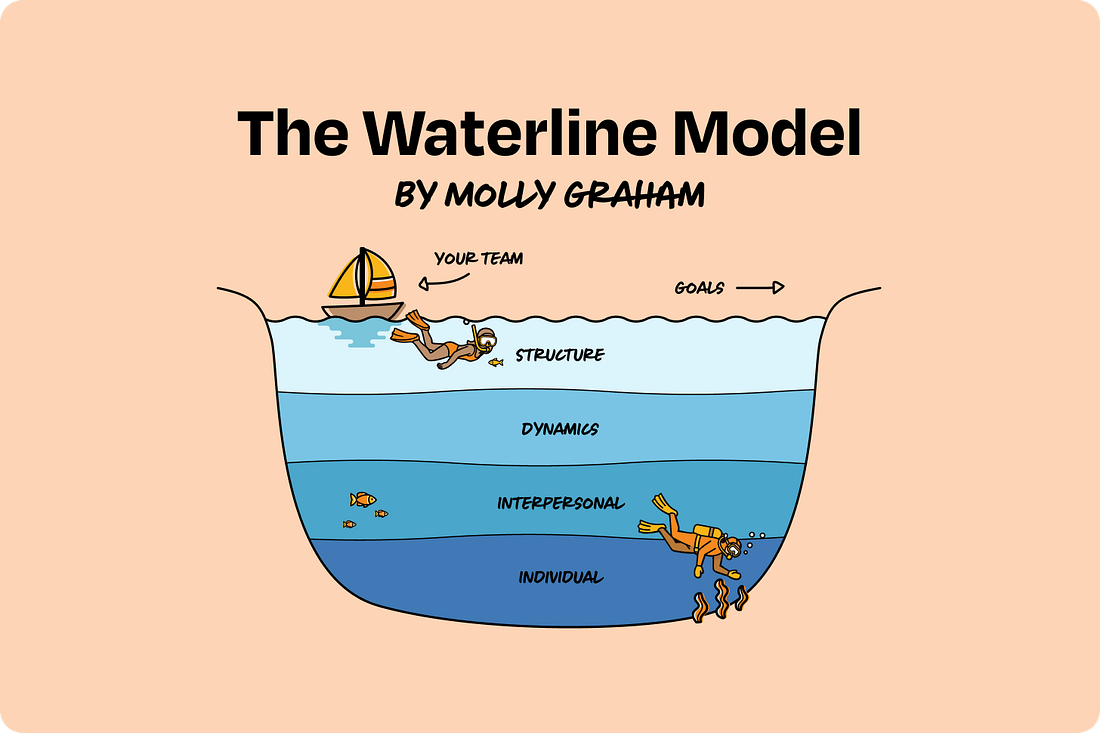
In her piece below, which I suspect will become as iconic as “Give Away Your Legos,” she builds on our recent podcast conversation to unpack a management framework that will change how you tackle team challenges: the Waterline Model.
Let’s get into it.
For more from Molly, check out her Substack and LinkedIn, and her Glue Club community. You can listen to this post in convenient podcast form: Spotify / Apple / YouTube.
 |
There’s a moment most leaders recognize. You’ve set a clear goal (or so you think), your team’s bought in (or so they say), yet timelines keep slipping, execution is messy, and you’re having the same conversations over and over. When that happens, it’s tempting to jump straight to people-based explanations: “This team just doesn’t work well together.” “That person isn’t strong enough.” “We need better execution.”
Sometimes that’s true. But after two decades of working inside companies like Google, Facebook, and the Chan Zuckerberg Initiative, and supporting leaders at companies like Stripe, Anthropic, OpenAI, Microsoft, and Gamma, I’ve come to believe that blaming people for problems that are actually structural is one of the biggest leadership traps there is.
I’ve learned to slow down in these moments and use a simple diagnostic tool I picked up early in my career: the Waterline Model.
I first learned how to use this tool when I was leading 75-day wilderness expeditions in Patagonia and Alaska for the National Outdoor Leadership School at age 22. Out there, when a team isn’t working, things fall apart fast. People get cold, hungry, tired, scared. There’s no hiding behind process or politeness, and there’s definitely no time for vague diagnoses like “the vibe is off.” You have to identify the source of what’s disrupting the team—not just the symptoms—and fix it quickly.
 |