- That is, the S&P 500’s heavyweights have tended to march to the beat of their own drummers, despite seemingly having a common critical success factor (whether their AI spending binges will pay off).
-
Low correlations help tamp down volatility at the index level — when one stock is down, another’s up. When volatility is suppressed, there are fewer scary daily drawdowns that inspire panic and send the index screaming even lower.
-
Tuesday’s rout was the most meaningful challenge to the low-correlation environment that’s been reestablished over the past few months. And that’s not only true for what’s within the stock market, but also between different asset classes.
|
|
|
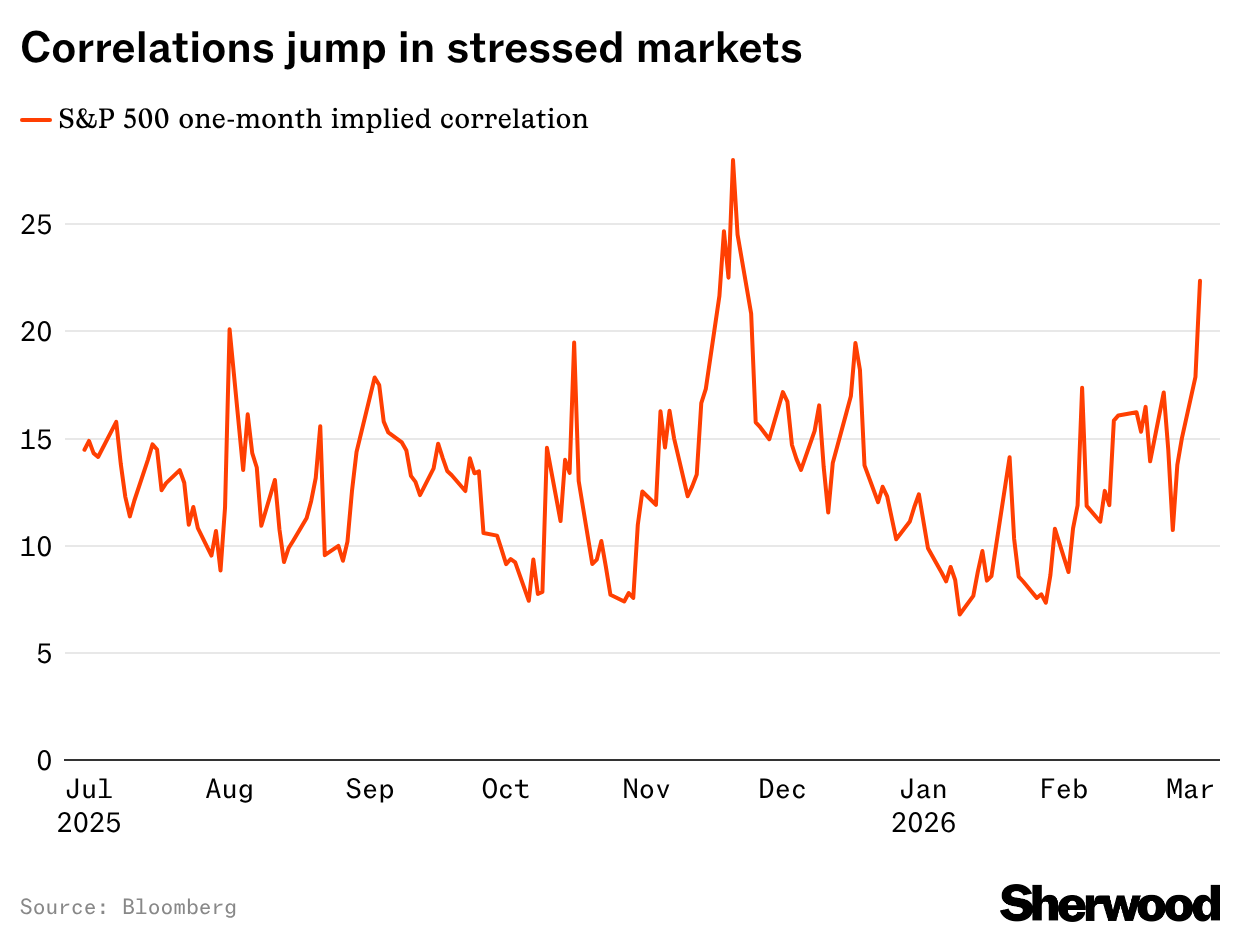
There have been only four previous sessions with this correlation since the iShares Bitcoin Trust’s inception in early 2024. One-month correlations — the extent to which the S&P 500’s constituents are expected to move in the same direction, derived from options prices — spiked, and hit their highest close since November 21.
Even if one ETF, SPY, managed to break out, it was a photo finish and it doesn’t change the underlying trend that, for the first time in a long time, the entire market was pretty much in the same boat. Bad news: the boat ain’t doing great. |
|
|
-
Micron and Sandisk each fell about 8%, Western Digital was down 7%, and Seagate Technology was off nearly 6%. Things started off bad — by 6:35 a.m. ET, Micron and Sandisk had traded more dollar volume than any US stock outside of Nvidia — which was an early signal of the highly motivated selling of these high-flying stocks.
- The steep losses were linked to an ugly reopening for South Korean markets, home to high-bandwidth memory giants SK Hynix and Samsung, which tumbled 11.5% and 9.9%, respectively, in local markets on Tuesday.
-
South Korean markets were closed for a holiday on Monday, so this marked the first time traders were able to react to the US and Israeli strikes against Iran, which brings with it the threat of a prolonged disruption to energy markets. Such an outcome would be particularly challenging to South Korea, a major energy importer.
-
Foreign investors led the rout, pulling roughly $3.7 billion on net from stocks listed on the Korean Composite Stock Price Index, per Bloomberg. Retail traders in the East Asian country (dubbed “ants”) who have an affinity for leveraged products are reportedly buying the dip in a similar size.
|
Memory stocks had been the investing world’s favorite way to play the AI trade in recent months, as the outlook for a prolonged supply/demand imbalance sent prices of their offerings soaring. This dynamic prompted furious upward revisions to earnings and sales estimates for the cohort, which trade at modest valuations relative to most of the tech universe.
|
|
|
There may be some industry-specific chatter accentuating the losses, but at its core, this is just a parabolic trend breaking in the face of unexpected negative news.
As the fourth of famed Wall Street investment strategist Bob Farrell’s “10 rules for investing” dictates: “Exponential rapidly rising or falling markets usually go further than you think, but they do not correct by going sideways.” |
|
|
Core Scientific announced in its earnings call this week that it sold over 1,900 bitcoin for $175 million in January, and may sell the rest of its stash as it shifts focus to AI and colocation growth. And it’s not alone: former bitcoin miner Bitdeer made a similar move in late February, and more miners are making pivots to AI as mining economics “have gone from bad to worse.”
|
|
|
|