De-escalation in the Gulf, the Fundação Calouste Gulbenkian and Singapore’s first eco-friendly town.
|
Thursday 12/3/26
|

|
|
London
Paris
Zürich
Milan
Bangkok
Tokyo
Toronto
|
|
|
|

Good morning. Following our rundown of the best shows at Paris Fashion Week, today we’re staying in the French capital to ponder how some brands can lose sight of their identity. For more news and views, tune in to Monocle Radio. Here’s what’s coming up in today’s Minute:
THE OPINION: What sample sales reveal about our appetite for excess
Q&A: UAE’s minister of state, Noura bint Mohammed Al Kaabi, discusses de-escalation
DAILY TREAT: Spend a morning at Fundação Calouste Gulbenkian
IN PRINT: Take a tour of Singapore’s first purpose-built, eco-friendly town
|
|
Ditch the discounts: Sample sales are big on business but small on substance
By Augustin Macellari
|
All great fashion brands value their image. So why do so many throw it all away once sale season comes around? Shifting stock at pace can damage dignity. One culprit demeans brand identity more than anything: the sample sale.
Imagine yourself in a queue. It’s one-hour long and stretches as far behind you as it stretches ahead. It’s also composed almost exclusively of men wearing the same outfit, the products of a recognisable brand, whose clothes you have admired in the past. The queue winds its way into an indeterminate space where examples of these clothes hang from wobbly rails in large numbers. Cardboard boxes are filled with brand-new scarves and ties.
The atmosphere is competitive. You look at what the men are wearing, as well as what’s on the hangers. The clothes, you think, as a tall man elbows his way between you and an unsteady rack, don’t look very nice anymore. And the tall man has extremely sharp elbows.

| |
|
All hat and no cattle: Sample sales are rarely worth the frenzy
|
|
Popping into a sample sale might sound like an agreeable way to pass an idle hour between lunch and your next meeting. It might even seem like an interesting opportunity to get a handle on the locals as you stroll around a foreign fashion capital and snag a bargain at the same time. Buyer, beware.
A label’s carefully constructed identity and the logic of manufactured scarcity – desire piqued through limitation – go out the window at a sample sale. The true value of visual merchandising is thrown into sharp relief. The odd gem nestles among a case study in bad inventory planning. Over-ordered seasonal misfires, the stuff that didn’t sell at the time, is given a second, cut-price chance. Despite the atmosphere and the sharp elbows, the approach seems to work. With prices lowered, the question “Why buy?” gives way to “Why not?”
It’s not hard to find an unpleasant shopping experience in 2026. And it’s not difficult to learn why – and how – the culture of sales is contributing to an environment of overconsumption and unrealistic consumer expectations. Smaller brands and businesses that try to do interesting things struggle to compete in a market where someone, somewhere, is always knocking two-digit per cent reductions off the price.
What’s trickier is tracking down the boutiques where expertise and dedication are given free rein to present a thoughtful selection of garments in their best light. Where people passionate about their work, who know more than you do and are prepared to spend the time sharing the benefits of their knowledge with you – and your wardrobe. A good retail experience, after all, treads a fine line between deliberation and impulsiveness: a long-considered purchase can layer very nicely over a shirt bought on a whim. At a sample sale, value collapses like a cardboard box overstuffed with last year’s T-shirts.
Not every sample sale is the same. Some truly live up to their name; there are unique pieces and bargains to be found. For the rest, well, there’s no doubt that selling surplus stock to fanboys is a better alternative than sending it straight to landfill. But better yet would be to mitigate the risk of that surplus. The challenge for brands is finding the sweet spot by limiting production runs, not to manufacture scarcity but instead to manufacture responsibility. Customers can make it easier by short-circuiting discount hysteria to ensure that impulse is informed, reflecting critically on the thoughtless desire that prompts men to queue for an hour in the rain, for example. In doing so we might find ourselves prepared to spend a little more and buy a little less.
Augustin Macellari is a Paris-based journalist and regular Monocle contributor. If you’re after a good place to shop, why not check out our City Guides?
And for more on boutiques and well-considered retail…
– Amid retail-sector uncertainty, boutiques and catalogues are making a comeback
– Best boutiques in the world: Neighbour, Vancouver
– Brooklyn boutique L’Ensemble proves that privacy and intimacy are the new luxury
|
|
Q&A: UAE
‘Escalation would bring a much wider war to our doorstep,’ says UAE’s minister of state, Noura bint Mohammed Al Kaabi
More than 2,000 missiles and drones have been launched towards the Gulf states by Iran in the past 10 days, with the UAE absorbing a large share of the attacks (writes Inzamam Rashid). Yet Abu Dhabi insists that escalation is not the answer. Speaking to Monocle, Noura bint Mohammed Al Kaabi, the UAE’s minister of state at the Ministry of Foreign Affairs, says that the country remains focused on defence, diplomacy and maintaining stability at home, even as warning alerts continue to flash across residents’ phones.
Al Kaabi argues that the UAE’s openness and economic model have made it a target for Tehran but insists that the country will not be drawn into a wider war. Instead, she points to the resilience of the UAE’s diverse population, the success of its missile-defence systems and a diplomatic push at the United Nations to condemn the attacks. Here she speaks to Monocle about the conflict’s impact on the nation, the risks to global trade and why the nation believes that de-escalation – not retaliation – remains the only viable path forward.

|
The UAE has intercepted most incoming attacks but why hasn’t it retaliated militarily?
Because we understand the consequences. Escalation would bring a much wider war to our doorstep and that is something that we want to avoid. The UAE is acting responsibly. We are pursuing diplomatic channels, including efforts at the United Nations, and we are working with our partners to condemn these attacks through international law.
To read the conversation in full, click here.
|
|
• • • • • DAILY TREAT • • • • •
Spend a morning at Fundação Calouste Gulbenkian
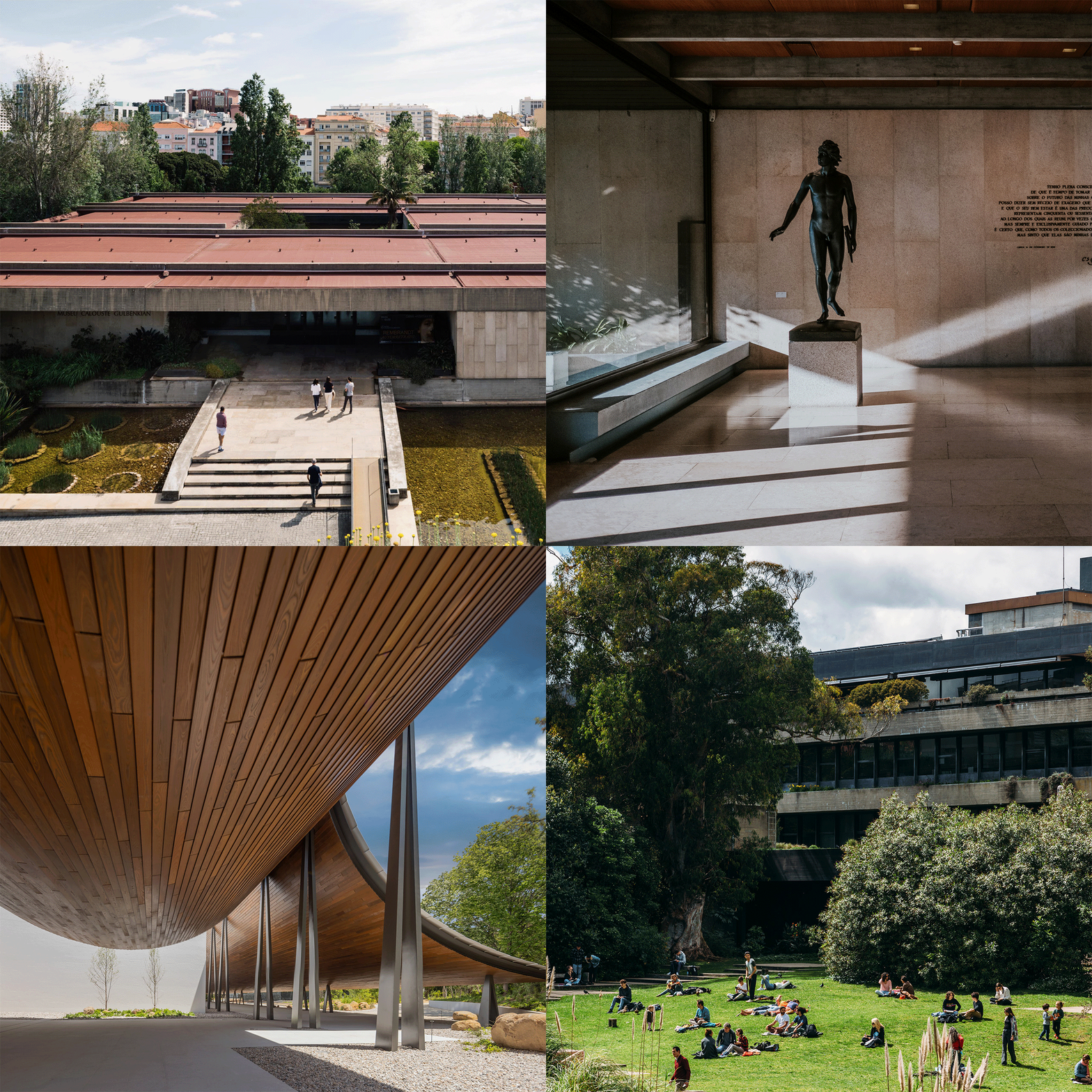
If you only have a morning in Lisbon to spare, the Fundação Calouste Gulbenkian is your best bet. While the Gulbenkian Museum reopens in July 2026 after a much-anticipated revamp, the real gem will be the gardens. A late-1960s milestone of modernist landscape design, it’s an urban oasis where verdant greenery plays against the coolness of brutalist buildings and meticulously kept lawns offer quiet, shaded corners. This urban Eden serves as a true public living room where locals spread picnic blankets by the lake, watch a performance in the open-air amphitheatre or wander along the paths.
Once you reach the wooden canopy designed by Japanese architect Kengo Kuma in 2024, you have arrived at the Centro de Arte Moderna (Cam). Head in to explore the Portuguese modern art collection before breaking for lunch at Cam’s Table, where stunning views bring nature and architecture together once again.
gulbenkian.pt
|
|
|
Sponsored by Hitachi Energy
|
|
|
|
|
|
in print: singapore
Inside Tengah, Singapore’s first purpose-built eco-friendly town reshaping public housing
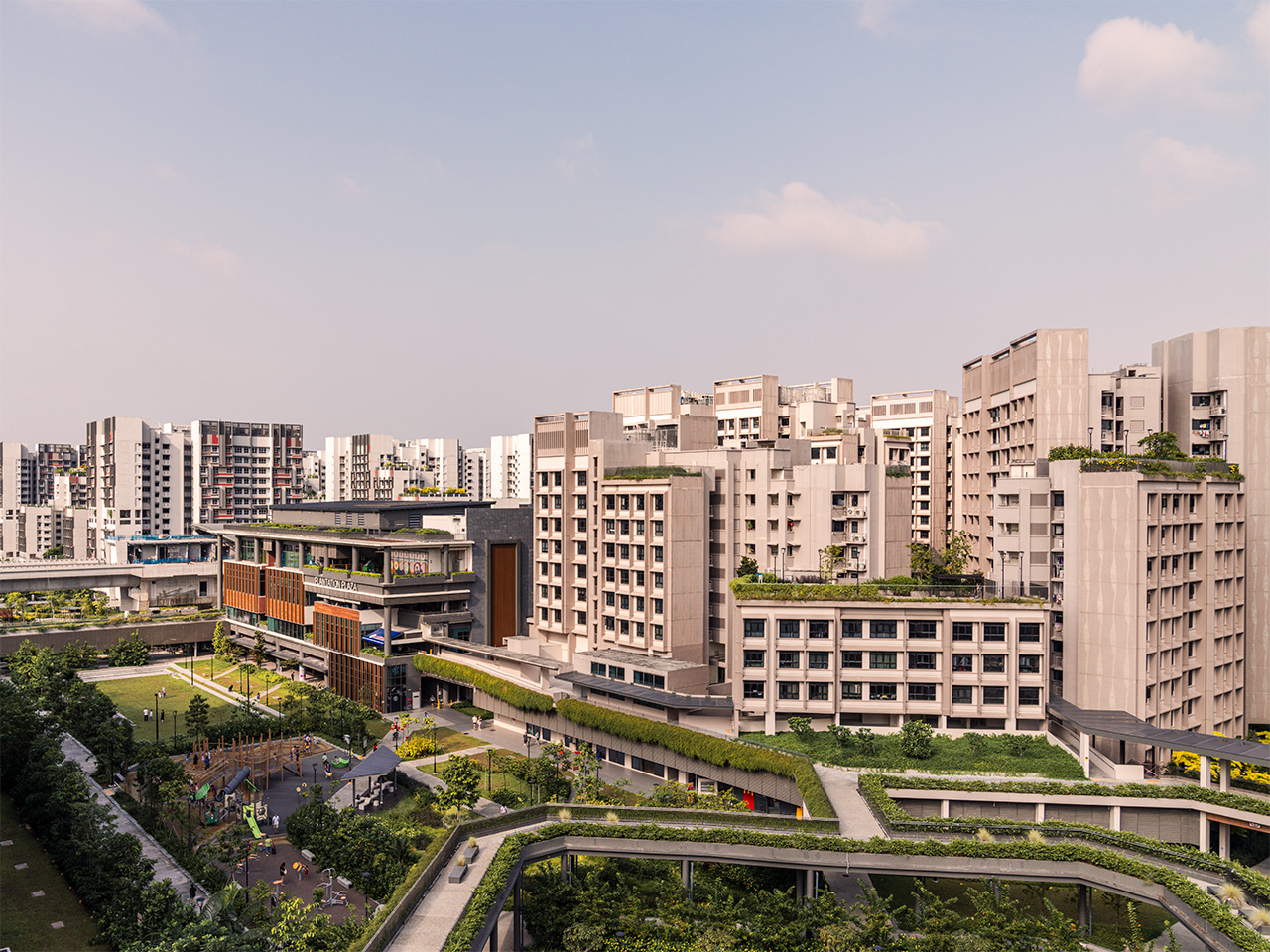
When Farhani Hanafi-Shuy was hunting for a home with her partner in 2019, she knew that there was one public-housing development that she was willing to wait years for (writes Joseph Koh). Tengah in Singapore’s West Region was pitched by the city-state’s Housing & Development Board (HDB) as its first smart and sustainable town. On what was once a military training ground, 700 hectares of land would be turned into a walkable, eco-friendly neighbourhood with about 30,000 residential units. Unlike most of the older public-housing estates, Tengah would be enveloped in nature, flanked by a 5km forest corridor linking the Western Water Catchment area to the Central Catchment Nature Reserve.
| |
|
Building community: Tengah in Singapore’s West Region
|
|
Ten years after Tengah’s announcement – and following delays related to the coronavirus pandemic – half of its homes have been completed, with a town centre, clinic and train stations still to come. Twelve months after she finally moved in, Hanafi-Shuy says that the long wait was worth it. “Unlike in my former estate, everything that I need is now only a short walk away and the paths aren’t disrupted by cars,” she says. “You’re guaranteed to see a garden along the way.”
| |
|
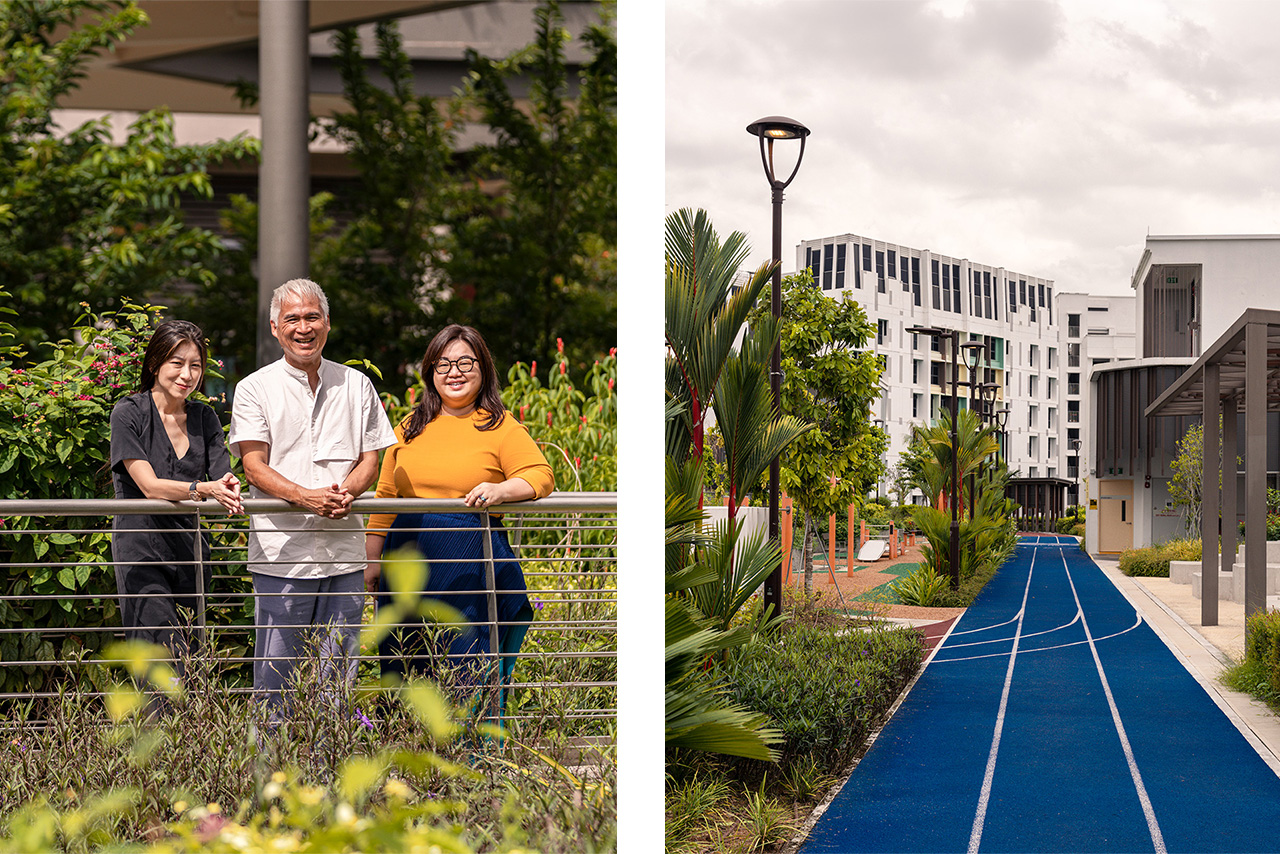
In their element: Guo Zi Ang, Chai Yee Foo and Yvonne Tan from DP Architects
|
|
Exploring Tengah on foot leaves a striking impression. Two “community farmways” – 40-metre-wide, 1.3km-long tapestries of pavilions, nature-themed playgrounds and fitness areas, all amid luxuriant flora – blur the line between a housing estate and a park. The playgrounds are positioned beside the fitness areas and outdoor seating to foster a sense of community | | | | |
 MONOCLE