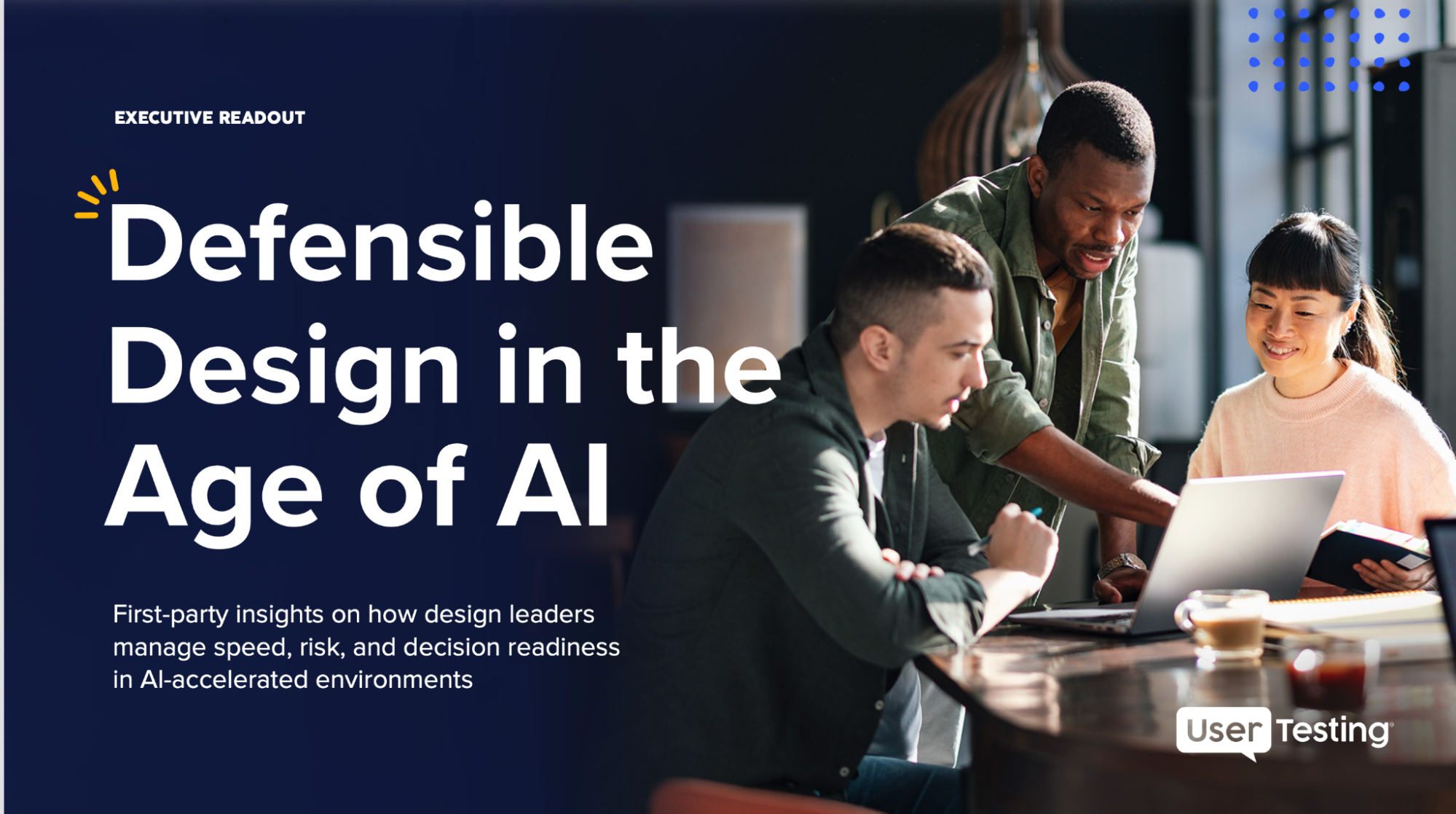
AI has officially killed the blank page. According to our new report, Defensible Design in the Age of AI, 91% of designers say they’re working faster in AI-accelerated workflows. Mission accomplished, right?
Not exactly.
Only 15% feel much more confident in the quality of their decisions. Confidence drops as stakes rise—peaking at 4.1/5 during early discovery, then sliding to 3.6–3.7 when it’s time to ship. Speed is up. Defensibility? Question mark.
It gets better (or worse): 37% say outcomes haven’t improved at all. Nearly 20% say they’re sometimes worse. And designers are split straight down the middle—38% say AI increases the risk of making the wrong decision, while 38% say it decreases it.
The real anxiety? Not bad outputs. It’s outputs that “sound right, but are hard to verify” (47%). In other words, the plausibility trap.
Our takeaway? AI doesn’t reduce risk. Evidence does. Teams that validate with research, testing, and analytics feel more confident. Teams that rely on discussion alone? Not so much.
If you’re betting your roadmap on AI speed, this report is your wake-up call. Using the UserTesting platform, we surveyed 183 designers across the United States and Europe (UK, France, and Germany). We asked how decision confidence changes at different stages of work, how teams manage risk, and where accountability ultimately sits.