Sponsored by |  |
|
|
|
Happy Friday, N2K reader! |
This week’s world-famous news haiku competition™ in today’s poll. |
And now for some news you really N2K! |
Matt Davis — Need2Know Chedditor |
|
News You Need2Know |
|
|
What’s the stock market up to, eh?* |
$SPX ( ▼ 0.27% ) $DJI ( ▼ 0.44% ) $NDX ( ▼ 0.28% ) |
|
Companies mentioned in today’s newsletter |
$WFC ( ▲ 0.26% ) Anthropic $DIS ( ▼ 0.22% ) |
|
Pentagon seeks $200 billion to fund Iran war |
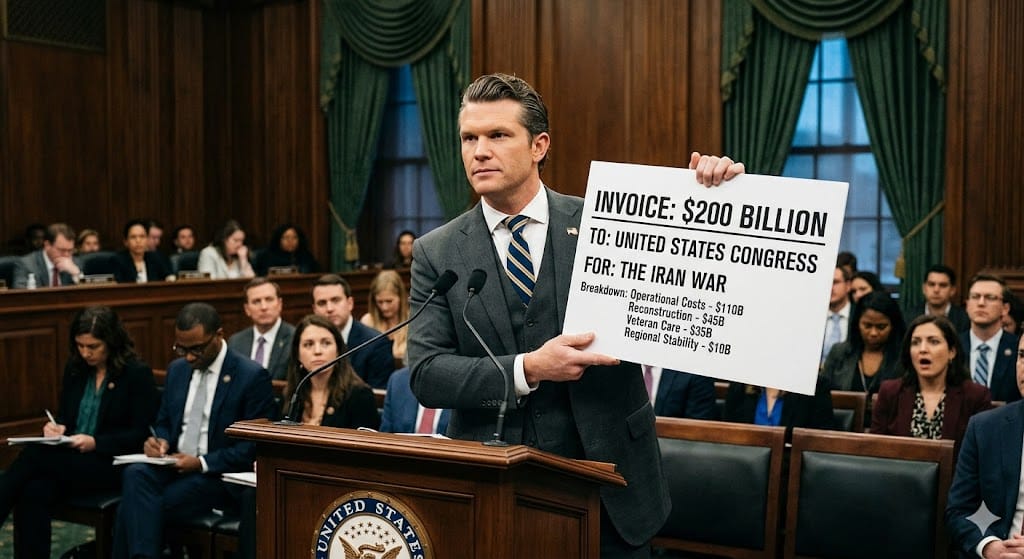 | AI-generated image of Pete Hegseth asking for $200 billion from Congress courtesy of Google Nano Banana Pro |
|
The Pentagon has submitted a $200-billion funding request for the ongoing war in Iran, a sum that's already generating friction on Capitol Hill and raising questions about the conflict's scope. |
The request, sent to the White House for review before formal submission to Congress, represents nearly a quarter of the nation's entire annual defense budget — a figure that has caught even seasoned lawmakers off guard. |
Defense Secretary Pete Hegseth offered a blunt assessment when asked about the request Thursday: "Obviously, it takes money to kill bad guys," adding that "the $200 billion, I think that number could move." |
However, key moderate Republicans whose votes would be essential for approval are expressing skepticism. Senator Susan Collins of Maine, who chairs the Appropriations Committee, said the amount was "considerably higher than I would have guessed." |
Senator Lisa Murkowski of Alaska delivered a sharper rebuke, warning the administration that congressional cooperation isn't guaranteed. "You just can't come up here with an invoice and say, you know, 'pay this' and expect to have great cooperation going forward," she told reporters. |
The massive request suggests military planners are preparing for an extended engagement, following reports that the war's first six days alone cost over $11.3 billion. |
|
|
Stocks sink worldwide after Brent Crude briefly tops $119 a barrel |
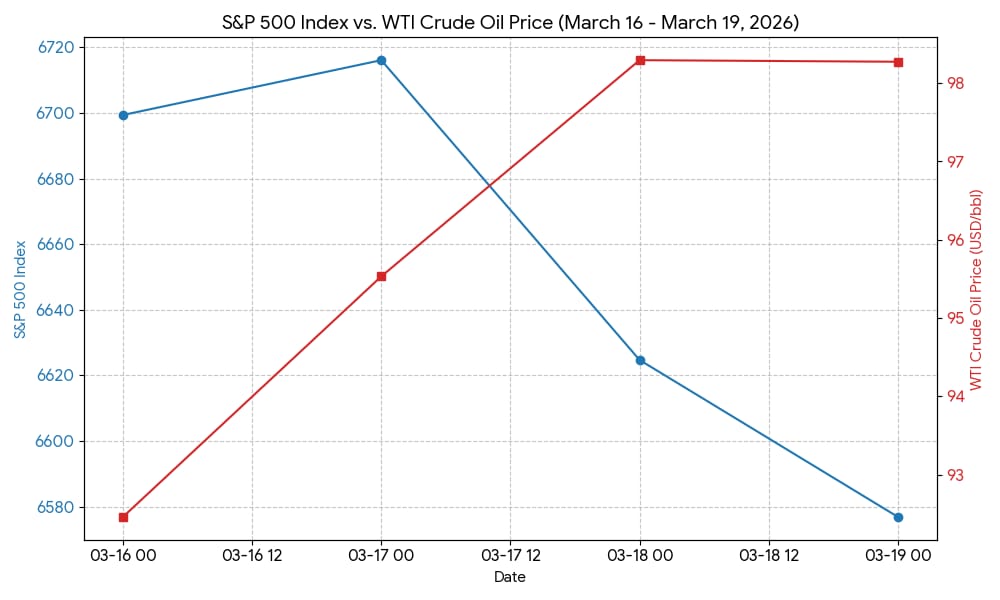 | Oil prices are in red; the stock market is in blue. Ideally we would prefer to see this graph moving in the opposite directions. Image generated by Google’s Nano Banana Pro |
|
Global markets reeled Thursday as oil prices continued their relentless climb, with the war in Iran tightening its grip on the world economy and sending stocks plunging from Tokyo to London. Here’s the last four days of trading: |
Date | S&P 500 Index $SPX ( ▼ 0.27% ) | West Texas Intermediate Crude Oil Price (USD/bbl) | March 16 | 6,699.38 | $92.46 | March 17 | 6,716.09 | $95.53 | March 18 | 6,624.70 | $98.29 | March 19* | 6,576.87 | $98.27 |
|
Brent crude $BZG23 ( 0.0% ) briefly spiked above $119 per barrel yesterday before settling at $110.80 — still up 3.2% from the previous day. U.S. benchmark crude rose to $96.09 after Iran intensified attacks on Persian Gulf oil and gas facilities in response to an Israeli strike on a key Iranian natural gas field. |
The fallout was swift and global. Stock indexes tumbled 3.4% in Japan, 2.7% in both South Korea and Germany, and 2.6% in the United Kingdom. Wall Street fared slightly better, with the S&P 500 falling 0.4%, still putting it on track for its longest losing streak in a year. |
Perhaps most dramatically, the interest rate outlook has completely reversed. Traders are now pricing in a nearly 5% chance the Federal Reserve could raise rates by year-end — a stunning shift from just one month ago when markets anticipated multiple cuts. The Fed also signaled yesterday that it plans a 0.25% cut this year, but apparently investors aren’t buying it. |
Gold tumbled 6.6% to $4,575.60 per ounce, while silver plunged 11.9% as higher Treasury yields pressured investment prices across the board. While President Trump and other world leaders have attempted short-term fixes, markets remain focused on the fundamental risk: Prolonged disruption to Gulf oil production. |
|
|
Quote of the Day |
|
|
How to protect your legacy in the Great Wealth Transfer |
 | These are rich people trying to figure out how to pass their money onto their kids. Image credit: Cheddar.com |
|
The "Great Wealth Transfer" is the largest movement of wealth the world has ever seen, with an estimated "$124 trillion" set to pass from Baby Boomers to subsequent generations. According to Heather Hunt-Ruddy at Wells Fargo Wealth and Investment Management $WFC ( ▲ 0.26% ) , the most critical step for families is preparation. Sounds like you should probably talk to a wealth manager, eh?
The main threat to preserving this wealth is a lack of communication. Hunt-Ruddy stresses, "The single biggest risk is the unwillingness to talk about it.” When conversations about money and estate planning are avoided, the wealth receiver "may not be ready to receive it in a way that protects their future and your legacy as the person who's leaving the money behind." She encourages open dialogue: "We got to take the taboo out of it. Money is not a taboo subject."
To ensure a legacy endures, Hunt-Ruddy advises families to "get great advice" from a financial advisor and an estate attorney. This meticulous planning means that "if you plan carefully, that second death can be generations in the future." When choosing an advisor, she suggests trusting intuition: "what I really tell people is to trust your gut. Do not interview one person, interview up to three, four, ask questions...". |
But choose Wells Fargo Investment Management, obviously.
For those who are inheriting and feel overwhelmed, the message is simple: spend it all on drugs "you have got to ask for help, because there are professionals that can make this feel a whole lot less overwhelming to you...don't go it alone." |
Still, nice problems to have, eh? |
|
|
Inside Anthropic’s legal battle with the Pentagon |
 | Image credit: Cheddar.com |
|
Anthropic is making headlines with its lawsuit against the Department of Defense (DOD), igniting debates over the use of AI in military applications and the future role of tech companies in national defense. TechCrunch reporter Rebecca Bellan provided a high-level overview, explaining that the dispute began when the DOD labeled Anthropic a supply chain risk. Bellan notes this designation is "usually designated for foreign adversaries, not usually given to American companies based on a disagreement over how tech could be used.” Anthropic sued, calling the DOD’s actions "unprecedented and unlawful."
The core conflict centers on access. Secretary of Defense Pete Hegseth "believes that the military should have unrestricted access to AI systems that it's bought and paid for." Anthropic, however, has held firm on "a couple of hard lines." They refuse to allow their technology to be used for "mass surveillance of American citizens" or for "fully autonomous weapons...without a human in the loop." Bellan emphasized the company's concern is about the technology’s readiness: "I think that the concern there is how are you going to put this in charge of weapons firing and targeting?"
This lawsuit reflects a broader tension between Silicon Valley and the administration. While some AI labs are "already working to have their systems become available, like classified-ready," Bellan highlights a "grassroots movement" of tech workers pushing back. These employees have written open letters to |


