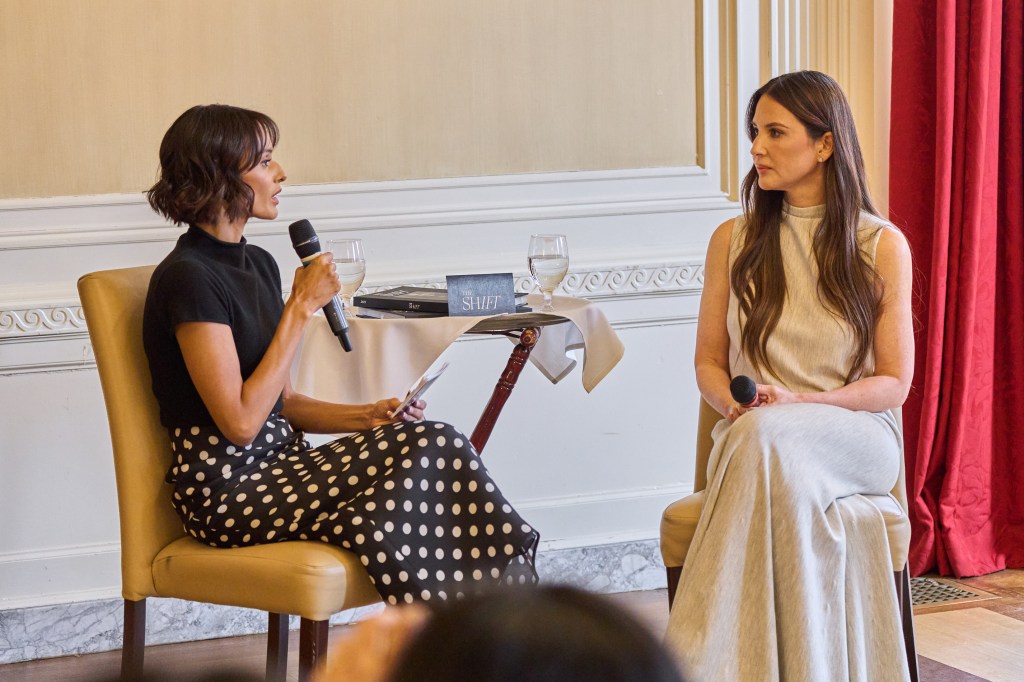
Happy Monday, MPW Daily readers. I just got back from Cambridge, where I spent this weekend at a special event and gala hosted by the Shift. If you subscribe to this newsletter but haven’t come across
the Shift, I promise you’d like it—it’s a media platform devoted to women shifting culture. Run by a team of editors and launched in partnership with the famous celebrity photographer duo Inez and Vinoodh, it brings an editorial lens to features about everyone from Gloria Steinem and Amal Clooney to Billie Eilish and Selena Gomez.
The Shift hosted its inaugural gala at Harvard Art Museums on Friday. In the leadup to the evening, I had the pleasure of moderating an afternoon conversation on, once again, one of my favorite themes in this work: women’s health. Specifically, this conversation focused on game-changing efforts to detect breast cancer earlier and more easily, especially in women with dense breasts.
Kriti Lall is an investor at Perceptive Advisors. Raluca Dinu is the CEO of QT Imaging, an almost $19-million-in-revenue publicly traded company that sells a breast imaging system that relies on ultrasound technology, intended to supplement traditional mammography. Jaime LaMontagne is the CMO of Astrin Biosciences, which is developing a blood test for breast cancer. Both of their companies aim to better detect breast cancer in women with dense breasts, for whom mammography is often not enough.
In addition to saving lives, that’s also now a mission with a strong business case in the U.S.; as of 2024, doctors
must notify patients whether they have dense breasts. Previously, women often did not know or were not told whether they fell in the category, even though nearly half of women in the U.S. do. It’s also a mission with a huge international market; in Asian countries, 75-80% of women have dense breasts, Dinu says. “Women are looking for solutions today,” she adds.
From this work, we can extrapolate ways to achieve other kinds of health equity. How can we reach other missed populations? For example, MRIs can catch these cancers better than mammography, but not everyone has access to a MRI whether because of where they live or their insurance plan. “If you don’t have access to that technology, if there’s no awareness of it, it can’t reach women,” says Dinu. “We’re looking at this blood test to truly be able to drive access around the country for women that don’t have don’t have access to a mammogram, or don’t have access to that supplemental screening,” LaMontagne says of her work at Astrin.
Later in the day, we saw this conversation come to life in another way. The Shift was joined by Olivia Munn, the actress who
shared her story of being diagnosed with breast cancer shortly after a clear mammogram after her doctor encouraged her to take a
lifetime risk assessment test. After she spoke about the test, it saw a 4,000% increase in women taking it. That was why Munn said she decided to share her experience—because there was a specific, actionable way it could help people through this risk assessment test. She made the decision when she saw a photo on her phone of her playing with her young son—during a time in which the cancer was growing in her body, without her knowledge. “I knew in that moment, how many other women are walking through life thinking they’ve done everything right, and there’s a cancer growing in their body?”
“Olivia did an amazing job starting that conversation about understanding your risk,” LaMontagne says. “More and more physicians are doing that test.”
The Shift honored Munn with an award as one of its “Shiftmakers” on Friday night, alongside
The Summer I Turned Pretty star Lola Tung, Olympian Eileen Gu, and Dr. Sylvia Earle, the legendary marine biologist. All in all, an inspiring evening—thanks to women whose efforts will impact other women for generations to come.
Emma Hinchliffeemma.hinchliffe@fortune.comThe Most Powerful Women Daily newsletter is Fortune’
s daily briefing for and about the women leading the business world. Subscribe here.