Impacts of the Iran War, U.S. Supreme Court Ruling on Tariffs, and Global Democratic Regression |
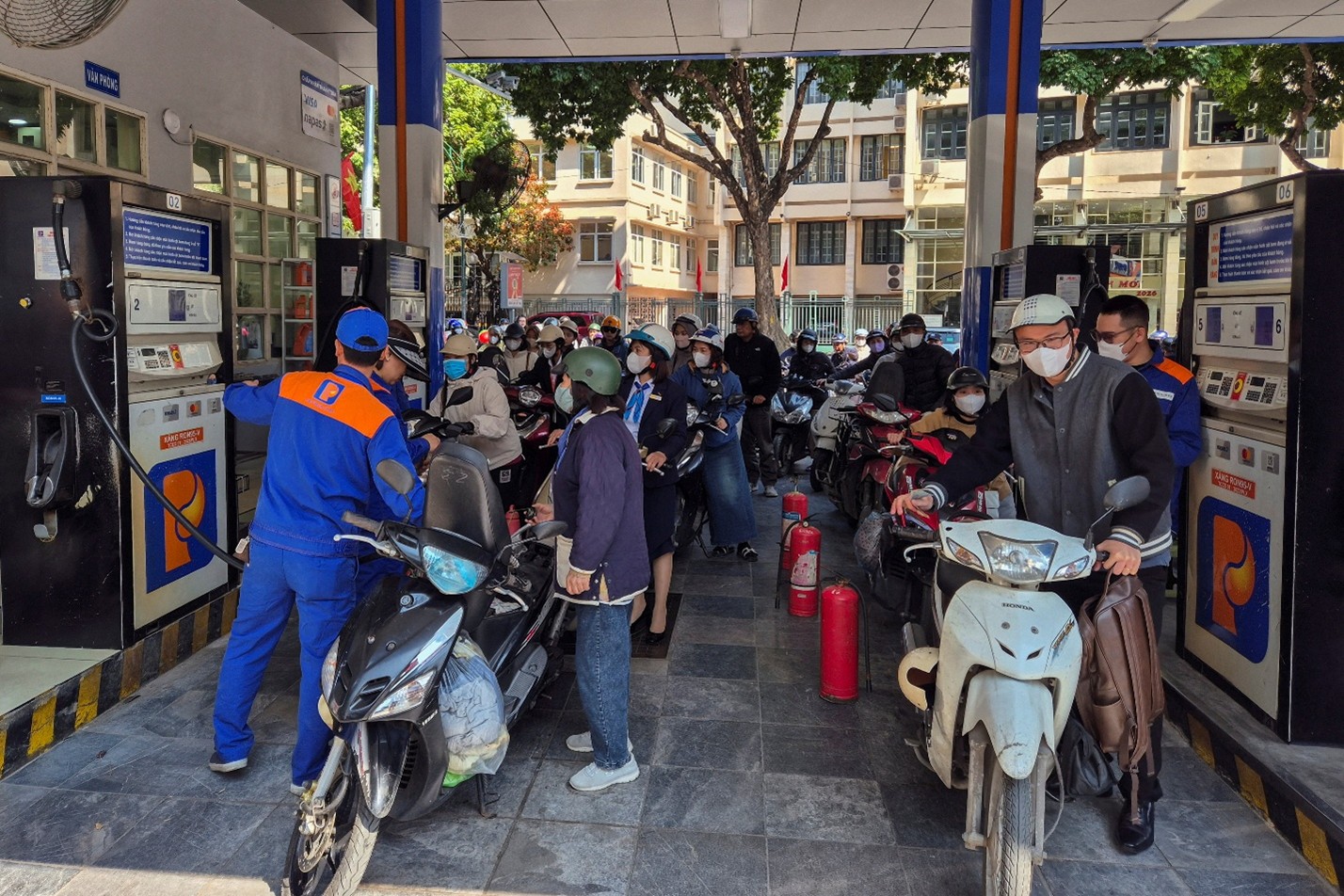
Bikers queue to buy oil at a gas station in Hanoi, Vietnam on March 10, 2026. (Khanh Vu/Reuters) |
In this month’s newsletter, Council on Foreign Relations (CFR) experts explore recent developments in Asia, including the U.S.-Israeli conflict with Iran, the U.S. Supreme Court’s ruling on President Donald Trump’s tariff powers, and democratic regression in Asia and globally, among other topics. |
|
|
On February 20, the U.S. Supreme Court ruled that the International Emergency Economic Powers Act (IEEPA) does not authorize the imposition of tariffs, invalidating Trump’s ability to invoke emergency powers to slap tariffs on foreign states. Maurice R. Greenberg Senior Fellow for China Studies Zongyuan Zoe Liu argues that the landmark ruling has long-term implications for U.S.-China relations by slowing the Trump administration’s strategy of executive brinkmanship, and could facilitate a more regulated deployment of economic statecraft and competition. Read on here
|
|
|
Impacts of the Iran War on Asia and Energy Security |
| |
Since the start of Trump’s second term, the United States’ global authority and credibility have eroded. But not every perceived loss for Washington has been a gain for Beijing, argues Liu in a new article for Foreign Affairs. The United States and Israel's recent strikes on Iran have weakened Washington’s international image as a facilitator of global order. However, they also demonstrate the irreversible fraying of the U.S.-led international order—an order Beijing prioritizes maintaining above all else, even outcompeting Washington. Find out more
|
|
|
Against the backdrop of the ongoing conflict in Iran, John E. Merow Senior Fellow for Asia-Pacific Studies Sheila A. Smith writes that the rapport between Trump and Japanese Prime Minister Takaichi Sanae—and the U.S.-Japan alliance at large—has been put to the test ahead of Takaichi’s visit to Washington. Get her take
|
| |
Asia’s most vital energy supply chains have been compromised by the almost-total closure of the Strait of Hormuz and the shutdown of most liquified natural gas production across the Persian Gulf. Senior Fellow for Southeast Asia and South Asia Joshua Kurlantzick and Research Associate Annabel Richter examine the near-term chaos caused in Asian states and the potential for resultant unrest. Learn more
|
| |
Like many crises that have driven structural change, the Iran war has dramatically altered how Asian governments are planning to ensure energy sufficiency in the future, leading them to embrace nuclear energy, reconsider renewables and even revert to coal, write Kurlantzick and Richter in a piece for World Politics Review. Read their argument
|
| |
Fifteen years since the catastrophic meltdown of Japan’s Fukushima Daiichi nuclear power plant, Senior Fellow Daniel B. Poneman, Senior Fellow for Climate and Energy Clara Gillispie, and Deputy Director of the Climate Realism Initiative Lindsay Iversen examine the safety lessons learned from Fukushima, Japan’s revival of its nuclear energy strategy, and the continuing vulnerability in the country’s energy mix. Read their analysis
|
| |
Democratic Reckonings Across Asia and the World |
| |
In an argument for Foreign Policy, Senior Fellow Manjari Chatterjee Miller writes that Canadian Prime Minister Mark Carney’s call for middle powers to band together—initially delivered in a speech at this year’s World Economic Forum in Davos, Switzerland—could actually have the reverse effect of further fracturing global order. Get her take
|
|
|
In an article for CFR.org, Kurlantzick writes that Freedom House’s recently released Freedom in the World 2026 paints a stark picture about democracy’s global failure and the rising power and collaboration of autocratic states across the world. Democracies’ collapse, he notes, are speeding up the arrival of a world with no order, other than one that Thomas Hobbes would have recognized in the seventeenth century: the powerful do what they want. Read his analysis
|
| |
Bucking a trend of defeats for Gen-Z-favored parties in Asia’s elections this year, the youth-backed Rastriya Swatantra Party (RSP) dominated Nepal’s March 5 general elections. Kurlantzick writes that a new, RSP-led government, the first in years to have majority control of parliament, could have a chance to address the corruption, inequality, and stagnation that sparked Gen Z-led violent protests in Nepal last year. Learn more here
|
| |
In Thailand’s national elections last month, the pro-military, conservative Bhumjaithai party won a landslide victory. Writing for World Politics Review, Kurlantzick warns that Thai Prime Minister Anutin Charnvirakul’s mandate is leading him to further harden Thailand’s approach to Cambodia by building a border wall and canceling bilateral deals—and that this posture risks reigniting border conflict between the two neighbors. Read his article
|
| |
- China Wants Germany in Its Corner. It’s Not That Easy. (Yanzhong Huang, New York Times)
-
Why China’s Fight on Air Pollution Has Slowed (Yanzhong Huang, The Economist)
Asia Embraces Energy Austerity as Dire Fuel Shortages Force Philippines to Declare National Emergency (Joshua Kurlantzick, CNN) Impact of Middle East War on Asian Economies (Joshua Kurlantzick, CNN)
Iran War: Will Southeast Asia Opt for Pragmatism? (Joshua Kurlantzick, DW News)
Singapore and the Long Shadow of Lee Kuan Yew (Joshua Kurlantzick, Rear Vision – Australian Broadcasting Corporation Radio National) The Garuda Economy (Joshua Kurlantzick, The Edge Singapore)
Frankness Needed on China Policy; Expectations for Concrete Investment in the U.S. (in Japanese) (Sheila A. Smith, Kobe Shimbun)
Japan Emerges From High-Stakes U.S. Meeting “Unscathed”—but its China Woes Remain (Sheila A. Smith, Christian Science Monitor)
The Oval Office Meeting Japan’s Prime Minister Can’t Afford to Get Wrong (Sheila A. Smith, DW News)
Trump’s Call for Asian Allies to Help Unblock Strait of Hormuz is a “Test”: Analyst (Sheila A. Smith, Channel News Asia) For Xi, Iran War Reinforces View of U.S. as Dangerous Superpower (Joseph Torigian, Wall Street Journal)
|
|
|
The Asia program at the Council on Foreign Relations informs policymakers, business leaders, and the public about the complex challenges facing the world’s largest continent.
To stay up to date on the latest Asia-related commentary and analysis, follow CFR’s Asia program on X and visit our blog Asia Unbound. |
|
|
Rush Doshi
@RushDoshi C.V. Starr Senior Fellow for Asia Studies and Director of the China Strategy Initiative |
| |
|
|