Hi Huju!
Welcome back to Launchpad. Over the last month or so, NASA’s moon exploration programme, Artemis, has had some big changes, plus as I write this, the Artemis II mission is preparing for launch (Note: it launched! Read about it here!) – so let’s take a look at what the future of that programme has in store now.
|
| |
|
Hi Huju!
Welcome back to Launchpad. Over the last month or so, NASA’s moon exploration programme, Artemis, has had some big changes, plus as I write this, the Artemis II mission is preparing for launch (Note: it launched! Read about it here!) – so let’s take a look at what the future of that programme has in store now.
|
|
|
Artemis II itself is, as you probably already know, a test flight in preparation for landing humans on the surface of the moon for the first time since 1972. It will take a crew of four on a 10-day voyage, in a loop around the moon and then back again, to test the SLS rocket and its Orion crew capsule. Perhaps the biggest change that has happened in the past month is that the next crew, the Artemis III astronauts, will not be reaching the lunar surface. Originally, Artemis III was planned to include a landing, but now its crew will launch in 2027 and stay in orbit around Earth to practice docking with the landers that will eventually be used on a future mission to take astronauts to the lunar surface.
The next time we may actually make bootprints on the moon will be 2028 at the earliest, with the Artemis IV mission. A delay like that may seem disappointing, but it gives NASA time to mitigate one of the biggest problems with the Artemis programme: the low launch frequency for the Space Launch System (SLS) rocket. The last time SLS was launched was in 2022 and letting a rocket sit around gives it time to spring a leak or break down in some other way. It’s also just sensible to take advantage of hardware that’s already built, ready and slowly ageing in warehouses. So, starting with Artemis IV, the new plan is to launch Artemis missions once or twice a year, which also means ditching previous plans to redesign SLS and Orion between launches – another way new problems can crop up and cause delays.
Another big change, and one that I frankly applaud, is pivoting away from an idea that was as ambitious as it was unlikely to happen: the Lunar Gateway. This space station was intended to orbit the moon and serve as a staging ground for landings, but NASA officials announced last week that instead, the agency will be focusing on building a moon base on the surface. I’ll admit that I joked to friends that I personally am more likely to build a moon base in the next decade than NASA is… nevertheless, it seems to me a much more sensible and plausible idea than a lunar space station. If we want to have an “enduring human presence” on the moon, as NASA folks have been saying for years now and as is theoretically the whole point of the Artemis programme, it makes much more sense for it to be on the surface than in orbit.
Overall, it seems to me that these are good changes, aimed at making lunar exploration safer and more sustainable. So yes, maybe it’s a bit disappointing that Artemis III won’t be going to the moon, but I think it’s setting us up for more “we’re going to the moon!” moments than we would otherwise get. And Artemis II is still the first step. As I look up at the moon over the next week, I’ll try to remember that there are four people on their way there, and that hopefully they are just the trickle before the flood.
|
|
|
We may have just glimpsed the universe's first stars
|
|
|
Credit: Adolf Schaller for STScI/NASA |
|
|
A galaxy spotted by the James Webb Space Telescope, known as Hebe, that existed just 400 million years after the big bang appears to contain extremely pure and young stars. Read more
|
|
|
Earth may have formed from two separate rings around the sun
|
Our solar system’s rocky planets – Mercury, Venus, Earth and Mars – may have formed from two rings around the young sun, rather than a single disc. Read more |
|
|
We could protect Earth from dangerous asteroids using a huge magnet |
A new spacecraft concept called NOVA could keep asteroids from hitting our planet by using a huge magnet to gradually pull them apart while shifting their trajectories. Read more |
|
|
I almost drowned in space when my helmet filled with water |
During his second-ever spacewalk, European Space Agency astronaut Luca Parmitano felt water creeping across his face – and knew he could be moments from drowning inside his helmet. Read more |
|
|
Why the lack of water on Mars is so mysterious |
An accounting of all the water that should have been and gone on Mars’s surface has come up with a discrepancy that shows just how little we understand the Red Planet’s hydrological history. Read more |
|
|
We’ve spotted a huge asteroid spinning impossibly fast |
Astronomers have found a 710-metre-wide asteroid that spins once every 1.9 minutes, so fast that it should have spun itself apart. Read more |
|
|
Annular solar eclipse 2027: Patagonia, Argentina |
13 February 2027 - 8 days |
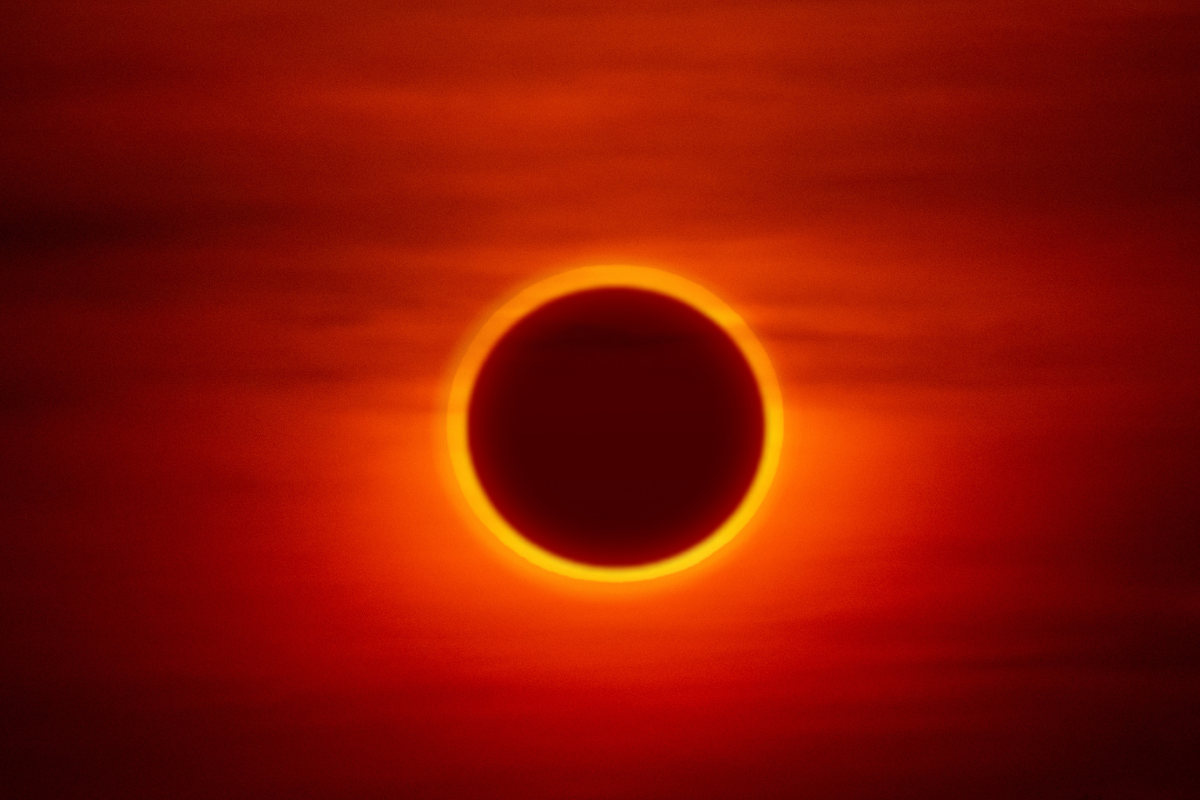
Experience the 2027 annular “ring of fire” eclipse in Patagonia with astronomer Jamie Carter, exploring Buenos Aires, Bariloche and El Maitén while enjoying guided stargazing. Find out more
|
| |
|
Credit: NASA, ESA, Dennis Bodewits (AU) |
This picture was supposed to be of one comet. Instead, it’s four – and that’s a lucky break for astronomers. It’s the best picture ever taken of a comet that’s just broken up, because it’s extraordinarily hard to predict when one’s going to crack and we generally can’t turn telescopes quickly enough to face one that’s just cracked. But when astronomers pointed the Hubble Space Telescope at this one, called C/2025 K1 (ATLAS), they didn’t yet know that it had fallen apart. Its crumbling means that we can get an unprecedented look at its insides, which are made of pristine ice from the outer solar system that has almost certainly been around since the time when the planets were just forming. It also exhibited some really strange behaviour, which you can read more about here.
|
|
|
The true nature of dark matter
|
Daniel asked, “Could dark matter be another family of fundamental particles rather than just one type of particle?”
In short, absolutely! I actually favour this idea, because dark matter makes up so much more of the stuff in the universe than regular matter, and it seems extremely unlikely to me, just based on intuition, that it would all be just one type of particle. There are, of course, some limits on what it could be, based on all the ways we’ve looked for dark matter particles and not found them, but there could be many types of particles that still lie within those constraints.
The reason we tend to talk about dark matter as a single type of particle is that it is the simplest solution, and so far, there’s not much reason to complicate things beyond that. The more extra particles (and accompanying forces) we add to our models of dark matter, the more observable phenomena would be affected, and right now the effects that we see could plausibly be caused by just one type of dark matter particle.
Nevertheless, there’s not really any evidence either way at this point. Particle physicists and cosmologists are constantly coming up with new ways to hunt for dark matter, and those methods include some that are looking for entire families of particles. The best option here is to keep an open mind. |
|
|
Get one year of unlimited digital access for just €99 to expand your understanding of the world, from quantum breakthroughs to environmental challenges. Subscribe now
|
| |
|
|