
|
 |
This is a public post so please share it widely. If you enjoy this newsletter, I hope you’ll consider upgrading to a paid subscription.
For those who don’t want a Substack account, you can keep Off Message going with a donation. All support is appreciated, and donations of $75 or larger come with a comped annual subscription—all content unlocked and emailed to the address provided.
Donald Trump's Plan To Steal Or Destroy Everything
We should assume it's underway, starting with the Epstein files.
|

| |||||||||||||||


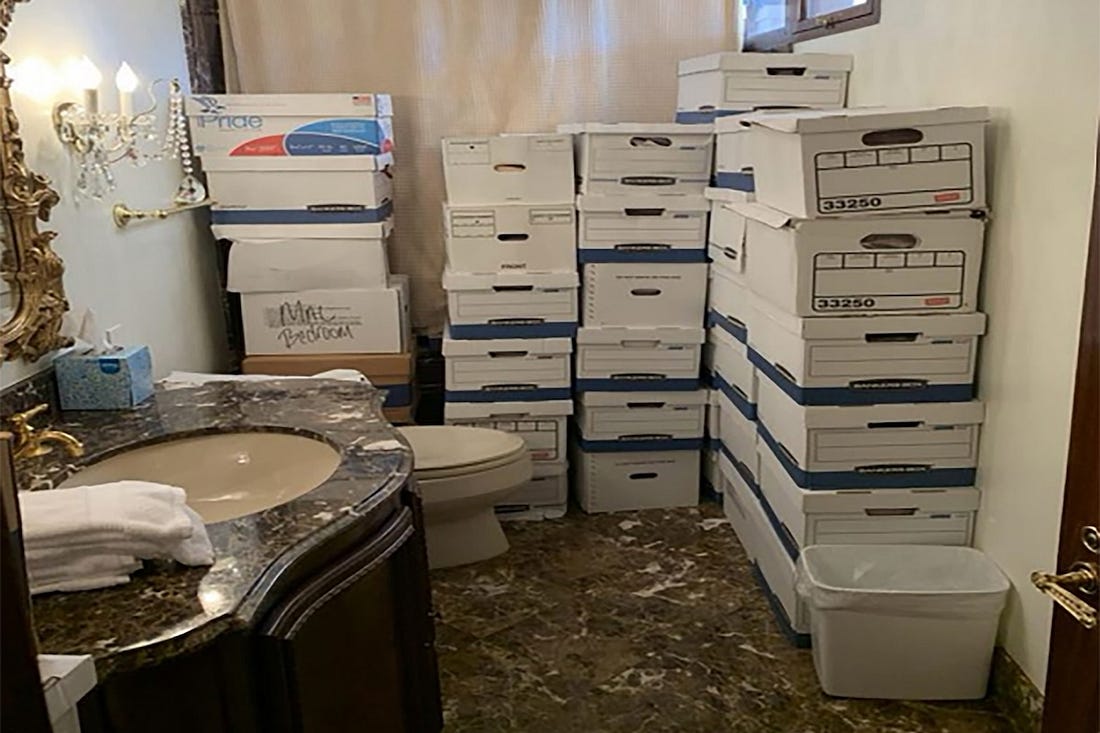 |
Donald Trump now claims to own all of his presidential records. To be more precise, his Justice Department’s Office of Legal Counsel, which interprets law for the entire executive branch, recently opined that the Presidential Records Act is unconstitutional, and thus that any government documents that cross the president’s desk, or pertain to his work, are his to keep, unless he chooses to leave them with the National Archives.
DOJ published the opinion on April 1, but it’s no joke, and the political class, consumed by war and myriad other dramas, are not making enough of it. Trump has asserted total political control over the department, which means this opinion was written at his request or insistence, or because he made clear he needed impediments to stealing presidential records removed.
Diligent legal thinkers, all of whom understand this opinion is bullshit, will nevertheless explicate its defects at length, because calling something “bullshit” doesn’t do much work in court. But for our purposes, we can dispense with the fiction: This is bullshit because the president works for the public, not the other way around; he is no more entitled to make off with our documents than you’re entitled to charge a Ferrari to the company credit card.
For now this is “only” an opinion. The Presidential Records Act has not been overturned by any court, nor have the merits of the OLC opinion yet faced the scrutiny of any judge. But the executive branch typically adheres to OLC guidance up until such time as a judge orders otherwise (or Congress acts, or a new administration takes over). Which means millions of documents are endangered right now. Some may have already disappeared.
And we should suspect the worst, because this action only really makes sense as a fabricated legal defense against actions Trump and his subordinates have already taken or intend to take imminently. There was no reason for Trump to do this unless he means to make off with or destroy a large number of incriminating or valuable public records in short order—not merely at the end of his term. If Trump had sincere, above board motives, he could have challenged the Presidential Records Act in court directly, rather than make a lawless assertion of power and wait for litigants and judges to stop him. The reason an administration of such low character would do this now, years before Trump leaves office, is to begin the process of burying or destroying or privatizing records right away—many months before Democrats regain control of Congress.
Do not be shocked if this devolves into a fact-finding inquiry to determine which documents were destroyed or spirited out of the government between the publication of the opinion and its enjoinment or withdrawal.
In a normal presidency, it’s perfectly ordinary for outgoing presidents and archivists to haggle at the margins over what constitutes a presidential record versus a personal one. Thus, if Trump wanted to keep certain documents, he could make an ordinary claim to them. The existence of the opinion is evidence of serious irregularity in and of itself. And, more importantly, we weren’t born yesterday.
Trump shredded documents routinely in his first term, forcing White House employees to salvage them from the trash and hand them off to records keepers to be reassembled. At the end of that term, he stole a bunch of government documents, including state secrets, and concealed them from the government at his Florida palace. Federal prosecutors concluded he did this at least in part for personal financial gain. He’s spent the past year and three months looting the federal government in broad daylight. And even if none of that had happened, the opinion is so sloppy and appeared so abruptly that we must infer ulterior motives. There’s almost certainly more driving this than a pissing contest over the merits of an old indictment, and it certainly doesn’t reflect a sincere dispute over constitutional interpretation. The frivolousness of the opinion suggests it’s doing work Trump needs done now.
The picture looks worse when you zoom out. This isn’t an isolated assertion of personalist power over a small number of documents, it is part of a larger legal scaffolding that Trump could and surely will interpret faithlessly, to provide him dominion over basically every document in the possession of the U.S. government. The text of the opinion might facially pertain to presidential records, and nod to distinctions between presidential records and agency records. But what in Trump’s history suggests he respects these distinctions?
He’s the unitary executive, with absolute immunity from criminal accountability for actions he takes that touch on his official duties. If (hypothetically) he and his advisers have left a documentary record of their Epstein files coverup—notes of meetings at the White House or directives from the executive office of the president to DOJ—those would be presidential records, and his interest in destroying them would be obvious. But what would stop a crook with unitary authority and official-acts immunity and a pliant judiciary from ordering DOJ to produce the entire Epstein files cache to the White House? And once Trump claims to have incorporated those documents into his own work product, why wouldn’t he simply deem them all presidential records and have the incriminating ones destroyed, or buried on the grounds of one of his golf resorts? (Also, apropos nothing, why did Trump abruptly fire Attorney General Pam Bondi, then obstruct her testimony under subpoena to Congress?)
If the presidential records aren’t ours, they’re his. If they’