Vote for the Best Literary Adaptations of the Last 50 Years
Round 4
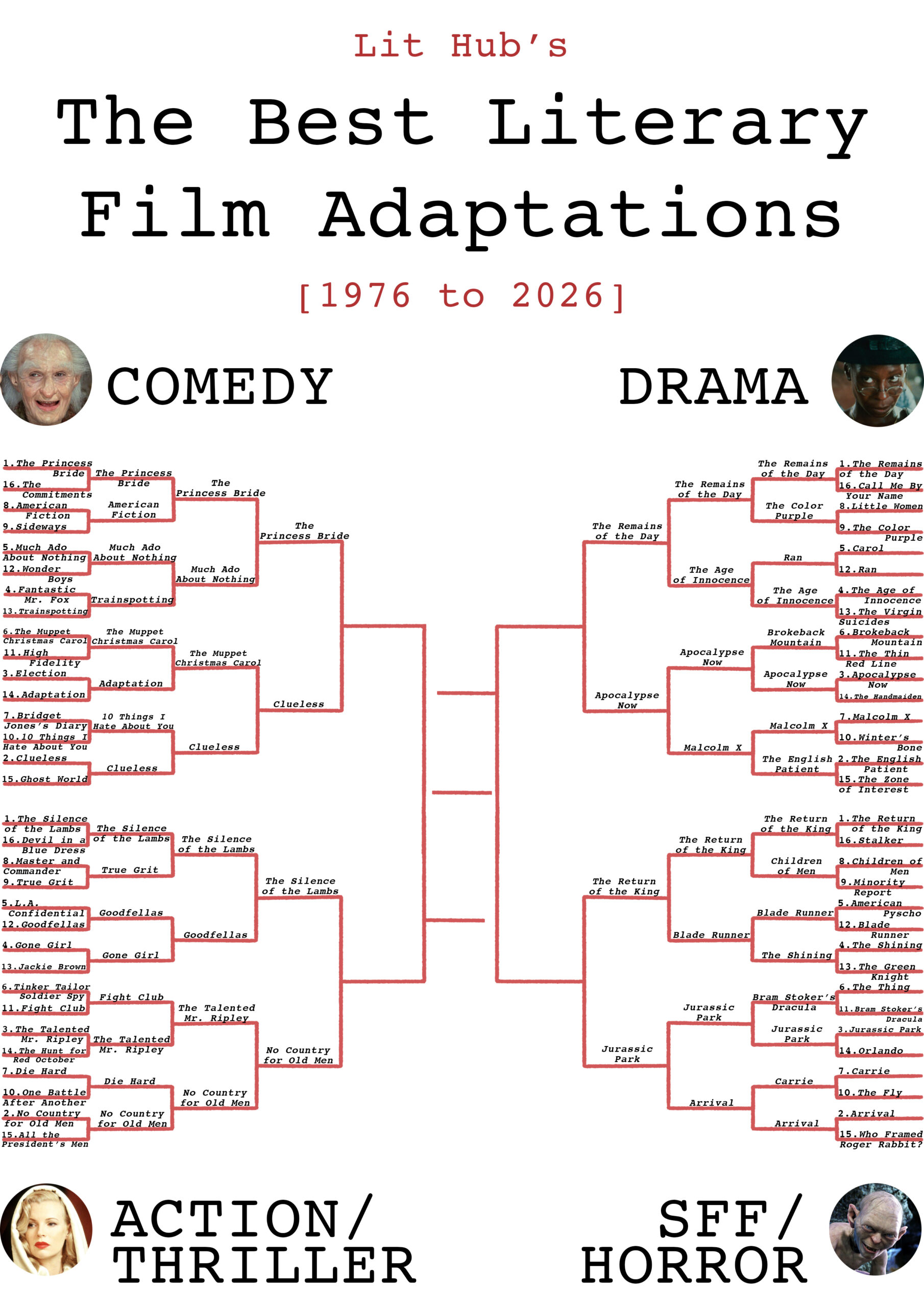
After tabulating yesterday’s results, we’ve arrived at the quarterfinals. The end of the bracket is shaping up to be just the hits, all killer and no filler. Each of our four top seeded movies are still in contention, and up against exclusively #2s and #3s. The underdogs put up a good fight though: The Talented Mr. Ripley, Blade Runner, and Arrival all came very close to making it to the next round.
Heartache abounds. Shakespeare is out, Scorsese is out, and the Muppets are out. Personally, you can find me sitting outside of The Age of Innocence’s Paris apartment, remembering what we once had and wondering what might have been…
Looking at the final eight, there aren’t a lot of quiet movies left, with the very notable exception of The Remains of the Day. Though I suppose you could make the case that the suppressed emotions of that book and film are larger and deadlier than Dr. John Hammond’s genetically engineered T. Rexes.
It’s not just giant animatronic dinos stomping around and ominously rippling water—there are a lot of monsters in the remaining movies. We’ve got Hannibal Lector, the Uruk Hai, Christopher Guest’s Count Tyrone Rugen, the brutal American War Machine, and 1930s Britain’s most dedicated Nazi sympathizers. In particular, the action/thriller showdown between Silence of The Lambs and No Country For Old Men features two iconic screen psychopaths, and is reminding me of our best villains in literature bracket.
Looking just at the question of how best to adapt a book, we have an interesting variety of approach still in the mix. There are inventive adaptations that take big swings, like Clueless and Apocalypse Now which both explore their source’s themes and relationships by transposing them to new contexts. These are up against more faithful, one-to-one adaptations like Remains of The Day or Lord Of The Rings, films which succeed by replicating not just the specifics, but by managing to replicate something essential about the experience of reading these novels—quiet introspection in the former and the vast sweep of an epic in the latter.
There’s no right way to adapt a novel. But there can only be one winner of our bracket. Let’s vote.