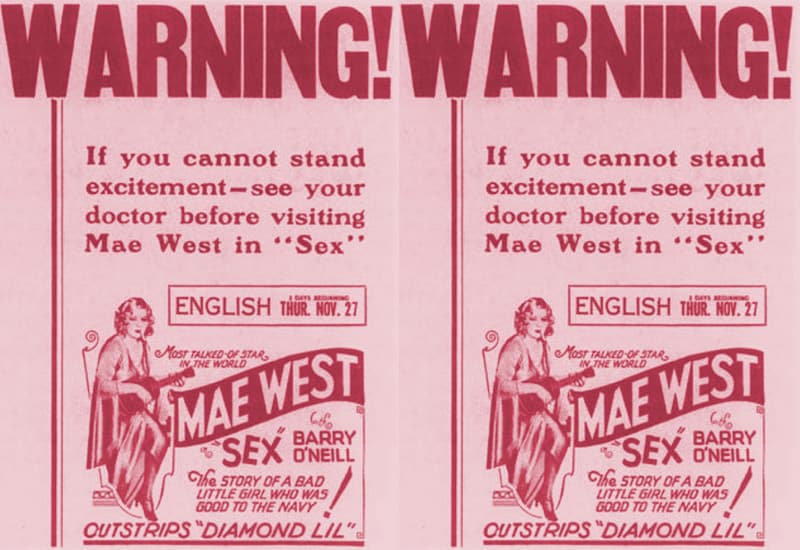
On February 9, 1927, Mae West was arrested after a performance of her play Sex, which she had written and in which she starred. In fact, the New York Police Department’s Municipal Vice Squad arrested the whole cast, and carried them off in black vans.
“I was the first one ever to say ‘sex’ on stage,” Mae West told Anjelica Huston and Peter Lester in 1974. The play in question, which West wrote, was “a dramatic play with a jazz band in it,” originally called Follow the Fleet, she told them, but when she brought it to the director, Edward Elsner, he couldn’t stop saying how sexy it was. “I was hearing the word sex so much I was beginning to like it,” she said. “‘Gee,’ I thought, ‘this might be good for the title, Sex.’ So I tell my manager I want to change the title to Sex. He says, if only we dare… so we do! Then there was a lot of trouble.”
At first, it was only publicity trouble. “When it opened, the newspapers wouldn’t use the word,” West said. “They said, ‘Mae West in that certain play.’ Finally we had to hire those sticker guys, you know. You’d leave your car for ten minutes and there’d be Sex all over it.”
But eventually, when the play had been running for almost a year, the complaints piled up and the morality hammer came down.
On April 19, 1927, West and two producers were fined and sentenced to ten days in jail, while the nineteen other cast members were given suspended sentences. The official crime? Giving a performance that “tended to corrupt the morals of youth and others.”
“The jury was instructed by the Court to render a verdict based upon their conception of the moral standards of today as they exist in this city, of which they were representative citizens,” the trial Judge commented. “Their verdict, based on this standard, ought to silence forever those who are continuously maligning the fair name of New York.”
He also described New York City as “the most moral city in the universe.” As for West, he argued that “she seemed to go to extremes in order to make the play as obscene and immoral as possible.”
West was sentenced to ten days in jail, but was released after eight, no doubt for charming behavior. Of course, the publicity from the whole affair only made her more famous. “She knew that in showbiz, crime paid,” writes Frank Rich. “Festooned with white roses, she rode a limo to incarceration on Welfare Island and boasted of wearing silk underwear throughout her eight-day stay there. When Liberty magazine paid her $1,000 for an exit interview, she used it to start a Mae West Memorial Library for female prisoners.”
The writing was on the wall. Soon she’d be a superstar.