This issue: Filmmaker Jane Schoenbrun tells us about their first novel, Helen DeWitt is done explaining Windham-Campbell-gate, and a party report from Lena Dunham’s book launch. |
|
|
| Senior newsletter editor, New York |
|
|
Jane Schoenburn’s Debut Novel Might Have Been a TV Show A chat with the filmmaker and author.
|
Photo-Illustration: New York Magazine; Photo: Hogarth |
|
|
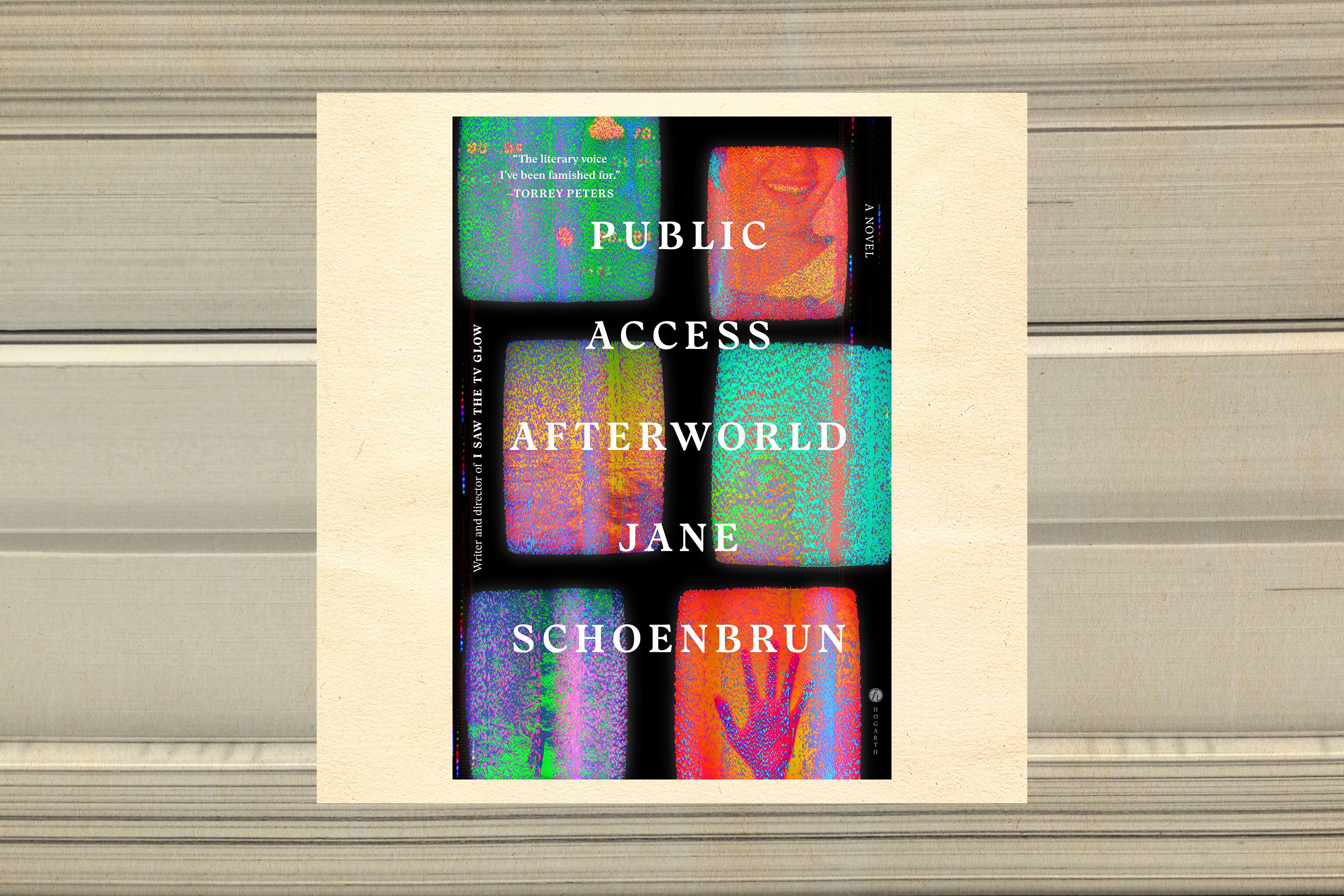
Jane Schoenbrun loves genre-bending. Their 2024 solo directorial breakout hit, I Saw the TV Glow, and 2021’s We’re All Going to the World’s Fair incorporate references from slasher movies, sci-fi dramas, and teen shows of the early aughts to build sweeping allegories for trans self-discovery. This fall, they’ll expand their cinematic universe with their debut novel, Public Access Afterworld. Out in October, it’s a reality-warping epic about friendship, transformation, and the internet that stretches across decades and dimensions. Earlier this week, Schoenbrun and I chatted about the book cover, revealed for the first time here on Book Gossip, Schoenbrun’s novel-writing process, and what to expect from their new horror-comedy film.
Can you tell me a little about the cover design? Was this always the one you wanted?
We honestly did go back and forth a ton. That design was there from the very beginning and I was quite excited by that one. We had a ton of beautiful options, but that one just felt like such a perfect mix of genre and something a bit more literary. There was one that we all really liked that reminded me of the aesthetics of my first film, We're All Going to the World's Fair. There was a hand reaching through a screen with famously bisexual lighting behind it, but I'm really happy with where we landed.
The novel is narrated in episodes. Is it true that this book was initially conceived as a TV show?
Yeah. I had planned out and even written 1,600 pages of scripts of this story as a TV show. No one asked me to do that. I just couldn't stop myself. Literally the moment that I finished TV Glow, I just obsessively started writing. All of these different ideas and this vast mythology and all of these different characters, it all just started forming into these episodes, which is the structure that the book takes. I think of it now as a very early and nascent draft of the book. I love TV so much. I just can’t imagine writing a pilot for something and being like, Well, I'll figure out what happens next. I just couldn't help myself but map out this whole story in intricate and epic detail.
How did it become a novel instead?
I understood that no one was going to give me the hundreds of millions of dollars necessary to make this story into a film or TV show. I also understood that the freedom I needed to get my vision across as clearly as possible would only be possible by writing it as a book. There was this terror in the beginning when I was thinking, Oh, maybe I should try to make this as a TV show, but if I write a pilot and then the network gives me a ton of notes and picks it up, then they own it. Like, oh my God, this has formed in my head as this epic, this opus that years and years of work had gone into, and I was terrified of that being corrupted or co-opted or only partially ever finished.
After years of writing film scripts, what was writing a book like? Was it different than you expected?
I think my initial assumption going into writing prose was that I would get to speak a lot more to internal experience, and this to me was like, Oh, amazing! What freedom! I've been working in this medium for so long where all I'm allowed to do is show you images and action, but now, oh my God, I have words. I can create an interior monologue. I can talk about people's emotional experiences without having to just represent the external. But then what I found when I actually started writing is that I really dislike unearned internal monologue. I felt I needed to earn each moment that wasn’t pushing forward story and character. It was one of the crucial lessons for me, that just because writing allows you to look inward doesn't mean that it’s going to be earned.
I was very rigorous. I significantly changed my life to do it, and it very much was on faith. Right after I wrapped TV Glow, I moved out of New York City and moved upstate just to write it. I woke up every day and just sat at my desk and slowly chipped away at it for what ended up being years. I've been working on this since 2021. There were years of editing with my amazing and very patient editor to get it into this form that I think is ready for people. Public Access Afterworld is the third installment of your “screen series,” which began in 2021 with We’re All Going to the World’s Fair and continued with I Saw the TV Glow in 2024. How does this novel build on those previous works?
World's Fair is a film about there being something wrong and not quite knowing how to find a name for it. TV Glow is a film about what happens when you do find that name and this trauma and catharsis of realizing that there's something wrong that needs to change. The novels as I've planned them out are about what happens when that change is enacted.
You’re planning on turning this into a series, then?
Very much so. The first novel, Public Access Afterworld, is about coming into one's self as a body and as an artist. The second novel, which will be called The Cinematic Universe, I think of as about trying to figure out how to have a life after so many years only half inside of one. The final novel in this series, which will be called A History of Static, is about building better worlds within a bad one. When you add those three discrete themes together, that is my experience of these early years of living as a trans person: coming into oneself, getting over the trauma of a lot of years spent in the wrong body, and finally building worlds that might be more livable than the one we all live in.
Your upcoming film, Teenage Sex and Death at Camp Miasma, is playing at Cannes this year. What can you tell us about it?
I've described it sometimes as a Portrait of a Lady on Fire if it took place during a Friday the 13th sequel. Here’s what I'll tell you that I don't think people are expecting — I think it's really funny. It's kind of a comedy. And there's lots of blood and lots of guts and lots of sex. |
|
|
Helen DeWitt Doesn’t Care to Comment Further |
|
|
If you or anyone you know still frequents the site formerly called Twitter, then you’re likely already aware that two weeks ago, Helen DeWitt, author of the cult favorite The Last Samurai, used the platform to publicly air a grievance. The Berlin-based novelist had been awarded Yale’s Windham-Campbell prize of $175,000, but ultimately declined the money because she felt the promotional asks of the winners — including a podcast appearance, attendance at a six-day conference, a piece for the Yale Review, and full-day video shoot — were impossible for her, a distraction from writing, and a misrepresentation of what was supposedly a “no strings attached” grant. Her thread, which linked to a nearly 6,500-word blog post detailing her back and forth with the prize committee, was timed to the announcement of the actual winners of the prize. In it, DeWitt exhaustively details her back and forth with Windham-Campbell Literary Prize program director, Michael Kelleher, and lays out the many obstacles — ranging from an inability to find Wi-Fi in Amsterdam to a mind struggling with executive function after 15 months of caring for her mother — that would prevent her from fulfilling her duties as a winner. She also takes shots at her publisher, Dalkey Archive Press, for the delayed publication of her last book, Your Name Here.
The saga sparked one of the most polarizing online lit debates in the collective, internet-impaired memory, fueled at least in part by DeWitt’s own replies to the myriad threads about it. Posters breathlessly defended DeWitt as a “mad creative genius” of the type who shouldn’t have to contort herself to adapt to the overprofessionalization of the writing world. (In her blog, DeWitt compared herself to Artaud, Beckett, Proust, Plath, and Pynchon, among others, arguing that they never would have been asked to do what she was asked to.) Others joked that DeWitt had helmed a PR blitz that overshadowed the actual Windham-Campbell winners. Others still expressed concern, referencing the writer’s documented history of mental illness and a suicide attempt. But only those who read till the end of DeWitt’s blog knew that Kelleher had been willing to negotiate down the terms of her win: no podcast appearance, no conference, and a one-year deferral of the grant in exchange for a “60-90 second” video of DeWitt reading from her work. Ultimately, the author declined anyway, due, she says, to the fact that Kelleher asked her to sign paperwork that didn’t reflect these new terms. (Kelleher did not respond to Book Gossip’s request for comment.)
Then, nearly a week later, DeWitt announced that she had been awarded the exact same sum by the Emergent Ventures program at the Mercatus Center, a right-leaning think tank housed by George Mason University, “with no requirements of any kind in the way of publicity, attendance at meetings, or anything else.” In his blog post about the grant, libertarian economist and chairman of the center Tyler Cowen thanked Stripe co-founder Patrick Collison “for enabling this.” The Center is known to have been originally founded with help from Charles G. Koch — who also sits also on the board — which kindled charges that DeWitt had accepted shadowy money. Last year, DeSmog, an international outlet devoted to climate-change news, reported that a U.K. charity served as a front for a nearly million-pound donation to the Mercatus Center by Koch, and it continues to receive significant support from the Kochs.
When I reached out to DeWitt for comment, she offered to answer to some questions over email, then, after reading them, said she wouldn’t be able to do it. When I asked if a call would be an easier option, she replied generously with several paragraphs not directly responding to the questions but touching on them. She followed up to make sure they wouldn’t be misrepresented as direct responses to my original questions. A few days later, I received another email asking me not to quote her at all.
Cowen, for his part, wasn’t available for an interview (“on the run this week”), but he confirmed that the award was not created specifically for DeWitt and that there would be other winners. He said that the money for this particular grant came from Collison and told me he’s been a fan of DeWitt’s for years, linking to an old blog post about Lightning Rods, in which he called her a “national treasure” whom we have “driven to Berlin.” —Jasmine Vojdani
|
|
|
Lena Dunham Was Hard to Spot at Her Own Soiree |
|
|
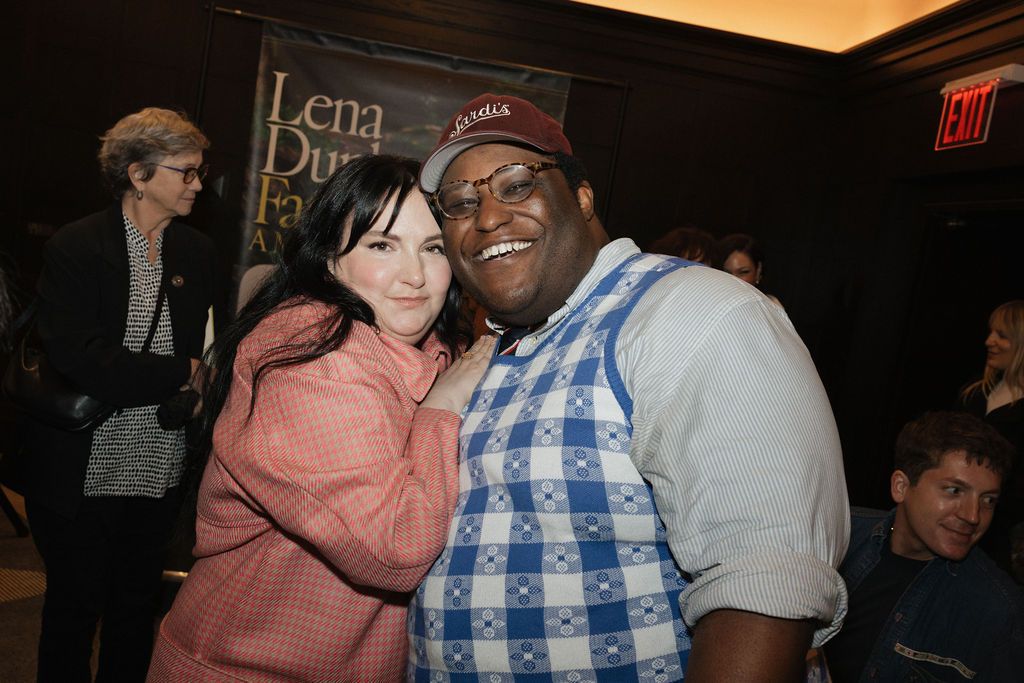
On a warm night in midtown, when it finally felt like the city had turned a seasonal corner, I entered a room of Wonderland proportions in the Algonquin hotel. By that I mean that the dark-wood-paneled room was improbably sized, far longer than it was wide. The effect was of a receding intimacy, and by the time Lena Dunham took her seat at the far end of for a Q&A with her C-Word podcast co-host, Alissa Bennett, she remained completely out of many attendees’ sight. (A colleague later admitted that she didn’t get to see what Dunham was wearing: a pink-and-tan houndstooth dress with pleats, pink pumps, and white tights echoing the upside-down set of legs on her book cover, evocative of Alice falling down the rabbit hole in her mary janes.)
Scattered bar tables held white-and-yellow bouquets and copies of Dunham’s new memoir, Famesick, the greatly anticipated subject of last Monday’s private celebration. The flyer had invited guests to “get famesick on drinks, hors d'oeuvres and gentle gossip … Just like Dorothy Parker would have wanted.” The book took Dunham — creator, director, and star of HBO’s Girls, and the eternal subject of discourse — eight and a half years to finish. In it, she ties the story of her rise to fame in her early 20s to a parallel narrative of behind-the-scenes illness, which she believes was exacerbated by the sheer weight of all the pressure she was under. It all culminated in Dunham checking herself into rehab for a Klonopin addiction and then moving to London, where she now lives.
The bar was fittingly geared toward sobriety. Its headliner was “Not That Kind of Mule,” a strawberry-and-mint mocktail referencing Dunham’s divisive 2014 memoir, Not That Kind of Girl. When a magazine writer I met on line ordered a white wine, the bartender asked her to clarify whether she wanted alcohol. I downed a mock mule while catching up with a couple of friends who had been reading about a cat named Hamlet that, like Parker’s ghost, allegedly stalks the halls of the building. Then an unassuming bearded man in a brown cap floated by — “a Safdie,” said an editor friend, unsure which one. It was Josh (Famesick, page 5), and as he and Zadie Smith (page 242), looking debonair in a white blazer and aviators, filtered through the space, we registered our surprise that Dunham seemingly hadn’t thrown herself a more intimate party than this. Her parents, the artists Carroll Dunham and Laurie Simmons, had also joined the thickening crowd.
For the most part, even the VIPs in the room had yet to get their hands on Dunham’s memoir. Galleys had been under formidable lock and key. Madeline Leung Coleman, my colleague who reviewed the book, had to sign an NDA just to get a PDF. Freelance book critic Gideon Leek, squished against a wall, agreed that the rollout was all “very mysterious. She’s doing a press tour where she’s on random Substacks — I read her on Health Gossip.” Dunham is a legendary figure for many millennials, but Leek had a personal tie-in. “I went to Oberlin after she had gone there in the 2010s and people were so against her, and now she's cool again. It's possible I'm too cloistered in Brooklyn and on Twitter, but in my mind Girls is back.”
There were no Girls girls in the house, unless you count Wing founder Audrey Gelman (Famesick, page 34), the real-life inspiration for Marnie Michaels. Near the entrance, I spotted Ashley Avignone — known bestie of the person winkingly credited as “TayTay” in Famesick’s acknowledgments — leaning against a banquet table. I asked her what part of Dunham’s life she was most excited to read about. “I know her personally, so I’m just excited to put it all together,” she said. “I was trying not to read the excerpts. I really want to take the whole thing in—”
“Do you know if it’s possible to buy the book somewhere?” interrupted a brunette with hunger in her eyes. The two copies left on the table were free, I told her, and probably the last. She and another woman slid between me and Avignone to snatch them up.
Anyway: Avignone hasn’t rewatched Girls since it first aired, but said she was “a little nostalgic for — it feels crazy saying that’s old New York now, but it kind of is. I would probably see me in watching.” Which character did she see herself in most? “I feel like everyone is a mix of all of them,” she said diplomatically. When I pressed for more specifics, she cracked immediately, as if she’d been waiting to confess. “I guess Marnie,” she said with a smile. I assured her that she was far from the only one.
By then creative director Dione Davis, the critic Naomi Fry, Cosmo and Seventeen editor-in-chief Willa Bennett, some Booktokers I recognized, and Jeremy O. Harris, who was flying through the event with his young niece and nephew en route to a Gaga concert, had arrived. “Lena’s siren call of being if not the voice then a voice of a generation forced so many people, myself included, to pick up a pen and embarrass ourselves,” said the playwright and director.
A hush then fell over the room, signaling the beginning of the Q&A. CNN style reporter Rachel Tashjian and model and woman–about–Dimes Square Meetka Otto snagged one of two available couches. Save for a few more chairs toward the front, it was standing-room only. Next to me, writer Lili Anolik leaned against the wall, then squatted. The lucky few with copies of the book clutched them to their chests. A source later told me that she saw Smith gallantly tuck a woman’s tag back into her shirt during the discussion.
Up front, Dunham drew easy laughs, her comedic timing well intact. There was a recurring bit about an alternate universe in which she became a veterinary assistant. She joked that people sure had a lot to say about Girls when it aired, given that the show got the same amount of viewers that “Emma Chamberlain gets in a makeup-routine video for the first 13 seconds.”
When Bennett asked Dunham how her audience had changed over time, Dunham fawned over her friend, whom she first met in college in a class called Fashion and Identity Formation. Bennett redirected: “Answer the question.”
“The best analogy I can come up with for writing confessional work and then putting it into the world is like: You have a party, you invite everybody over, it's beautiful,” Dunham later said. “And they're like, Now that you invited me over, I live here. I get my mail here and this is where I'm going to stay. And you're like, Well, I did tell them all to come at six, and I didn't say that the party ended at any particular time. So I guess they do live here and I just got comfortable with that.” But that was easier said than done. Dunham explained that she began to feel like she didn’t feel like she could ever give the public enough: “I think it started to be like, Here, take a piece of me.” She added, “but it was at a great cost to my own sense of self.”
“I think it’s really hard to want to be liked,” Bennett offered. “I want it so bad, guys!” exclaimed Dunham. “I don't really mind if people don't like my work, but if I talk to someone and I feel like I've left a negative impression, it can really keep me up at night.”
The author thanked everyone for being there, then was immediately but respectfully swarmed by fans and friends. As guests began to circulate again, I approached Alison Roman, who was wearing a silky black top and a low bun. She didn’t think the stakes of the second memoir were as heightened as Dunham’s first go around. “I think she laid so much bare already in front of us that it’s like, What else could upset people in the same way that it did the first time? It won’t,” she said. “And if so, she’s ready for it.”
Nearby, Safdie and the author’s sibling, Cyrus Dunham, were talking to a third person I didn’t recognize. By the time I approached, Safdie brushed me off on his way to “say ‘hi’ to Lena,” who had disappeared out a side door. But comedian Larry Owens, a self-described Hannah in a Sardis cap and a two-piece by Rachel Antonoff (Famesick, page 105) reminiscent of the world’s most tasteful tea towel, was down to chat. “Everyone with a phone is in the public eye so we’re all at risk of being famesick in some way,” he said. I asked him if he thought the book would resonate with him on a personal level. He did. “I was just talking about this with my friend. What is the cost of this thing? Is the reward enough?”
Later, as the crowd started to thin out, I caught Smith, still in her aviators, by the door. The author appeared reluctant to talk at first, but then she told me how she first met Dunham when she had “a small baby and couldn't go to the movies anymore.” She and her husband had devised a method of keeping their baby alive in shifts while allowing each of them to catch alternating screenings: “I would go to the movies for the first showing, come home, and he would go to the second showing.” It was under these conditions that she saw Dunham’s first feature, Tiny Furniture, which she liked so much that Smith emailed Dunham through the movie’s website. Crickets — until, “months later, she was closing down the website and wrote me back,” she said. Smith also told me she had just rewatched Girls for the third time. “My only claim to fame is that I knew it was great at the time, unlike all these motherfuckers,” she said. “I always knew it was great. It remains great. It's a great show.” —J.V.
|
|
|
Notes From a Midnight Launch |
|
|
Last Monday, around 90 fans of Solvej Balle’s cult time-loop septology, On the Calculation of Volume, gathered to celebrate the release of its latest installation. The location was Le Pistol, an appropriately brainy Prospect Heights cocktail bar where the bartenders read theory. Staff from the Brooklyn Public Library, which co-organized the event, passed out library registration forms; Lofty Pigeon Books employees sold book copies; and attendees customized bookmarks with New Directions–themed stickers. “Is this László Krasnakorhai,” I asked, peeling off the face of an older man with a half-head of wintry white hair and a visage that conveyed suffering.
Since the initial English translations of On the Calculation released in 2024, the Danish books have become ubiquitous, appearing in virtually every major magazine and New York bookstore window display. I have never received so many congratulatory texts and remarks about a review of mine getting excerpted in a novel’s “select praise” section. A friend had texted before the On the Calculation launch saying that he would be covering it for the New York Times “Style” section, though that fell through; instead, I found my New York colleague Jeremy Rellosa and a team of photographers shooting for our “Lookbook” section. He was surprised to see me too.
Attempting to give him space, I beelined toward New Directions EIC Barbara Epler. She was sitting at the bar drinking beer, a twinkle of mischief in her eye. “They’re in an On the Calculation book club with Laurie Anderson and Nicole Krauss,” she said, motioning to her companions, who later revealed themselves as the visual artist and Anne Carson collaborator Rosanna Bruno and Jennifer Charles of the band Elysian Fields. Epler told me that Balle had officially outsold ND’s former bestseller, Tennessee Williams. The conversation drifted to Helen DeWitt’s new grant (“It’s Koch money,” Epler groaned) and the rings Epler had soldered for the late Muriel Spark. “I feel like it’s only time that Dua Lipa picks a New Direction book for her Service 95,” I blurted, suffering from a chronic affliction that makes it possible for me to go a week without mentioning the pop star. Epler offered that a “Kyle Jenner” had sold tens of thousands of copies of Amparo Dávila's The Houseguest by posting it on Instagram. (It was Kendall.)
By then, it was late. Jeremy pulled Epler and Bruno for a “Lookbook” photo while I chatted with some cheery Brooklyn Public Library staff outside the bar. When the clock struck midnight, about 20 party attendees gathered in a circle outside to read aloud from the newest On the Calculation of Volume. I asked one of the Le Pistol staffers what’s next on their theory discussion list; it’s Deleuze. —Cat Zhang |
|
|
|