A dispatch from the Google Cloud Next conference
 

Artificial Intelligencer

Artificial Intelligencer

What matters in AI this week


By Kenrick Cai, Technology Correspondent

Reporters covering the keynote of the Google Cloud Next conference in Las Vegas on Wednesday were greeted by signs on tables reserved for the press: “We recommend closing your laptops during any immersive moments.”

The immersive moment turned out to be a machine that dusted down a light coat of snow from the ceiling of the packed 12,000-seat arena as Olympic gold medalist Shaun White made a surprise entrance on stage.

White and a Google Cloud engineer demonstrated how Google’s AI tooling could analyze a video of White performing a daredevil stunt, and pull data such as flight dynamics and rotational velocity that could be useful to help athletes analyze split-second movements.

“This is really going to help not only the next-generation athletes learn new skills, but also help the fans at home understand the sport better — and not just for snowboarding, but I think sports globally,” White said.

The decision by Alphabet, Google’s parent company, to hire White for the event can be viewed through the lens of a broader push to show investors and customers how it is uniquely positioned to succeed in the race around enterprise AI. On stage, the Googler talked about how White’s video analysis was made possible using an AI model trained by Google’s DeepMind AI lab and Google’s own TPU chips.

It’s the same argument Google has been using for years to market its differentiation against hyperscaler rivals Amazon and Microsoft. But as AI labs enter the crowded competitive arena, White’s partner on stage also stressed some other points, such as the ability to train large amounts of data and Google’s enterprise agent platform.

In this week’s issue, we look at how Google is positioning itself for the changing competitive landscape in enterprise AI. Plus: could AI ravage the design industry? Scroll on.

Which cloud provider do you find best positioned for AI? Share your thoughts by emailing me or following me on LinkedIn. Forward this newsletter to your friend who would benefit from weekly news and insights on AI. They can also subscribe here.


Read our latest reporting in tech and AI: 

  • Exclusive: Meta to start capturing employee mouse movements, keystrokes for AI training data
  • Exclusive: SpaceX says unproven AI space data centers may not be commercially viable, filing shows
  • In the AI era, Apple's strengths may become its constraints
  • Anthropic plans to provide Mythos access to European banks soon, sources say
  • Software makers' best may not be good enough as AI fears mount
 

How Google sees the enterprise AI race

People walk next to the Google Cloud logo in Barcelona, Spain, March 4, 2025. REUTERS/Albert Gea/File Photo

At Google’s annual cloud conference in Las Vegas, the search company is looking to frame its unique role in the enterprise business as a mature and production-ready supplier of AI agents to power business applications.

Until recently, the battle for AI in the enterprise has been one dominated by hyperscalers and old-school software firms. But frontier AI labs Anthropic and OpenAI are increasingly moving downstream from models to applications, shaking up the field’s traditional focal points. Generative AI’s uncanny ability to write code has stoked widespread talk of AI’s potential to replace the tech workforce. Google will have more to say on the topic, but that is likely to come later this year at its I/O developer conference in May.

In my conversations with Google Cloud CEO Thomas Kurian ahead of the conference, he displayed a pragmatic self-awareness in identifying where Google Cloud is ahead, and where it is not.

“Some people are using the models to write code. They can use Gemini and also other tools like Claude,” he said. “But in other cases, we have unique things. There’s capability in the platform that nobody else offers.”

The attention is on Gemini Enterprise, a suite of tools Google provides for its cloud customers to deploy and manage AI. On Wednesday, Google announced that it was killing the name of Vertex AI, a tool that lets customers pick and choose which AI models to use, and folding the product under the Gemini Enterprise umbrella. In other words, a customer who chooses to use an Anthropic model in Google Cloud will be using Claude in Gemini Enterprise. 

Google’s move suggests how it plans to compete for enterprise dollars: by building a moat around its software. Part of what makes Gemini Enterprise unique, Kurian said, is its governance capabilities for customers to manage security and compliance. As OpenAI and Anthropic enter the market with plug-ins and tools that let customers connect their AI models to other pieces of enterprise software, Google is responding by touting a richer, more enterprise-grade feature set.

“I think the model companies will build models that we will partner with them to distribute, and we will help enterprises access the intelligence of those models,” said Michael Gerstenhaber, a vice president of product whom Google hired away from Anthropic last year, in an interview.

As Google Cloud’s competition changes, it is stress testing what a symbiotic relationship with the AI labs will look like. Alphabet is one of the biggest investors in Anthropic, which is in turn encroaching on Google Cloud’s customer base. But the option to use Anthropic’s models in Google Cloud is also part of what keeps customers around. Onstage during the keynote, Kurian touted Google’s own models such as Gemini, video model Veo, and audio model Lyria — then specifically shouted out the new availability of Anthropic’s latest frontier model.

Brian Delahunty, Anthropic’s former head of engineering, whom Google also hired in 2025, described the AI race like a war with multiple fronts.

“You can be a model company; you can be an integrator; you can be a (software-as-a-service) company; you can be Google — a hyperscaler with models and infrastructure,” he said. “But I think that it doesn't mean you have to actually compete in every particular area that AI is going.”


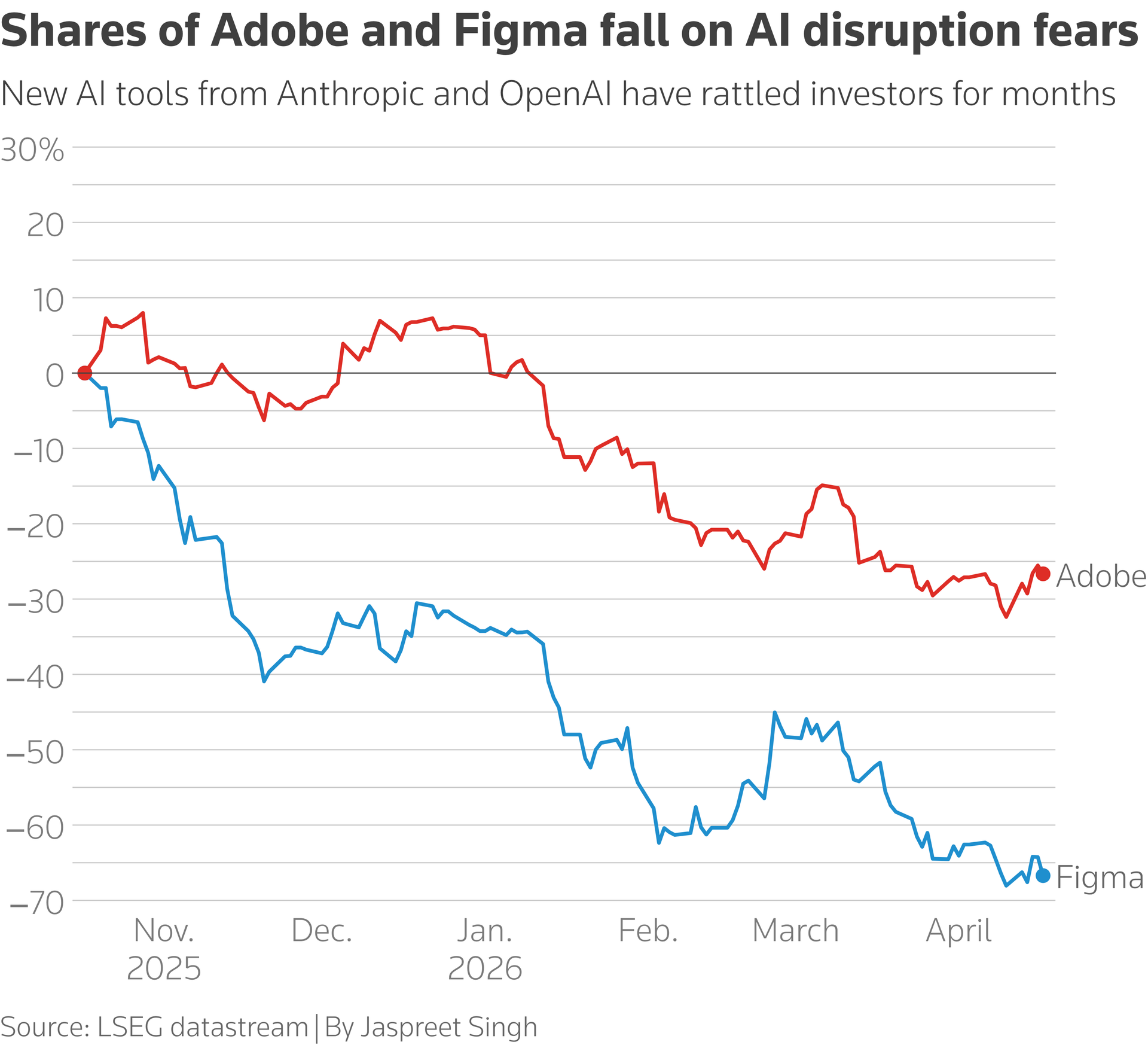
Chart of the week


Adobe held its annual conference across the Las Vegas Strip this week. The design company used the occasion to launch — you guessed it — AI tools for corporate customers. Adobe’s new software suite includes features for automating and personalizing digital marketing functions.

Just last week, Anthropic unveiled Claude Design, which can turn a text prompt into ready-made visuals, such as slides or design prototypes. In Silicon Valley, design is gaining traction as a potential new domain in which AI companies will duke it out, as has been happening with coding. Google, for example, has already teased the ability of its Nano Banana image generator to create studio-quality designs.

Existing design software companies like Adobe, Figma and IPO-hopeful Canva must therefore race to prove their defensibility against mounting pressure from Wall Street. Yet they face a delicate quandary: the companies that threaten to take their throne are the very ones with which they must strike partnerships. Claude Design integrates with Canva, for example, while Adobe’s new products can plug into Anthropic and OpenAI. It’s another version of the “frenemy” relationship that is growing between Google and Anthropic as the latter moves into the application sphere.


This newsletter was edited by Lisa Shumaker


Sponsors are not involved in the creation of newsletters or other Reuters news content. Advertise in this newsletter or on Reuters' website

LiveIntent Logo
AdChoices Logo
 

Reuters Artificial Intelligencer is sent once a week. Think your friend or colleague should know about us? Forward this newsletter to them. They can also sign up here.

Want to stop receiving this email? Unsubscribe here. To manage which newsletters you're signed up for, click here.

This email includes limited tracking for Reuters to understand whether you’ve engaged with its contents. For more information on how we process your personal information and your rights, please see our Privacy Statement.

Terms & Conditions


© 2026 Thomson Reuters.