Learn why many clinicians still feel uncertain in complex cases—and what FMU teaches that most programs leave unclear.


Dear Friends and Colleagues,


Many clinicians today know more functional medicine than ever before.


They understand disease patterns.
They understand contributory factors.
They understand lab interpretation.
They understand nutrition, supplements, and protocols.


And yet, when a complex chronic patient is sitting in front of them, many still do not feel fully clear on one of the most important clinical questions of all:


“What should come first in a complex case?”


That is the real issue.


Because in layered cases, the problem is often not a lack of knowledge.


The problem is the lack of a clear, repeatable system for deciding:


  • what comes first
  • what must stabilize before deeper work
  • what should wait
  • what the patient is actually ready to handle


That is the missing clinical decision layer.


And that is exactly why I built FMU Clinical Sequencing Engine™.


I recorded a short 2-minute video on this because it is much easier to see than to read.

[Watch the 2-Minute Video]


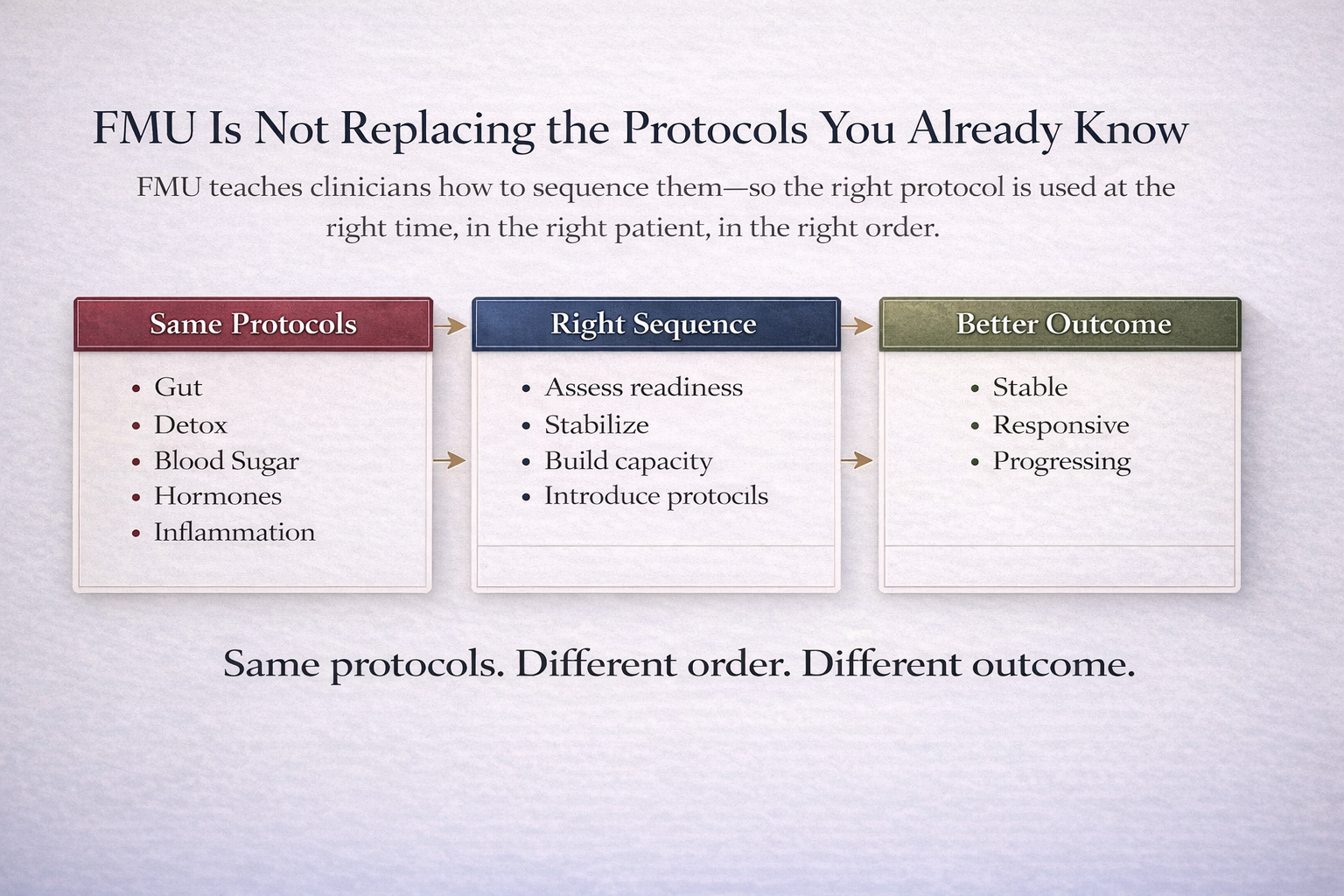
FMU Clinical Sequencing Engine™ is not about replacing functional medicine.


It is about solving one of the biggest gaps many clinicians still quietly struggle with:


how to move from knowing a great deal
to deciding where to begin


Because when that layer is missing, even a thoughtful clinician can still:


  • try to address too many things at once
  • over-test
  • over-layer the opening phase of care
  • introduce the right treatment at the wrong time
  • and end up with cases that become more reactive, more confusing, or more stalled than they should


That is why many clinicians still feel uncertain in complex cases.


It is not because they are not intelligent.

It is not because they have not studied.


It is because many have been taught what to look for, but not always how to determine what should lead the case.


That is the category difference with FMU.


For many clinicians, this is the missing reason otherwise good plans still become too broad, too layered, or too poorly timed in complex cases.


Most programs teach important functional medicine information.


FMU teaches the missing clinical decision layer that helps you determine what should come first in a complex case.


That is not a small distinction.


It is the difference between:


  • knowing many valid targets and still feeling uncertain
  • versus having a clearer clinical order-of-operations for how to move the case forward


At FMU, we absolutely teach the foundations clinicians expect from strong functional medicine education.


But we also go further by teaching:

  • sequencing
  • readiness
  • stabilization
  • what to test now versus later
  • what to delay
  • and how to think through complex cases with greater clarity and stronger clinical judgment

In other words, FMU was built not just to help you know more.


It was built to help you know where to begin, what must stabilize, and what should wait.


If that feels like the layer you have been missing, I encourage you to take a closer look at FMU:

[Learn More About FMU]


If you would like to review everything included in FMU in greater detail, you can do that here:

[See Everything Included in FMU]


And if you already know FMU is right for you, you can reserve your seat today with a $150 deposit:

[Reserve Your Seat with a $150 Deposit]


Enrollment ends April 27.


To your growth and success,

Dr. Ron Grisanti
Founder, Functional Medicine University


P.S. Many clinicians do not need more protocols first. They need a better way to decide what deserves attention first in a layered case. That is one of the central reasons FMU Clinical Sequencing Engine™ was built.



<