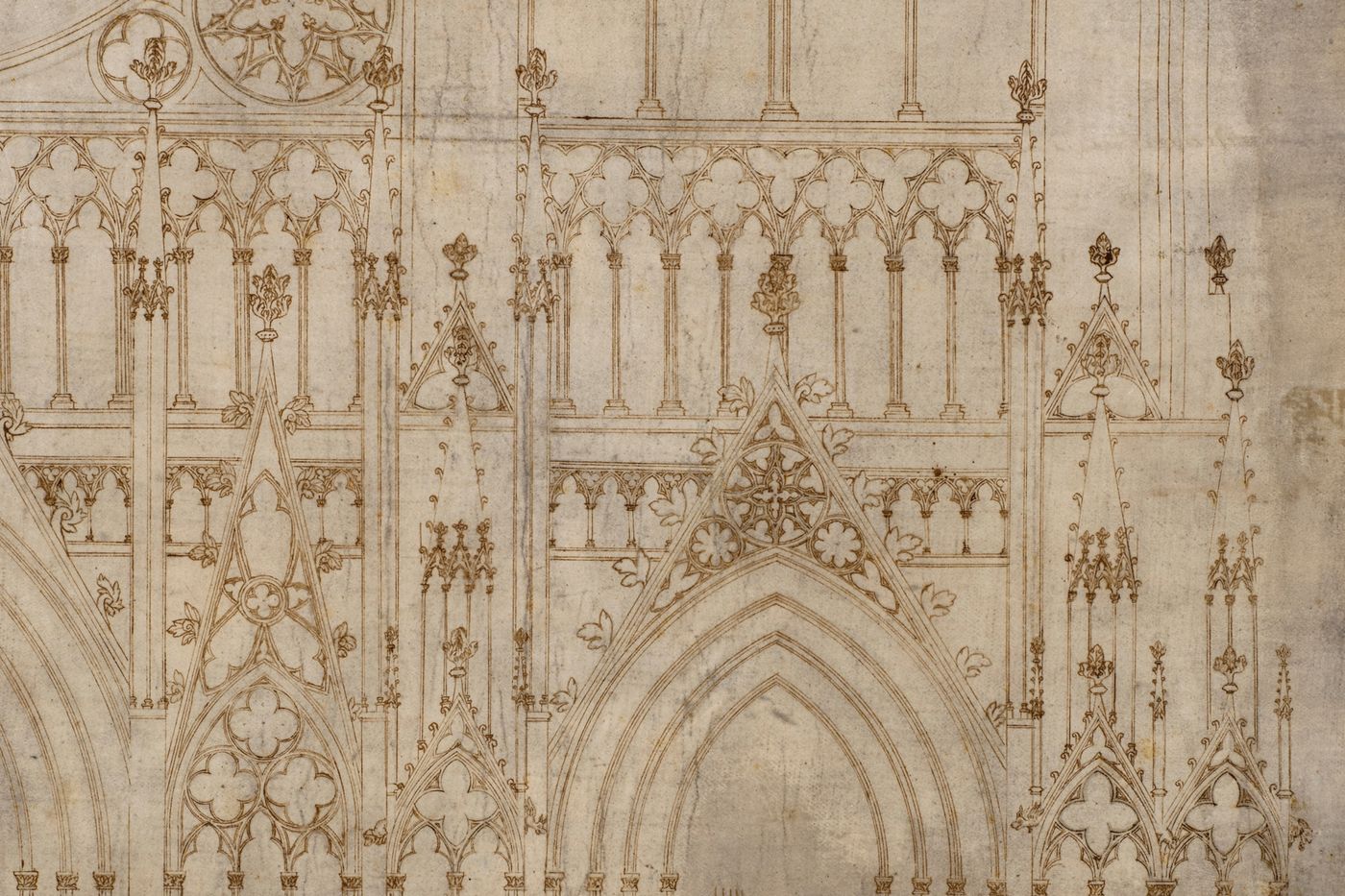
If all that remained of architecture from the 12th to the 16th centuries were the astonishing diagrams now on view in “Gothic by Design” at the Met Museum, you might suppose you were looking at wild fantasies. How could such finespun lacework stand up at all, let alone stretch hundreds of feet toward the heavens? The show helps you see clearly what the buildings themselves only suggest: Gothic cathedrals are drawings delicately alchemized into solid, nearly indestructible forms. Line by line, mark by mark, medieval builders figured out how to shape stone and pour light, conjuring complete buildings on parchment before the first rock was hewn. Confident that limestone wouldn’t crack or beams split, they diagrammed vaults, traced the arcs of graceful buttresses, and drew spires encrusted with statuary. These structures look unreal in two dimensions, as if they were made mostly of air.
At the Met, I wandered in awe through an architectural world where complexity was the norm and extreme engineering a starting point. The great cathedrals of Europe are exhilarating not just because they’re light and tall and bejeweled with stained glass, but because every carved curl and iron hinge is linked in a harmonic chain of relationships to joints, vaults, towers, and the sky beyond. Ornaments are no more dispensable than foundations. Today, we might think of those patterns as fractal; medieval architects saw them as holy. And where the spirit was concerned, detail mattered, because you couldn’t just value-engineer the presence of God.