
|
 |
Probabilistic vs. Deterministic: Why Tech Writers Need To Understand The Difference Now
Knowing the difference between a system that follows rules and a system that places bets is paramount to success in an AI-powered world
|

| |||||||||||||||


Artificial intelligence (AI) has introduced a new kind of workplace confusion, and not the fun kind where someone brings in an unfamiliar brand of sparkling water and everyone pretends to love it. No, this is the more consequential variety. The kind where people use words like probabilistic and deterministic as if everyone in the room was born knowing what they mean.
Most people weren’t.
That matters, because if you work in tech comm, those two words now describe a fault line running straight through our profession. If we don’t understand the difference, we risk misunderstanding what AI is good at, what it is bad at, and why it sometimes produces polished nonsense with the confidence of a middle manager explaining a spreadsheet he did not build.
Two Words That Explain A Lot
Let’s start simply.
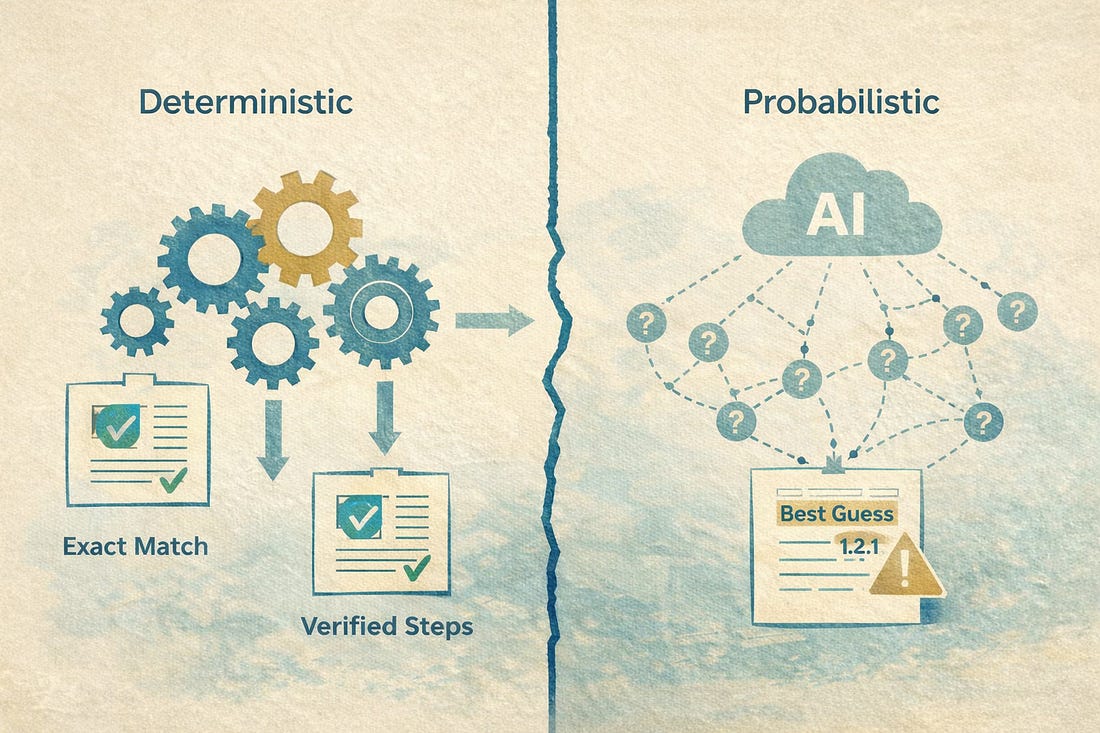
👉🏾 A deterministic system produces the same output every time, assuming the same input and conditions. You press the button, and it behaves as expected. Again. And again. And again.
Deterministic systems are governed by fixed rules. Traditional software functions often work this way. If a user enters a valid password, the system grants access. If they do not, it refuses. No soul-searching. No improvisation. No jazz hands. 👐
👉🏾 A probabilistic system works differently. It produces results based on likelihood, not certainty. It makes predictions about what output is most likely to fit the input. Large language models do this constantly. They do not “know” the next word in the way a database knows a customer ID. They generate language by calculating which sequence of words is most probable based on patterns learned from training data.
That means a probabilistic system can produce different (think “inconsistent”) outputs from the same prompt. It can sound sure while being wrong. It can be useful, impressive, and fast. It can also make things up that are untrue.
And there, at last, is the neighborhood where we tech writers now live.
 |
Why This Distinction Matters In An AI-powered World
For years, tech writers have worked in environments that leaned heavily deterministic.
A procedure either matched the software behavior or it did not.
A warning either appeared in the right place or it did not.
A version number was either current or obsolete.
Even when the work was messy, the target state was not supposed to be mysterious.
AI changes that.
When we use a large language model to summarize release notes, draft installation steps, rewrite a paragraph, classify content, or answer a customer question, we’re no longer relying on a system that simply retrieves or executes rules. We’re relying on one that predicts. That prediction may be excellent. It may also be slightly off in a way that looks harmless until it is published, followed, trusted, and screenshotted.
This is why we must stop treating AI like a magic vending machine that dispenses finished prose in exchange for prompts and optimism.
A probabilistic system is not broken when it gives you an imperfect answer. That’s how it’s designed to work. Its output is a best guess, not a guaranteed truth.
Deterministic Systems Feel Safer Because They Are
This does not mean deterministic systems are always better. They’re just better at different things.
Deterministic systems are strong where consistency, repeatability, compliance, and auditability matter. When we’re validating structured content, enforcing terminology, applying publishing rules, resolving conditional text, or pulling approved snippets into a template, deterministic logic is our friend. It doesn’t wake up one morning and decide the safety warning sounds warmer if rewritten as a haiku.
That reliability matters more now, not less.
As AI spreads across content operations, the smartest organizations aren’t replacing deterministic systems with probabilistic ones. They’re combining them. They use deterministic structure, metadata, workflows, approved source content, and governance to constrain and support probabilistic generation.
That is the grown-up version of AI adoption.
Everything else is basically letting a very fluent intern rewrite your customer-facing knowledge without supervision and hoping the legal department is unusually relaxed this quarter.