Thanks for reading The Briefing, our nightly column where we break down the day’s news. If you like what you see, I encourage you to subscribe to our reporting here.
Greetings!
Results from Google, Microsoft and Amazon last week showed AI is still fueling cloud revenues, news that helped lift the stock market to fresh records on Friday. This week, we’ll get a clearer glimpse into whether AI can also lift the lagging prices of software stocks such as Palantir and ServiceNow.
Palantir kicks off the week’s wave of corporate earnings reports on Monday. Stock in the company, which sells software to analyze and integrate large amounts of data, has been hit by the same fears that have prompted investors to dump shares in Salesforce, ServiceNow, SAP and HubSpot: namely, that new AI tools from Anthropic and OpenAI will lower demand for their software. Palantir’s stock has lost nearly 20% this year, a contrast with the Nasdaq Composite Index’s 8% rise.
But one could argue Palantir is better positioned to weather AI’s onslaught. That’s because it has, for longer than its competitors, sold software that lets a company consolidate its data from a bunch of other software systems. Palantir’s engineers also develop new custom applications and AI agents for the customer on top of their data. That kind of AI-enabling software is something companies such as Salesforce and ServiceNow have only recently begun to work on.
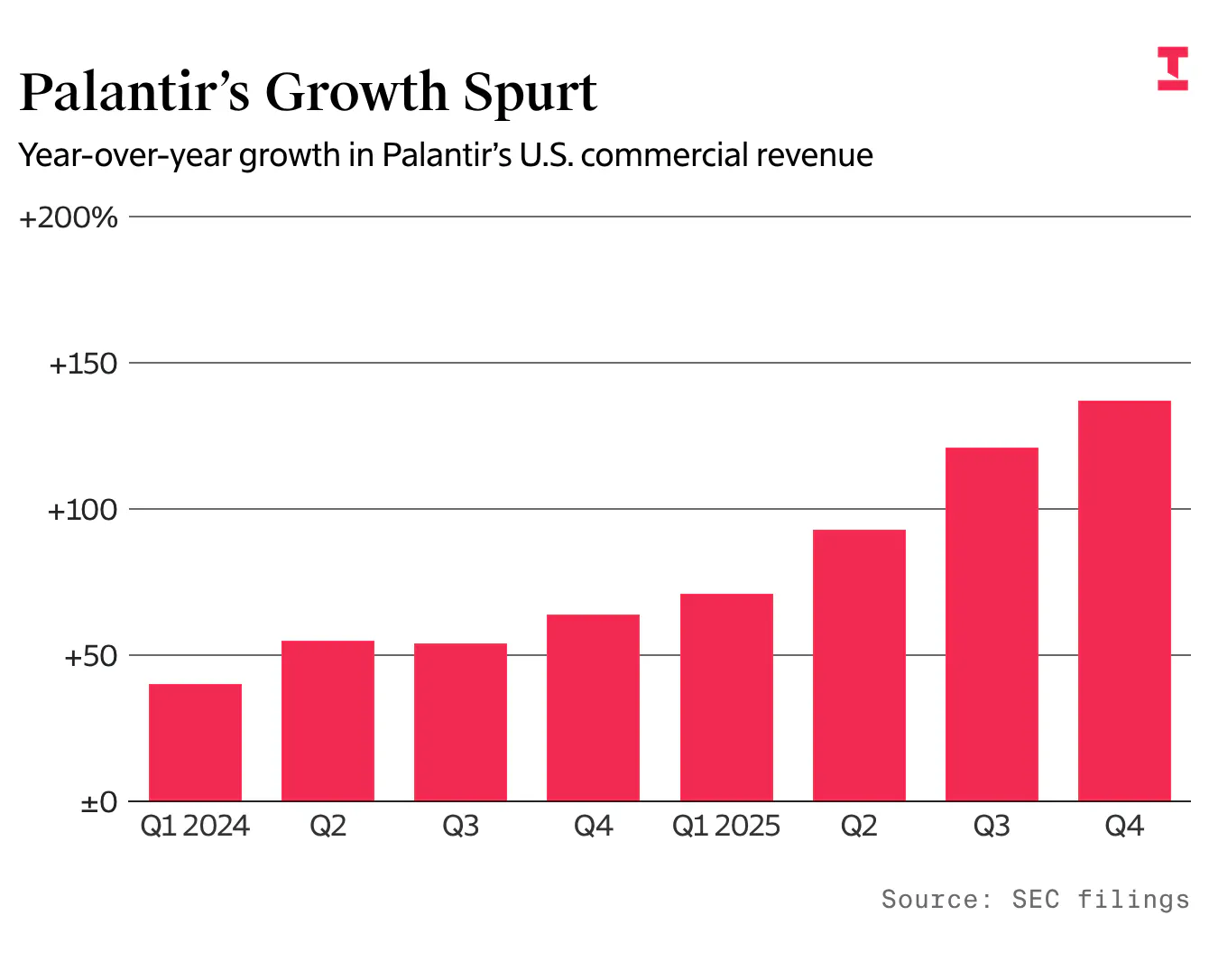
Palantir’s ability to capitalize on that early lead will likely show up in quarterly sales of its software to U.S. commercial business customers. This segment has far outpaced the growth of sales derived from its work with the U.S. government, which draws the lion’s share of public attention. In its most recent quarter, Palantir’s U.S. commercial segment’s revenue jumped nearly 140% to $507 million, while revenue from the U.S. government rose 66% to $570 million.
This year, Palantir has projected that its U.S. commercial revenue will rise 115% to $3.14 billion, faster than the 109% growth rate last year and the 54% growth rate in 2024. Monday’s results for its first quarter will reveal its progress toward that goal.
Palantir’s results and CEO Alex Karp’s comments could also cast light on whether its variable pricing is a boon to enterprise software sales. As we have explored in othercolumns, software companies including Salesforce, HubSpot and Adobe have begun charging customers based on how much AI they use or when the AI tools complete certain tasks rather than by seat or license. That’s a response to customers using more of the app makers’ AI features, raising app makers’ costs, as well as to app makers’ concerns that seat subscription growth may wane in the AI agent era.
Palantir is arguably ahead of other software firms just now scrambling to change their pricing models to tie software costs to usage or business outcomes. Palantir already charges some customers when they hit certain milestones after installing its software, mirroring the outcome-based pricing HubSpot and Adobe recently announced, according to two people with knowledge of the pricing. (Palantir declined to comment.)
For example, Palantir might charge a customer a predetermined fee only when their profit margins rise by a certain amount after installing the software. In another example, it might charge an industrial customer only when the software has successfully aggregated the customer’s data and begun to monitor how well its machinery is running.
Meanwhile, Palantir charges other customers flat annual fees as well as additional charges tied to usage, customers and consultants have said.
It also offers in-house technical consultants, which it calls forward-deployed engineers, to help customers build and use custom versions of its software for their business needs. Given the challenges of integrating AI in large companies, it’s a model firms from OpenAI and Anthropic to Salesforce have begun to copy to help customers use AI.
In other news, ServiceNow will get another chance to make its case for why the company is positioned to benefit from AI during its Investor Day presentation in Las Vegas on Monday. The $94 billion enterprise software firm, which mainly sells apps to help companies track and manage IT issues, has seen its stock drop about 12% since reporting earnings in late April that showed its profit margins are under pressure from a recent acquisition of cybersecurity firm Armis.
Other companies set to report quarterly updates include CoreWeave, Shopify and Mercado Libre. Here’s what analysts are expecting for the revenue and GAAP EPS of the biggest tech firms reporting this week, and their year-over-year growth, courtesy of S&P Global Market Intelligence:
Palantir (Monday)
First-quarter revenue $1.54 billion, +74%
EPS $0.24, +200%
Shopify (Tuesday)
Revenue $3.09 billion, +31%
EPS $0.24, +145%
Advanced Micro Devices (Tuesday)
Revenue $9.89 billion, +33%
EPS $0.74, +68%
Uber (Wednesday)
Revenue $13.26 billion, +13%
EPS $0.71, –14.5%
Arm (Wednesday)
Fiscal fourth quarter revenue $1.47 billion, +18%
EPS $0.37, +85%
MercadoLibre (Thursday)
Revenue $8.31 billion, +40%
EPS $8.20, –16%
CoreWeave (Thursday)
Revenue $1.96 billion, +100%
EPS –$1.20, +14%
In Other News
• A trial to determine Elon Musk’s lawsuit against OpenAI will continue in Oakland, Calif., Monday, when OpenAI’s co-founder and president, Greg Brockman, is scheduled to testify. OpenAI CEO Sam Altman is expected to take the stand later in the week. Read our coverage of Musk’s testimony and highlights from the trial.
• Videogame retailer GameStop is preparing a bid that it could submit as soon as this month to buy e-commerce site eBay, according to The Wall Street Journal. Ebay and GameStop shares rose after-hours Friday following the report.
• Founders Fund has raised $6 billion for its fourth growth-stage fund, less than a year after the firm raised its third growth-stage fund, of $4.6 billion.
• Meta Platforms has acquired Assured Robotics Intelligence, a startup developing AI models for humanoid robots, for an undisclosed sum. Meta has been ramping up its humanoid robotics efforts, hiring the former CEO of Cruise, General Motors’ robotaxi unit, in 2025 to lead its robotics product group.
• S&P Dow Jones Indices, the index provider behind the S&P 500, said it would consult with market participants to determine whether it should eventually let large stocks into indexes more quickly after their initial public offerings than current rules allow. The rule change could provide a big boost to demand for shares in the eventual IPOs of SpaceX, Anthropic and OpenAI.
Today on The Information’s TITV
Takeaway’s from the first week of the Musk-OpenAI trail, what’s driving Apple’s iPhone revenue surge and Shopify’s fintech ambitions. Watch here.
The Information and Aily Labs are convening an intimate group of pharma, CPG, and retail executives in Los Angeles to address the next phase of enterprise intelligence. Request an invite.
Save the date for The Information’s annual AI Agenda Live in San Francisco, where top AI researchers, founders, investors and executives come together for a day of conversations about the breakthroughs and applications shaping the future of AI.
Save the Date: The Information returns to Napa Valley October 27-28 to convene senior women across tech, media, and finance. The event will feature two days of intimate, candid conversations with the leaders navigating today’s global shifts.
Dealmaker was named the “Best in Business” newsletter for its insightful coverage of private technology and the AI hype cycle. Start receiving the newsletterhere.