
|
The $46,500 Retirement Loophole Your HR Rep Won't Mention
It's called the Mega Backdoor Roth. It's legal, it's in your 401(k), and most people leave it sitting there.
|

| |||||||||||||||


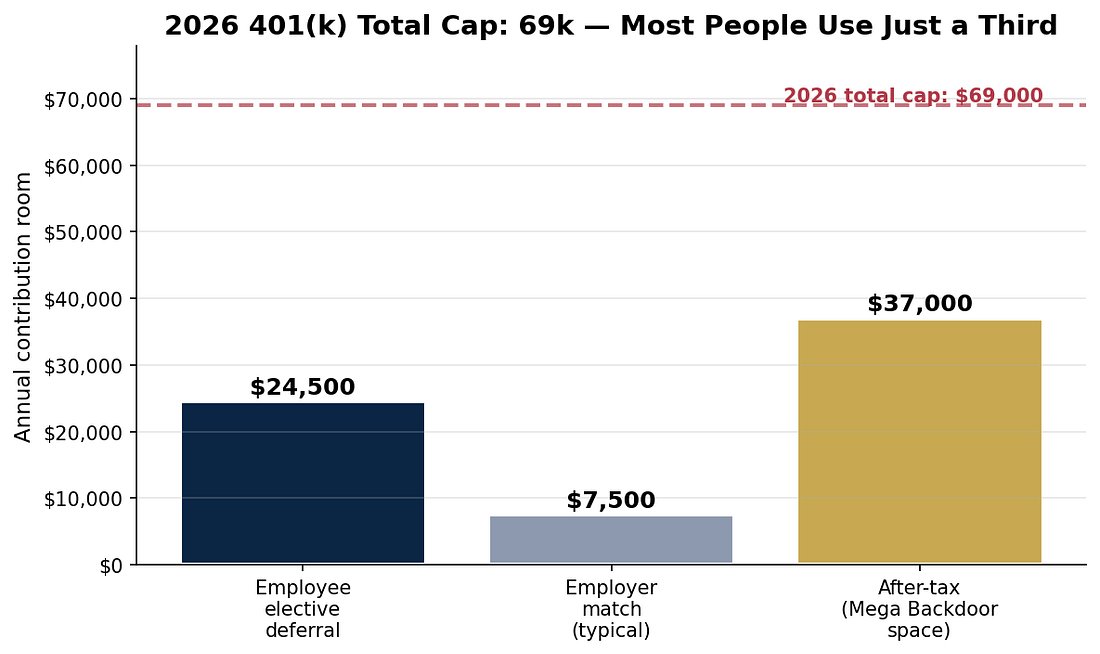
Your 401(k) has a number on it that’s probably $24,500 in 2026. That’s the employee deferral limit. That’s the cap your HR rep tells you about, the cap your benefits portal shows you, the cap most people work toward.
That number is wrong.
The actual cap on your 401(k) — what’s called the section 415(c) limit — is $69,000 in 2026. The difference between those two numbers is the Mega Backdoor Roth.
 |
How it actually works
Three things have to be true for you to use it:
Your 401(k) plan allows after-tax (non-Roth) contributions
It allows in-service rollovers or in-plan Roth conversions
You’ve already maxed your regular employee contribution
If those three boxes check, here’s the move: you contribute after-tax money on top of your $24,500. Then, before that money has time to grow, you convert it into the Roth side of the 401(k) — or roll it out to a Roth IRA. Zero tax on the conversion (since it was already taxed). The money now grows tax-free, forever.
Why it’s “hidden”
It isn’t hidden, technically. It’s buried in your plan document — the 80-page PDF nobody reads. HR reps usually aren’t financial advisors and they’re not going to walk you through it. Plan sponsors hate explaining it because most employees can’t afford to use it.
But if you’re a high earner — or you’re aggressively trying to compress 30 years of saving into 10 — this is one of the largest legal tax-advantaged spaces left in the U.S. tax code.
Action this week: Email your 401(k) provider (Fidelity, Vanguard, Empower, whoever) and ask exactly two questions: 1) Does my plan allow after-tax contributions? 2) Do you allow in-service Roth conversions or rollovers? If both = yes, you have the Mega Backdoor.
Real-world math
Say you make $180,000 and you can save aggressively. You max your $24,500 deferral. You get a $7,500 employer match. That leaves $37,000 of after-tax space. If you fund that and convert it for 10 straight years, at 7% growth you’d have roughly $510,000 in Roth — completely tax-free in retirement, no RMDs, fully inheritable to your kids.
That’s without raising your salary, switching jobs, or taking on more risk. You’re just using the cap that already exists.
When it doesn’t work
Two situations kill this:
Your plan doesn’t allow after-tax contributions (~40% of plans don’t — push HR to add it)
You’d have to dip into your emergency fund to pull it off (don’t)
And if you’re a 1099 contractor with a Solo 401(k), the same mechanic exists — and it’s usually easier to set up because you control the plan document.
Sources
• Mercer Advisors — Mega Backdoor Roth 2026 limits
• Risk Strategies — 2026 plan sponsor guide
• IRS — 2026 401(k) contribution limit announcement
Disclaimer
Affluent Notes is for educational and entertainment purposes only. Nothing in this newsletter is financial, tax, legal, or investment advice. The numbers, charts, and strategies discussed are illustrative; your situation, tax bracket, plan rules, and risk tolerance are different. Past performance does not guarantee future results. Talk to a licensed CPA, CFP, or attorney before acting on anything you read here. The author may hold positions in securities or accounts mentioned.
Affluent Notes is free today. But if you enjoyed this post, you can tell Affluent Notes that their writing is valuable by pledging a future subscription. You won't be charged unless they enable payments.
|