AI’s place in modern wars, skincare from Pañpuri and stories you might have missed.
|
Tuesday 12/5/26
|

|
|
London
Paris
Zürich
Milan
Bangkok
Tokyo
Toronto
|
|
|
|

Good morning from Midori House. For more news and views, tune in to Monocle Radio. Here’s what’s coming up in today’s Monocle Minute:
THE OPINION: Forget brunch – try the French tradition of
mâchon
DEFENCE: AI’s place in modern wars
DAILY TREAT: Save face with skincare from Bangkok’s Pañpuri
AFFAIRS: Is the latest Iran peace proposal really on ‘life support’?
THE LIST: Stories you might have missed
|
|
France’s next dining revolution might start before lunch
By Ben Drinkwater
|
“And here, sir, is your pastis.” It’s 10.00 and I’m already on the high-proof aniseed apéritifs. It’s concerning – not least because I could be turning into my dad but also because I’m in Farringdon, blinking into a day that’s hardly begun. And the pastis is barely the half of it because rapidly expanding in front of me is a spread so far removed from the usual Sunday morning fare that my brain is struggling to make sense of it. There’s the unmistakable whiff of
andouillette, pungently foreboding beside a plate upon which golden chicken thighs collapse into the buttery embrace of gravy and beans. A waiter brings out even more food: a bowl of tripe (of which I will say no more), a soft Saint-Marcellin cheese, torn chunks of baguette, something resembling fishy rillettes and a scattering of radishes, presumably for health reasons.
The food teeters on excess – not a limp poached egg in sight – but the warmth emanating from the long communal tables makes the whole thing feel oddly domestic, as though this herculean act of consumption might be taking place in someone’s kitchen. That faintly disorientating contrast, I soon learn, is the beauty of a
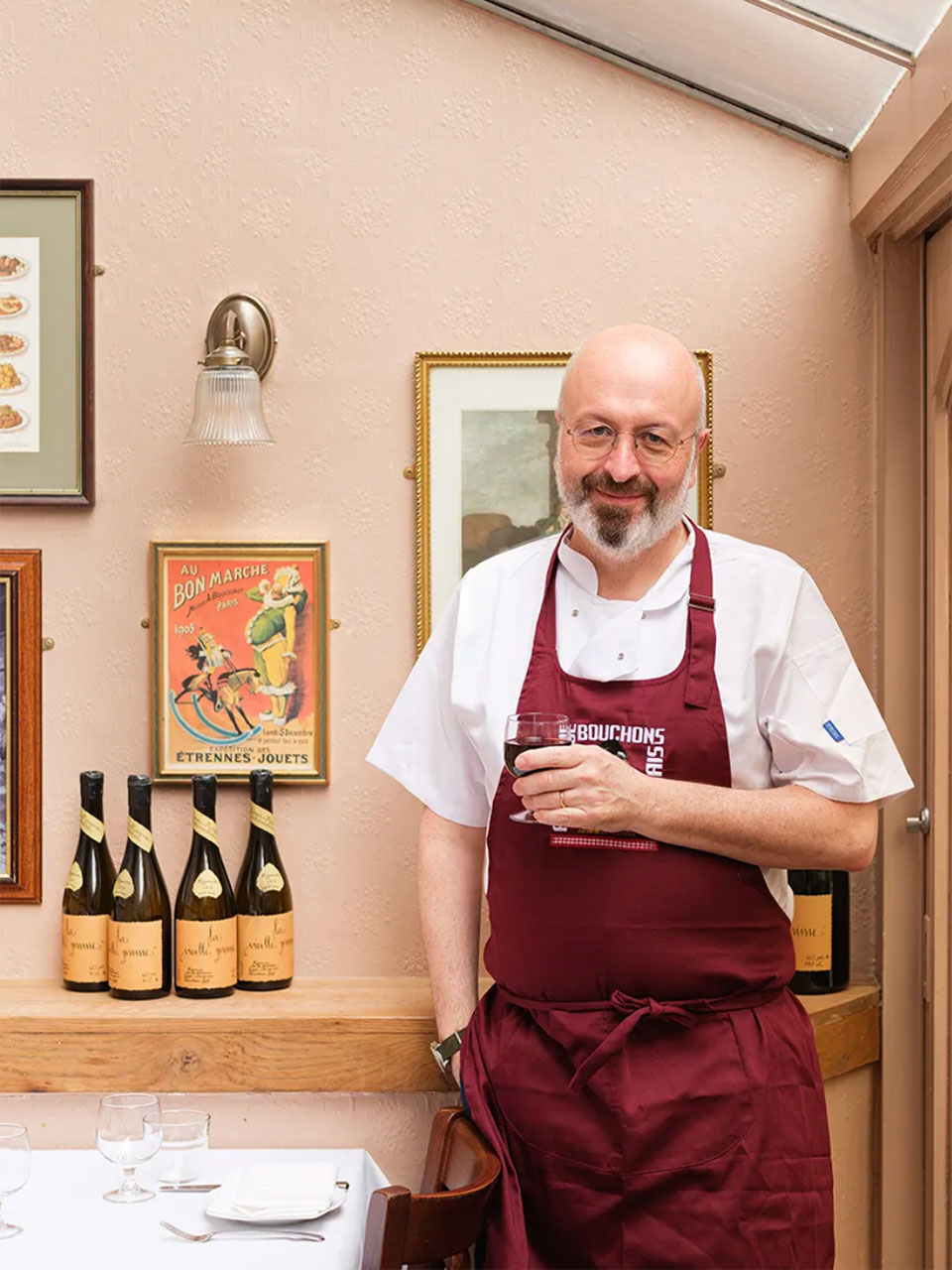
mâchon. “It’s a kind of cultural dining club really,” says chef Henry Harris, who is on hand as Monocle’s guide. His presence is apt, because few have done more to bring serious French cooking into British restaurants than Harris: first at Racine and now, two decades later, here at Bouchon Racine.
|
|
|
Chef d’oeuvre: Henry Harris
|
|
“A
mâchon is a very fraternal thing,” he says. “It’s a group of people with a common sense of purpose, meeting to eat in a particular place at a particular time.” Traditionally, that meant early- to mid-morning at a Lyonnais
bouchon, where silk workers would gather after a long shift and eat a savoury feast of offal, cheese and bread, often with wine. As we talk, I find a comparison with the polished vagueness of brunch increasingly hard to resist.
“The thing is, with brunch you’re kind of missing the best of both,” says Harris. “Whereas with a
mâchon, you’re having a proper savoury meal first thing and there’s a real purpose to that.”
That a niche, 19th-century Lyonnais dining ritual could attract people to one of London’s top restaurants is enough to ask whether its arrival is a sign of something bigger. In France, that
something is already taking shape: a glorious re-emulsification of old-world tradition and modern appetite, breaking up the sterile, fine-dining monotony that has had European cities in a chokehold for the best part of two decades.
Many point to the
bouillon revival as the clearest example of this shift. In recent years, France has seen the return of no-frills, canteen-style restaurants historically associated with the Parisian working class. Often housed in grand, 19th-century dining rooms,
bouillons have been embraced not just for serving traditional dishes at democratic prices but because they’ve restored a clarity of purpose to the bistro: rejecting the Michelin-chasing fuss that has made many cities’ top restaurants feel increasingly indistinguishable in favour of the French ideal of feeding people generously and convivially.
With reports suggesting that
bouillons are proliferating at a rate of as much as five a month, the question now is whether
mâchon might stage a similar rescue act for the no-man’s land between breakfast and lunch. That, at least, is what La Confrérie des Francs-Mâchons, which curates a national network of vetted
bouchons, is working towards, arguing for the wider adoption of
mâchon as a righteous alternative to brunch.
“We are absolutely seeing a renewed interest,” says Bruno Bouteraud, maître restaurateur at Café des Fédérations, a Lyon institution that’s part of La Confrérie des Francs-Mâchons. “At a time when restaurants can tend towards a certain uniformity, more people are looking for experiences full of identity. It’s not a transformation of the morning meal per se but rather a rediscovery of its fundamental values of simplicity, generosity and human connection.”
Ben Drinkwater is a London-based journalist. For more opinion, analysis and insight, subscribe to Monocle today. Want to read the rest of the feature? Click here.
Further reading:
- Parisian flair meets Dutch comfort at the new Bouillon d’Amsterdam restaurant in Hotel Die Port van Cleve
-
Our six favourite French-inspired restaurants
-
Late-night tables: Seven after-hours dining hotspots
|
|
defence: usa
Balancing ethics and efficiency: What is AI’s place in modern wars?
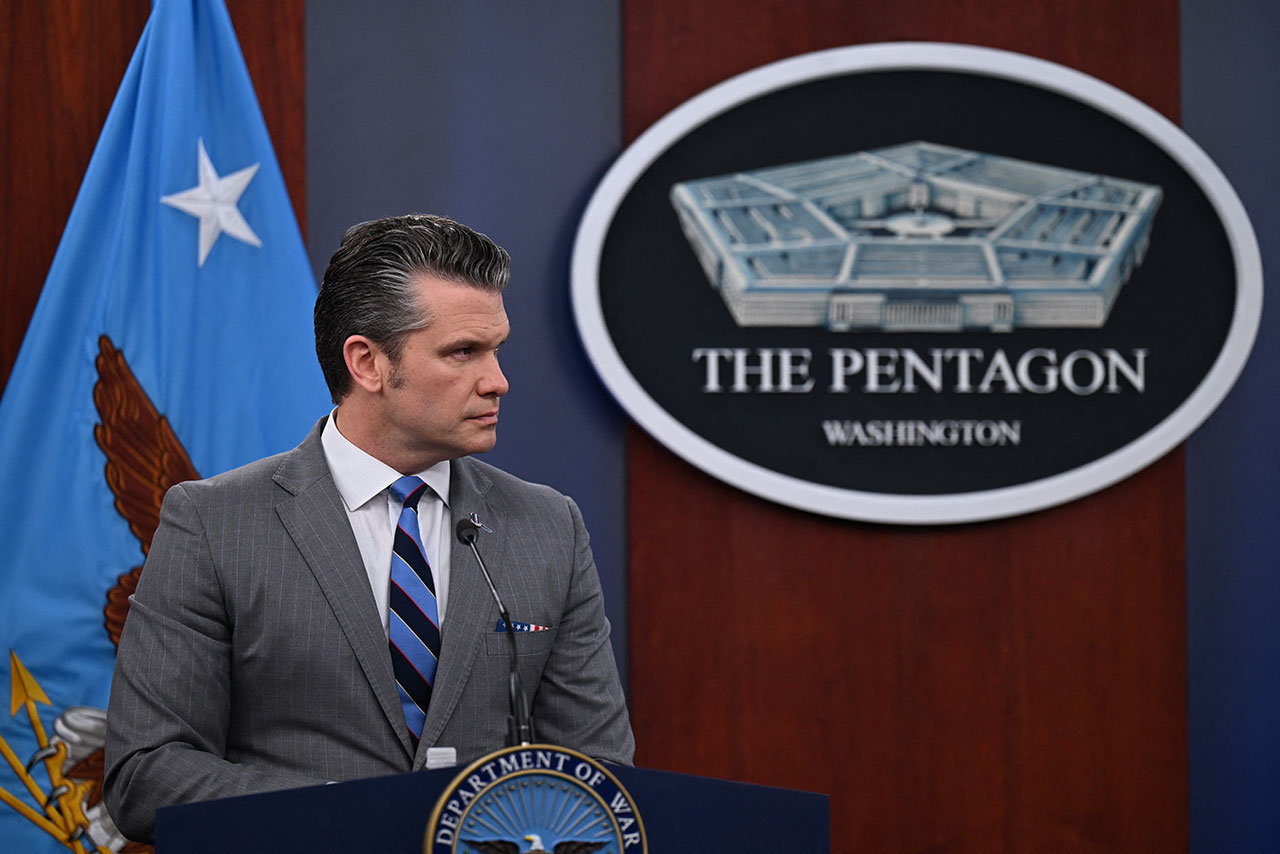
When, in early March, the Pentagon designated AI firm Anthropic a “supply-chain risk”, the dispute was less a procurement issue than a confrontation over the morality of modern warfare (writes Gorana Grgic). The US secretary of war, Pete Hegseth, and others castigated Anthropic after its CEO, Dario Amodei, refused to relax guardrails that prevent fully autonomous lethal uses, even as its Claude software was reportedly being used to identify and strike targets in Iran. Today four types of AI systems are used by militaries: guidance that allows a drone to reach its target when communication is lost; automatic recognition of vehicles; navigation without reliance on GPS; and software that plans routes and co-ordinates multiple units. The goal is for these tools to support commanders rather than replace human judgement.
|
|
|
AI, captain: Pete Hegseth has been vocal over the military use of Anthropic’s chatbot
|
|
The fight between the Pentagon and Anthropic matters because it exposes where human judgement sits in the loop of AI-driven operations. Analysts use the shorthand “human-in/on/out-of-the-loop” to describe whether people decide, advise or are effectively bypassed by AI. That tension between principled guardrails and battlefield expedience is now a central policy problem for governments and militaries the world over.
Major powers are pouring money into systems that promise to compress the “kill chain”: fusing satellite imagery, signals and sensor feeds into near-instant target recommendations. But investment is not the same as operational maturity. So far, 21st-century conflicts have chiefly used AI to amplify intelligence, surveillance and reconnaissance, not to field fully independent killer systems.
The Pentagon-Anthropic dispute strikes at the heart of the moral minefield that is AI weapons systems. States now have a choice to make – click here to learn more.
|
|
• • • • • DAILY TREAT • • • • •
Save face with skincare from Bangkok’s Pañpuri
Vorravit Siripark was inspired to create Bangkok-based fragrance and skincare company Pañpuri after noticing that Thai spas almost exclusively used foreign products, despite boasting a unique wellness culture. Since its genesis in 2003, the brand has become a leading name in the country’s luxury skincare and spa-products industry. Pañpuri uses innovative formulas that incorporate botanicals and essential oils in its range of hand creams, face cleansers and perfume oils, combining organic ingredients, such as Moroccan rose and Madagascan vanilla, with Thai plants, including sandalwood, jasmine and lemongrass.
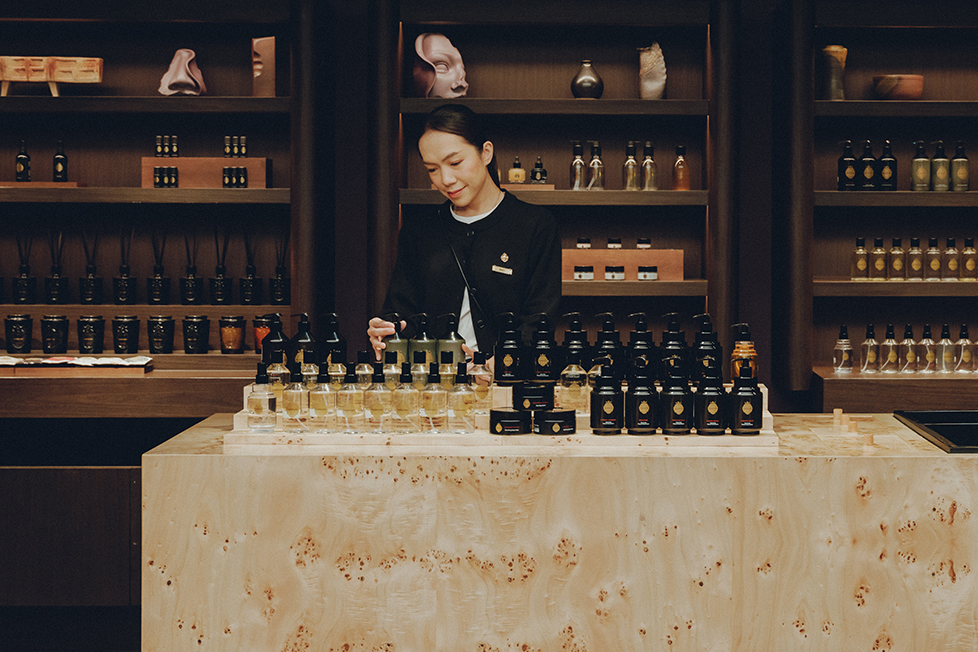
Equal care is paid to packaging, with the company using only unbleached paper and environmentally friendly soy ink. The brand is also the driving force behind a pioneering organic spa. For Siripark, the secret to Pañpuri’s longevity has been the dedication to creating high-quality products, all made within the country’s borders. “We don’t really have that many Thai luxury brands,” he says. “I want to build a legacy that lasts”.
panpuri.com
For more from Bangkok and beyond, pick up a copy of ‘Thailand: The Monocle Handbook’, which is out now.
|
|
Affairs:
the gulf
The protracted US-Iran war is a stress test for Gulf states
The Gulf’s uneasy calm is beginning to look less like the start of peace in the region and more like an intermission in the conflict (writes Inzamam Rashid). In Dubai, life still moves – perhaps not at full speed but with a buzz that is certainly welcome after weeks of eerie quietness. But last week, following a barrage of Iranian missiles over three days, the conversations turned back to phone alerts, intercepted drones and whether the latest escalation in the Strait of Hormuz would spill further into the Gulf. For the UAE, this is becoming an uncomfortable new reality. The country’s defence systems have proven effective but in an economy built on stability and confidence, a missile doesn’t even have to land to have an impact. The threat from Iran alone is enough.
That anxiety has only deepened following Donald Trump’s dismissal yesterday of Iran’s latest peace proposal as “totally unacceptable,” “stupid” and “on life support”. Tehran insists that its counteroffer was “generous and responsible.” The region remains in an awkward holding pattern: neither Washington nor Tehran appears eager for a full-scale return to war. Both understand the economic and political costs involved – global oil prices are high and costs of everyday goods have skyrocketed. Iran wants pressure eased around the Strait of Hormuz, sanctions relief and a ceasefire in Lebanon before making serious nuclear concessions. The US, backed by Israel, continues to insist that Iran’s uranium programme must ultimately be dismantled, with Benjamin Nethanyahu suggesting that troops could be sent in to retrieve the enriched uranium.
And so the shadow boxing continues, with Gulf states left absorbing the economic and psychological costs of a conflict that still has no obvious end.
|
|
| | |