
|
Yes, Europeans are poorer than Americans
Comfortable, leisurely, pleasant stagnation is just not good enough for the modern age.
|

| |||||||||||||||


 |
Which society is a better place to live: the U.S., or Europe? This is a very difficult question, for several reasons. For one thing, “Europe” can mean several different things — it can mean the richest northwest European countries like Sweden and the Netherlands, or it can include slightly poorer West European countries like Spain and France and the UK, or it can include East European countries that are still catching up after the fall of communism.
More fundamentally, though, the comparison is hard because life in the two countries is so different. If you like living in an urban apartment, strolling past picturesque old buildings to cute cafes, and taking a lot of vacation every year, then Europe is obviously for you. If you like living in a giant suburban house and having a bunch of friends drive over to barbecue and watch TV on your giant screen, then America is obviously the right pick. If you want to work 80 hour weeks building the future of AI, you should probably live in the U.S. If you want government health insurance and job security, I recommend Europe. There are also differences in politics and culture.
In general, my intuition is that all rich countries are about equally good places to live. One reason to believe this is that migration between rich countries is generally pretty small — it’s not that hard to move between Europe and the U.S., but not that many people do it. Here’s a map of the net migration difference between some European countries and the U.S., as a percent of each country’s population, for 2024:
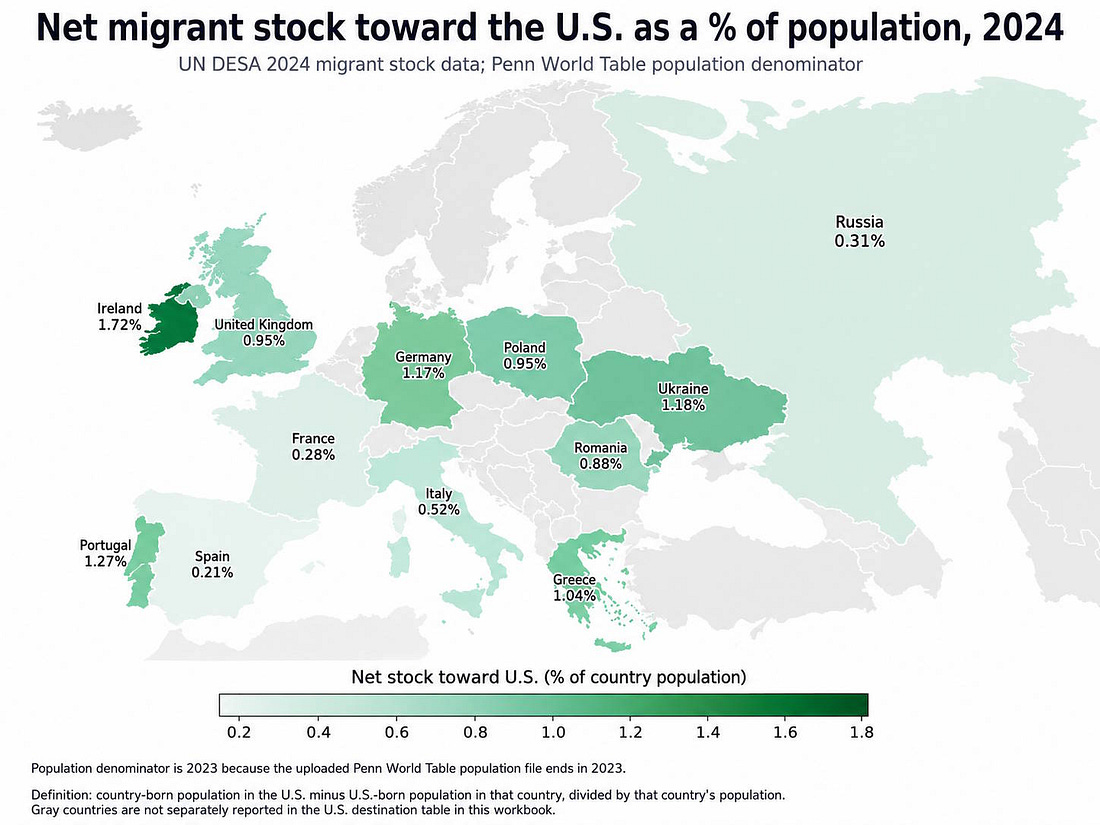 |
This means that if you take the number of Germans living in America in 2024, and subtract the number of Americans living in Germany, that net migration number is 1.17% of Germany’s population. In other words, the amount of migration between Germany and America is pretty small.
One thing to notice here, though, is that you don’t see any negative numbers on this map. There aren’t any European countries where significantly more people move from America to Europe than the reverse (for Switzerland it’s about equal). That means that to the extent that people vote with their feet, they choose America over Europe, even if they don’t do so in large numbers.
That’s not a slam-dunk case that America is better off, of course. The people who have the money and skills to move between the U.S. and Europe are probably disproportionately highly paid professional workers (who can earn more in the U.S.), while working-class people who would like to take advantage of Europe’s urban safety and generous welfare states find it harder to move. If there were open borders between America and Europe, we might see a different pattern.
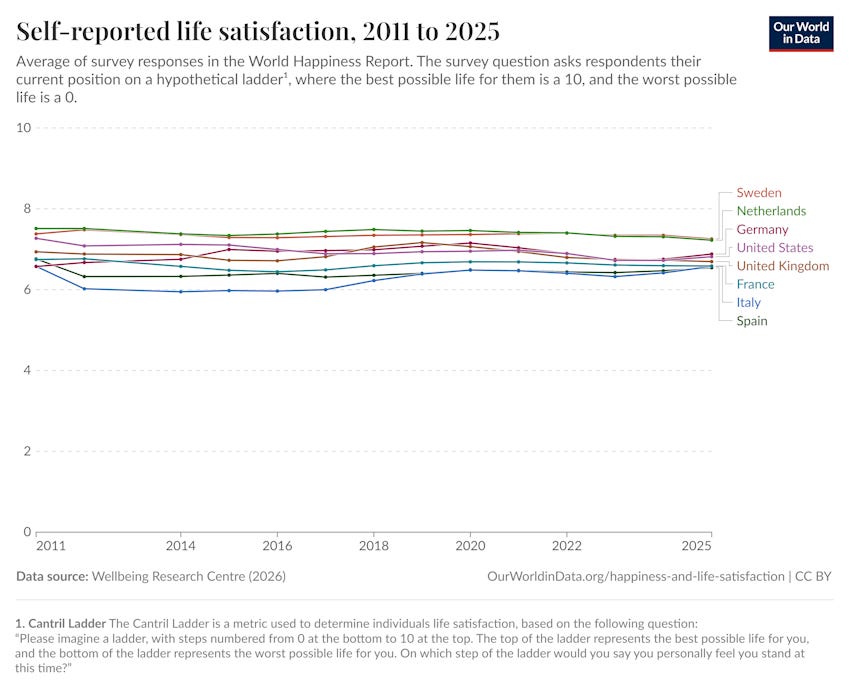
If you ask people how satisfied they are in life, America comes in around the middle of the West European pack:
 |
So my general impression is that Europe and America are about equally good places to live, and it mostly comes down to your own personal taste and your own personal circumstances. I believe that’s about the best answer we’ll ever get.
But an easier question to answer is: Who is richer, America or Europe? This is the subject of a recent debate in the econ blogosphere. It started when Joseph Sternberg wrote a WSJ op-ed entitled “What Happens When Europeans Find Out How Poor They Are?”. Paul Krugman responded with a widely read post arguing that Europe is not in economic decline:
