
|
Revolution, Revelation, and the American Dream
Three history books explore the stories we tell about America and the immigrants who call it home.
| |||||||||||||||


 |
What do books about the Revolutionary War, the Book of Revelation, and a Mexican American child of immigrants have in common? They all tell stories about the United States of America—and they recount the stories America tells about itself. As debates over immigration, citizenship, and American identity continue today, historian John Fea invites us to consider three books that explore how generations past discussed those same topics.
Happy Reading,
Taylor Berglund
Senior Features Editor, Christianity Today
PS. Eagle-eyed readers may have noticed the signature above has changed. Allow me to introduce myself: I’m Taylor, one of CT’s newest editors. I’m based in North Carolina’s Research Triangle, studied theology and the arts at Duke Divinity School, and belong to a church that meets in a local movie theater (Bright City Church in Durham). I’m very excited to be taking the reins from Kara for this newsletter, and I can’t wait to hear from you all and discover some great new books together!
A portion of this newsletter appeared as a column at Christianity Today. Join CT for full access to all our journalism.

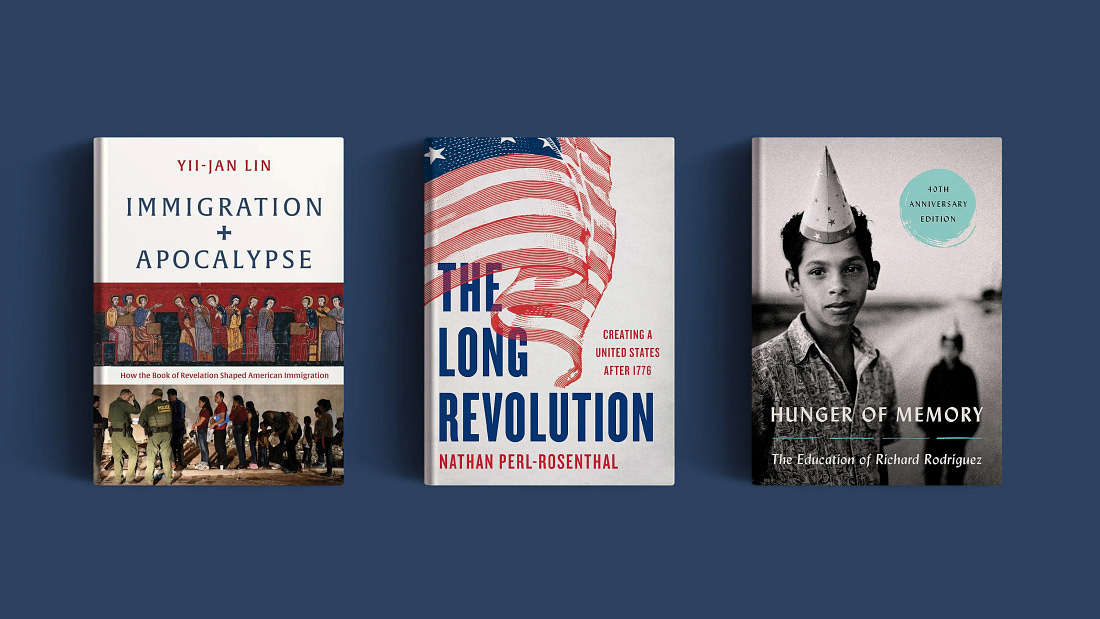 |
Three Books on American History
Nathan Perl-Rosenthal, The Long Revolution: Creating a United States After 1776 (Basic Books, 2026)
Is the American Revolution over? As we celebrate the 250th anniversary of the United States this year, public commentators will answer this question differently. For some, the Revolution was an event that happened in the distant past. They will celebrate the 250th with three-cornered hats, battle reenactments, and visits to historic sites. Others may try to “reclaim” the Revolution, as if the beliefs of the founding fathers froze in the 18th century and just need thawing and application in the 21st, as if little has changed since 1776.
Still others see the Revolution as ongoing. This latter view, Nathan Perl-Rosenthal argues in The Long Revolution, is the way most Americans living before the Civil War understood the Revolution.
After examining thousands of July 4 orations delivered between 1777 and 1876, Perl-Rosenthal concludes that the meaning of the Revolution was never “settled and agreed upon” during this era. Independence Day orators worried whether the American republic would survive amid the people’s individualistic impulses, global challenges to American security, and Indigenous threats on the frontier. Abolitionist and Black Independence Day orators used the Revolution to critique slavery. Working-class orators demanded that the ideals of 1776 be applied to them.
It was not until the 1876 centennial that Americans started to see the American Revolution as “over”—a “string of events that had taken place in the distance past.” Perl-Rosenthal suggests this was a mistake. We must continue to work out the implications of the Revolution, perhaps now more than ever.
Yii-Jan Lin, Immigration and Apocalypse: How the Book of Revelation Shaped American Immigration (Yale University Press, 2024)
While Perl-Rosenthal sees the ideals of the Revolution at the center of the American story, Yii-Jan Lin puts the Book of Revelation, specifically the New Jerusalem described in chapters 21 and 22, at the center. She is interested in the ways Americans, drawing on this New Jerusalem metaphor, thought about immigration.
When I first picked up Immigration and Apocalypse, I was expecting to read about how Americans quoted from Revelation or used specific references to the book as an inspiration for immigration policy. Instead, I found vague references linking the New Jerusalem of Revela