| | New infrastructure projects and trade deals are redirecting the flow of fossil fuels around the Stra͏ ͏ ͏ ͏ ͏ ͏ |
| |  | Energy |  |
| |
|
 - Breaking bottlenecks
- Import independence
- World’s biggest utility?
- Clean power compromises
- Angola’s mineral strategy
 The UAE piles into US LNG, while US oil majors’ earnings fall short of their European rivals’. |
|
 The war in Iran is entering an unpredictable new phase where the risk to energy markets is growing and analysts’ crystal balls are getting murkier. Conflicting messages are proliferating: On Monday, US President Donald Trump threatened to carry out a fresh “very major attack” on Iran and then withdrew the threat in the same sentence. Tehran said the US had offered to waive sanctions on its oil sector, which a US official then told Semafor was not actually on the table. Meanwhile, oil watchdogs say the market is approaching a tipping point in which prices for crude oil and refined fuels could skyrocket — including in the US, which is exporting record volumes of oil and gas but could soon find that US consumers are paying to compete for their own barrels against the rest of the world. It’s getting harder to find any reliable signal in all this noise. Despite Trump’s assurance that Tehran’s latest peace proposal offers a “very good chance” to reach agreement on nuclear deterrence, Fernando Ferreira, director of geopolitical risk at the DC consulting firm Rapidan Energy, still puts the odds of a renewed military escalation at about 70%, he told me. That’s based on the remaining distance between the two sides’ negotiating positions, the slow pace at which the US blockade can inflict meaningful pain on Iran’s economy, satellite imagery showing American military assets closing in on the strait, and the emerging pattern — totally unacceptable to the US — of foreign leaders negotiating directly with Iran for safe passage of their tankers through the waterway. Reopening the strait with military force could take weeks, Ferreira said, pushing the most ambitious timeline for resumption of normal traffic well into July. Others are more sanguine. “Our base case envisions the strait reopens in June,” Natasha Kaneva, head of global commodities strategy at JPMorgan, wrote in her most recent client note, arguing that the economic disruption for all sides is already becoming too painful to continue. Brookings Institution economist Robin Brooks, meanwhile, still has faith in relatively low oil futures prices as a safe indicator of where things are headed. The upshot is the stakes are rising, the strait is neither open nor closed, and there are no concrete signs of progress. |
|
 Jon Nazca/File Photo/Reuters Jon Nazca/File Photo/ReutersNew infrastructure projects and trade deals are redirecting the flow of fossil fuels around the Strait of Hormuz. The war has been a boon for sales of renewable-power equipment, as energy-importing countries race to untangle themselves from volatile fossil supply chains. But because the world still runs primarily on oil and gas, there’s also renewed momentum behind infrastructure projects designed to break bottlenecks like the strait. The UAE said it is racing to complete a new pipeline by next year that will double its oil export capacity bypassing the waterway, while the country’s Mubadala Energy signed off on a major new investment in a US LNG export terminal. Iraq is working to increase its exports through Türkiye. India struck a deal with the UAE to build new strategic oil and gas reserves, and Japan and South Korea are closing in on something similar. One more breakthrough could come this week: Russian President Vladimir Putin meets with Chinese leader Xi Jinping about finally completing the long-stalled Power of Siberia 2 gas pipeline, in what could be a more substantive fossil fuel trade takeaway than what US President Donald Trump was able to secure in his own meeting with Xi last week. |
|
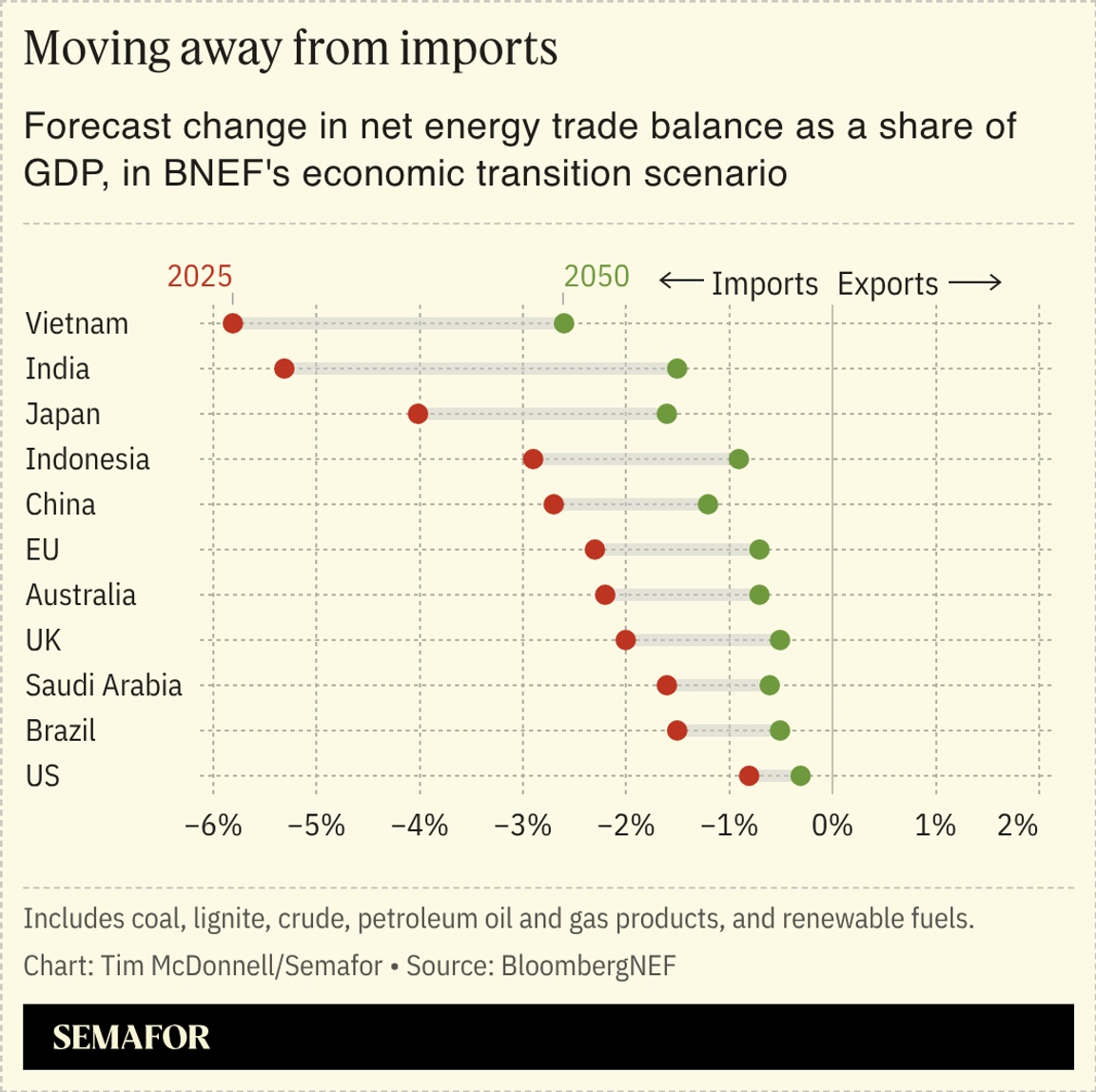 For many energy-importing countries, the Iran war is accelerating a trend away from fossil fuel imports, BloombergNEF reported. In a new energy market outlook projecting out to 2050, BNEF analysts forecast global oil demand will plateau in the early 2030s while natural gas demand surges well into mid-century. Though a record $2.3 trillion was invested globally in clean energy companies, projects, and technologies in 2025, that figure would need to double for the next five years to put the global economy on track for a “net zero” emissions outcome by 2050. But even on the current trajectory, clean energy adoption is already leading many countries to spend a smaller share of their GDP on fossil fuel purchases, David Hostert, BNEF’s chief economist, told Semafor: “Countries like Vietnam or India that are worst affected by the current crisis have the most to gain from electrifying and moving towards renewables.” |
|
 The amount that US power company NextEra Energy agreed to acquire rival Dominion Energy for, in a deal that would create the world’s largest utility amid soaring AI-driven energy demand. The merger, Semafor’s Rohan Goswami writes, is a big test for the uncomfortable fact facing the AI economy: Many people hate it. The purchase faces a rocky road ahead, namely in securing approval from regulators, and could complicate future efforts to control the company’s retail prices. But if it goes through, it could set a new standard for how utilities are navigating the AI age and allow it to chase much cheaper capital. |
|
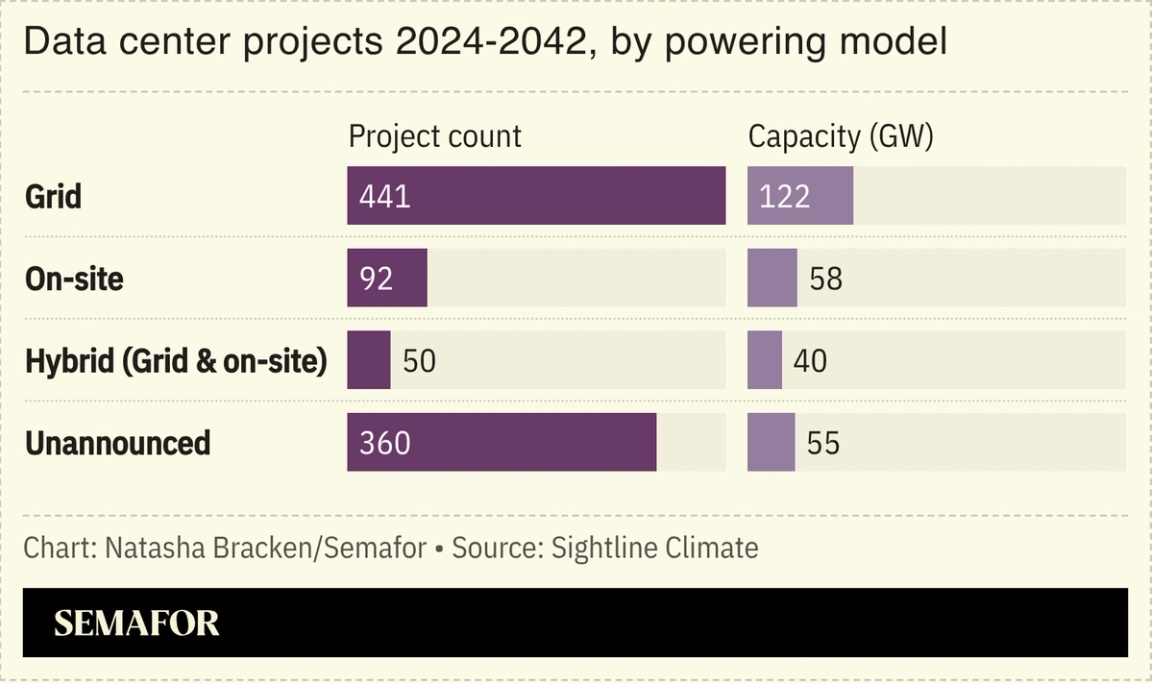 The premium put on faster grid connections is squeezing the window for clean power at data centers, a new Sightline Climate report found. The fastest clean, firm power options are still two to four years away, while natural-gas bridging systems can come online in months. That’s pushed hyperscalers to compromise on green targets, with Microsoft and Google both announcing unabated gas-fired data center projects in 2025 and 2026. For longer-term capacity, however, there are no simple solutions; even the lead times for some turbines, now hitting three years, are rendering natural gas pathways less attractive. “Speed now requires creativity,” the report’s lead author said, “and there’s plenty of clean power on the margins if you know how to find it.” Every option comes with its own set of drawbacks, though, so companies will need to pursue several strategies at once rather than bet on a single one. |
|
 A podcast about the “crime of the century” — the creation of climate denial. Award-winning climate journalist Amy Westervelt returns with a new season looking at the tech, money, and politics behind carbon capture’s rise. From midwest pipelines in the US to Brazil’s biofuel boom, Drilled: Carbon Cowboys investigates how tax credits, agricultural giants, and political power are driving a “climate solution” that may not cut emissions at all. Listen now. |
|
Angola’s mineral strategy |
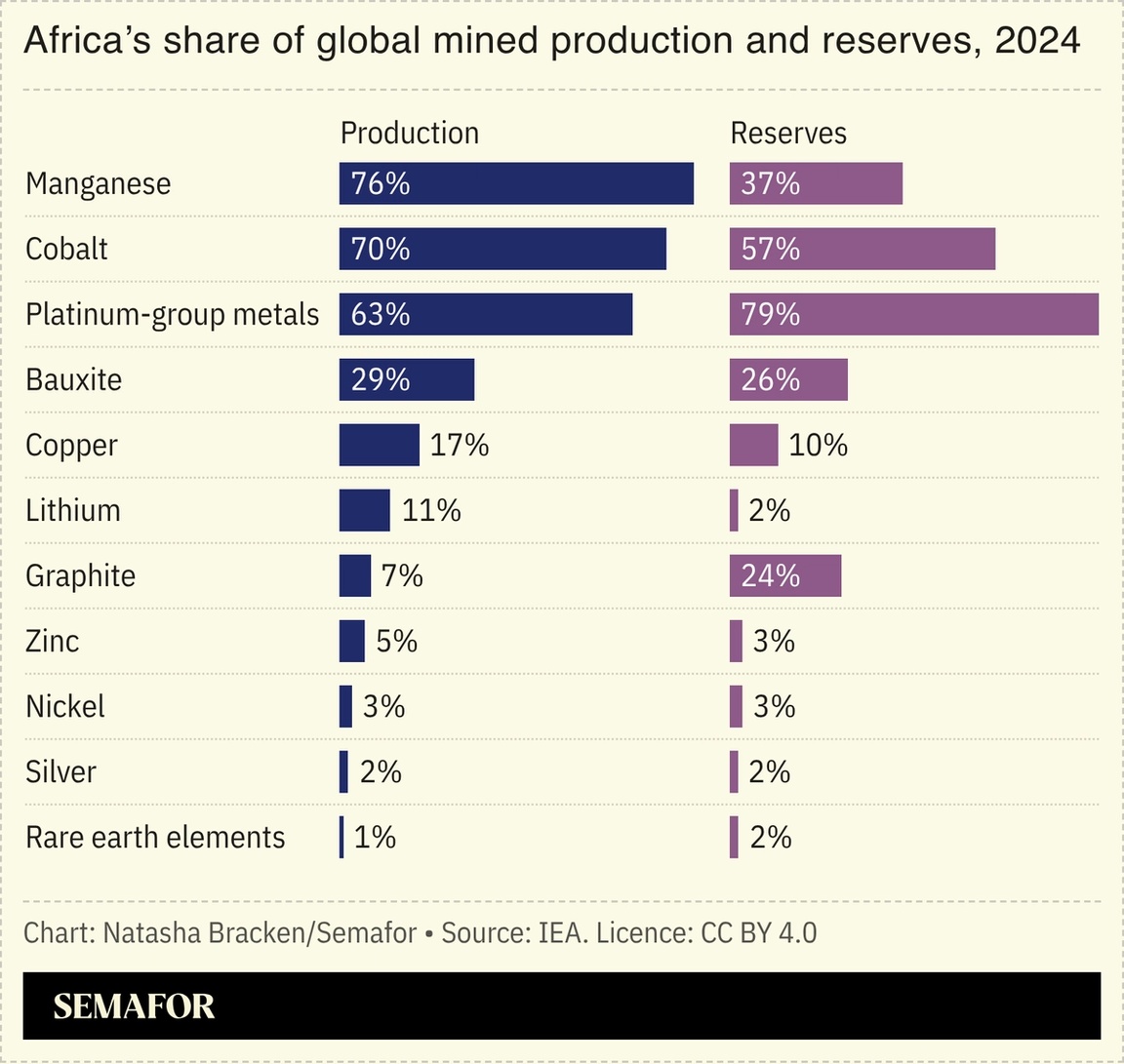 Angola does not plan to pursue punitive measures against mining companies such as export quotas or bans in order to bolster its domestic mining industry, a senior minerals minister said. Speaking to reporters in London, Diamantino Pedro Azevedo, the minister for mineral resources, petroleum, and gas, said Luanda would instead “prepare conditions to attract investment … so the private companies can come and set up factories.” The approach contrasts with that pursued by African countries such as the Democratic Republic of Congo and Zimbabwe: They have implemented quotas on foreign sales of cobalt and an all-out ban on the export of lithium, respectively, to build up refining capacity and capture more of the value from their natural resources. |
|
 New EnergyFossil Fuels- Recent headlines have shown Big Oil raking in windfalls from the war in Iran, but two American giants with different hedging positions, lower trading profits, and more production assets in the Middle East are not benefitting as much: Chevron and ExxonMobil are down by 1% and 2%, respectively.
FinanceTechPolitics & PolicyMinerals & Mining- China’s chokehold on global rare earths supplies will likely wane for the more abundant ones, but for those that matter most, including for military technologies, Beijing’s dominance will likely persist until the mid-2030s, according to Bloomberg.
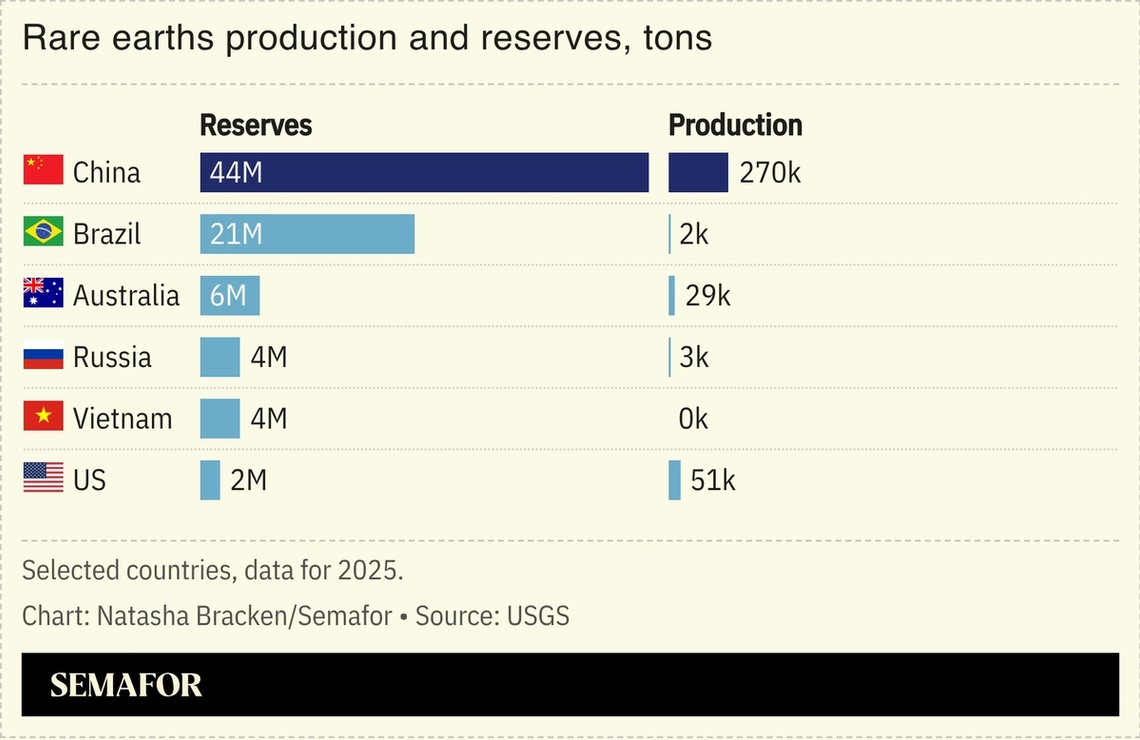 - China’s grip on the market is pushing a global “land grab,” the Financial Times wrote, with just one US company — USA Rare Earth — striking four deals in less than a year.
EVs- China’s EV juggernauts are focusing on speeding up charge times and increasing the size of batteries in hybrids, but next-generation storage technology is likely some years away, a new report noted.
|
|
|


