| | In today’s edition: Bahrain’s king receives loyalty pledges, Saudi Arabia makes a giant Syria pledge͏ ͏ ͏ ͏ ͏ ͏ |
| |  | Gulf |  |
| |
|
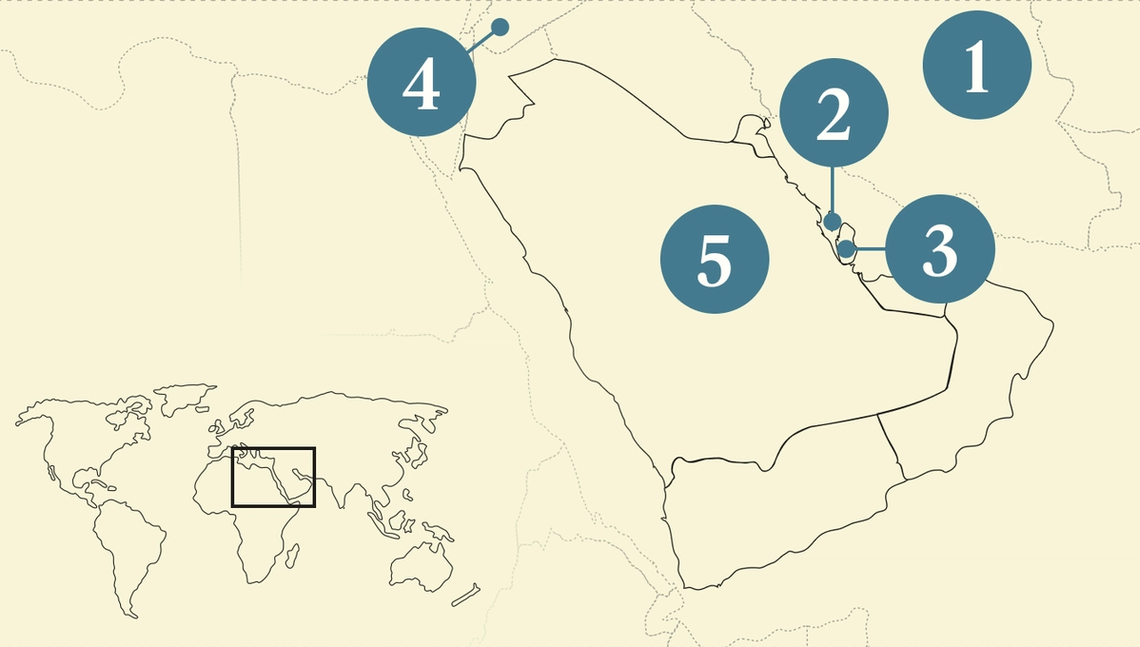 - New strikes by US and Iran
- Bahrainis vow allegiance
- Qatar LNG pioneer dies
- Saudi’s Syria pledge…
- …and tokenization push
 How the Gulf can defend itself, and other weekend reads. |
|
Hopes dim for reopening Hormuz |
 Stringer/Reuters Stringer/ReutersThe US and Iran traded fresh attacks, further undermining a protracted ceasefire and dampening hopes of the two sides reaching a durable peace deal. The American strikes were the second set this week of what Washington has characterized as defensive actions, with the most recent ones hitting Iranian drones and a launch site. Tehran said it targeted a US air base in the region; Kuwait, which is home to one such facility, said it had deployed air defenses against missile and drone threats. The ongoing pattern of negotiations interrupted by warnings and strikes points to the balance of leverage between Washington and Tehran, with one leading expert arguing that “a narrow deal is the likeliest end to this hot war.” Oil prices rose and stocks slipped on growing signs that the Strait of Hormuz was likely to remain all but shut for the foreseeable future. Iran wants to exert oversight of the channel, a move opposed by global powers. Washington imposed sanctions on the Iranian authority regulating the waterway, and US President Donald Trump threatened to bomb Oman if it worked with Tehran to share control of Hormuz. The number of ships crossing has, predictably, dwindled even further; ABN AMRO economists forecast that even if the strait reopened soon, oil prices would likely remain high for “the coming quarters.” |
|
Hamad harvests pledges of loyalty |
 King Hamad bin Isa Al Khalifa in 2025. Mohamed Al Hammadi/UAE Presidential Court/Handout via Reuters. King Hamad bin Isa Al Khalifa in 2025. Mohamed Al Hammadi/UAE Presidential Court/Handout via Reuters.More than 1,000 Bahraini citizens have sent messages of support to King Hamad bin Isa Al-Khalifa in recent weeks, praising a clampdown on those accused of being sympathetic to Iran. In what appears to be a well-coordinated campaign, the first cables were sent in early May, soon after the king criticized anyone supporting Iran, saying Bahrain needed to be “cleansed of every traitor.” Since then, at least 25 tribes, more than 200 individuals, and around 840 families have joined in, including the heads of prominent local organizations such as the central bank and the Strategic Security Bureau. The messaging campaign has continued throughout the month, with the most recent cables noted by the official Bahrain News Agency on May 26. At the same time, the crackdown continues on the regime’s perceived opponents. Three people were convicted on May 24 of supporting Iranian attacks on Bahrain and sentenced to 10 years’ imprisonment. Nine others were recently given life sentences for collaborating with Tehran’s Islamic Revolutionary Guard Corps. — Dominic Dudley |
|
Ex Qatari energy minister Al Attiyah dies |
| |  | Mohammed Sergie |
| |
 Al Attiyah in 2003. Heinz-Peter Bader/Reuters. Al Attiyah in 2003. Heinz-Peter Bader/Reuters.Abdullah bin Hamad Al Attiyah, the architect of Qatar’s LNG industry that transformed the country from a declining oil producer into one of the world’s wealthiest nations, died in London on Wednesday. The former energy minister was born in 1953, nearly two decades before Qatar’s independence. He grew up in a country with few institutions, once telling me that, because there had been no hospitals or formal bureaucracy, births in his clan were recorded by an uncle, and a mix-up between lunar and solar calendars left his official birth year incorrect. Still, he was privileged: His family was prominent, and his second cousin and childhood friend was Sheikh Hamad bin Khalifa (who served as emir from 1995 to 2013). After Hamad ousted his own father, he and Al Attiyah oversaw Qatar’s transformation through the development of the North Field, a huge gas resource neglected because it contained no oil. Fiercely loyal, Al Attiyah always credited the emir’s vision, though industry contemporaries stress that his own role in driving Qatar’s energy boom was undeniable. As condolences and recollections pour in, the common thread — one that matched my own experiences when living in Doha — was that beneath Al Attiyah’s encyclopedic knowledge of the region’s history and mastery of energy politics, his humility and warmth was what drew people in. After his retirement from government, I would meet him in Doha to learn more about LNG pricing formulas and the details of Qatar’s energy industry. He would always add stories from his own life, like a conversation with Gaddafi’s spy chief at the George V hotel in Paris, or how he avoided being kidnapped by Carlos the Jackal in 1975. Some of those memories are on video — including this podcast with reflections on his relationship with Sheikh Hamad and the rise of Qatar’s energy industry. |
|
Saudi’s huge Syria aid package |
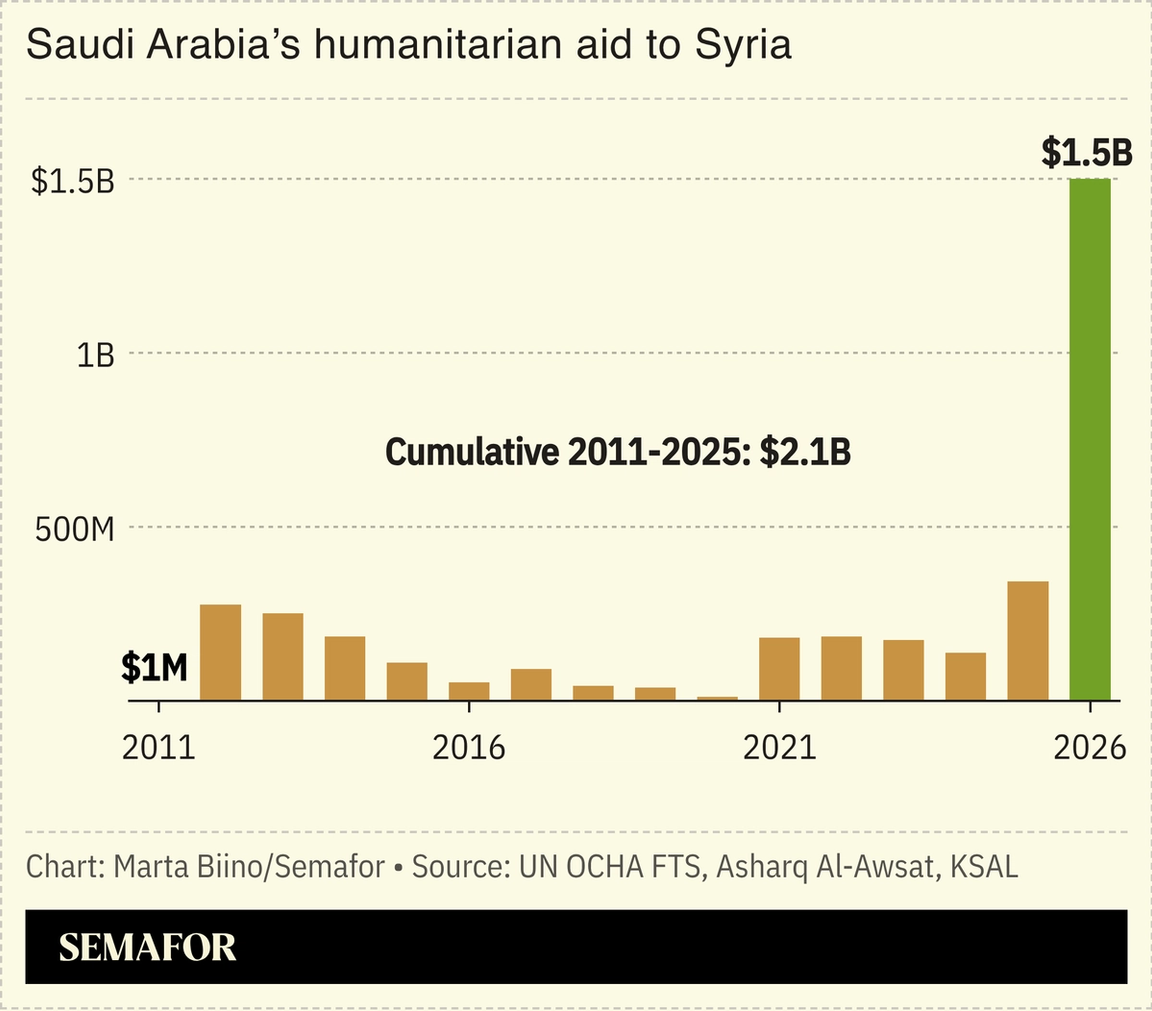 Saudi Arabia’s $1.5 billion pledge this month to help Syrians return from refugee camps is a major boost to the government in Damascus, which is working to consolidate power and restart the economy after more than a decade of war. The package — tied to housing, infrastructure, utilities, and small business support — is more than four times larger than any previous Syria-related contribution from Riyadh, according to Karam Shaar Advisory, a consultancy specializing in Syria’s economy. The funding is the latest signal of support — and competition — among nearby countries with a growing interest in fostering a stable Syria that could become part of a new logistics network outside Iran’s reach. Qatar, Saudi Arabia, Türkiye, and the UAE are all maneuvering for influence, with Abu Dhabi the latest entrant. A recent UAE delegation pledged billions of dollars for tourism, infrastructure, and port projects, viewing the route from Jordan to Syria’s Mediterranean coast as a strategic trade link integral to the planned India-Middle East-Europe Economic Corridor. — Mohammed Sergie |
|
A Saudi bet on a tokenized economy |
 Dado Ruvic/Reuters Dado Ruvic/ReutersSaudi Arabia has been relatively late in embracing crypto, but an entrepreneur who helped establish the kingdom’s digital payments system said it could become a global leader over the next few years. By tokenizing real-world assets such as property deeds, energy infrastructure, and manufacturing facilities, Faisal Monai, chair of tokenization platform droppRWA, sees an opening for the kingdom to build the settlement infrastructure for such transactions while avoiding the more speculative areas of crypto that Saudi regulators refuse to endorse. By building the rails, Saudi Arabia could be among the first countries to prove the model works, Monai told CoinDesk. His platform recently completed a tokenized property transfer in Saudi Arabia, reducing the settlement time from the usual days to seconds. Dubai is considered a leader in the region, with its Virtual Assets Regulatory Authority having overseen tokenized real estate sales last year. But the rest of the region is catching on, pursuing crypto as a way to unlock liquidity, attract foreign capital, and modernize industries and government services. |
|
 After more than a decade as Cisco’s CEO, Chuck Robbins says passive-aggressive behavior is “like death” to companies like his. On this week’s episode of The CEO Signal, presented by PwC, Robbins tells Penny and Andrew how he sets the pace for the tech giant’s shift to AI, why a bad decision beats a delayed decision, and what his approach is to people who aren’t on board with the strategy — “You get rid of them.” Robbins explains his biggest strategic calls and reflects on what he’s learned about leadership, including when to step out of the room so the CEO’s viewpoint doesn’t distort the decision-making process. |
|
 - Egypt has been walking a tightrope since the Iran war began. Cairo sees “cautious diplomacy” as its best approach: The country is too large and strategically important to ignore the conflict, but also too dependent on Gulf support to avoid taking sides, according to an analysis by International Crisis Group.
- The US bases in the Gulf are the main reason the region’s cities and refineries have been hit by Iran. The region needs to take responsibility for its own defenses, rather than outsourcing the role to Washington, and to sign a genuine non-belligerence treaty with Tehran, writes David Roberts in Foreign Affairs.
- Drone warfare has elevated Ukraine’s role as a security partner for the Gulf, Europe, and even the US. That has transformed Kyiv from having “no cards,” in US President Donald Trump’s assessment, into being a key player in countering Iranian attacks, Yaroslav Trofimov writes for The Wall Street Journal.
|
|
|


