| | In this edition, making sense of who prediction markets are for, and Democrats criticize the Pentago͏ ͏ ͏ ͏ ͏ ͏ |
| |  | Business |  |
| |
|
 - Econ data stymies WH push
- DoD’s Wall St. push draws fire
- Robinhood’s antidote to YOLO?
- Ellison sways DOJ
- BP’s chair won’t go quietly
 Mamdani trolls DOGE … Wachtell takes on the FTC … The great hotel blanding … |
|
 Looking around at our casino economy, I keep asking: Who is all this for? The long tail of nonsense bets on prediction markets can’t possibly be what Dwight Eisenhower had in mind when he endorsed the “people’s capitalism” put forward by America’s greatest Cold War propagandist, Theodore Repplier. The future of commerce can’t be a prediction market for whether someone will deliver me four kiwis. The future of investing can’t be crypto perps and a series of rolling bets on Nvidia stock that expire every midnight in a white-knuckled Groundhog Day portfolio. These products confuse populist capitalism, the urge to beat the elite at their own game, with Repplier’s people’s capitalism, where access is broad, affordable, and fair. Robinhood is on a mission to “democratize finance for all.” The mutual fund did that 100 years ago. Index funds perfected it 50 years later. Trump Accounts — which launch today — could expand it now. A fund that charges fees seven times higher than an S&P 500 index fund for 200% exposure to a nuclear-reactor company with zero revenue is something else entirely. At their most benign, these products are the Dubai Chocolate of markets. They were nowhere, are suddenly everywhere, and are a fun novelty but nothing we couldn’t actually live without. At their most pernicious, they are financial poison. The head of the Commodity Futures Trading Commission was right when he said that prediction markets can perform “useful functions for society… to hedge commercial risks like increases in temperature.” But he was wrong that the ideal users are “everyday Americans.” In theory, it makes sense to offset your heating bill by correctly predicting a cold snap on Kalshi. But a better route to that outcome would be for your electric utility to do that hedging itself and share those savings with you. This already happens: The option that utilities offer to smooth out your monthly bill is made possible by an old prediction market — electricity futures, around and regulated since the 1990s — and doesn’t require furiously gambling on your phone. When we had Vail Resorts’ CEO on Compound Interest earlier this week, he surprised me by saying the ski-mountain operator doesn’t hedge weather. There are nearly 800 weather-related bets available on Kalshi and Polymarket today. They could hit big for someone bold enough to tamper with a thermometer at a major metro airport, or for an insider at the National Oceanic and Atmospheric Administration. But somehow none of them fit the needs of a company whose revenue hinges on whether it’s going to snow next winter. The question that captured the shortcomings of 20th-century finance was “where are the customers’ yachts?” Today’s is: “who is this for?” |
|
Economic data breaks south |
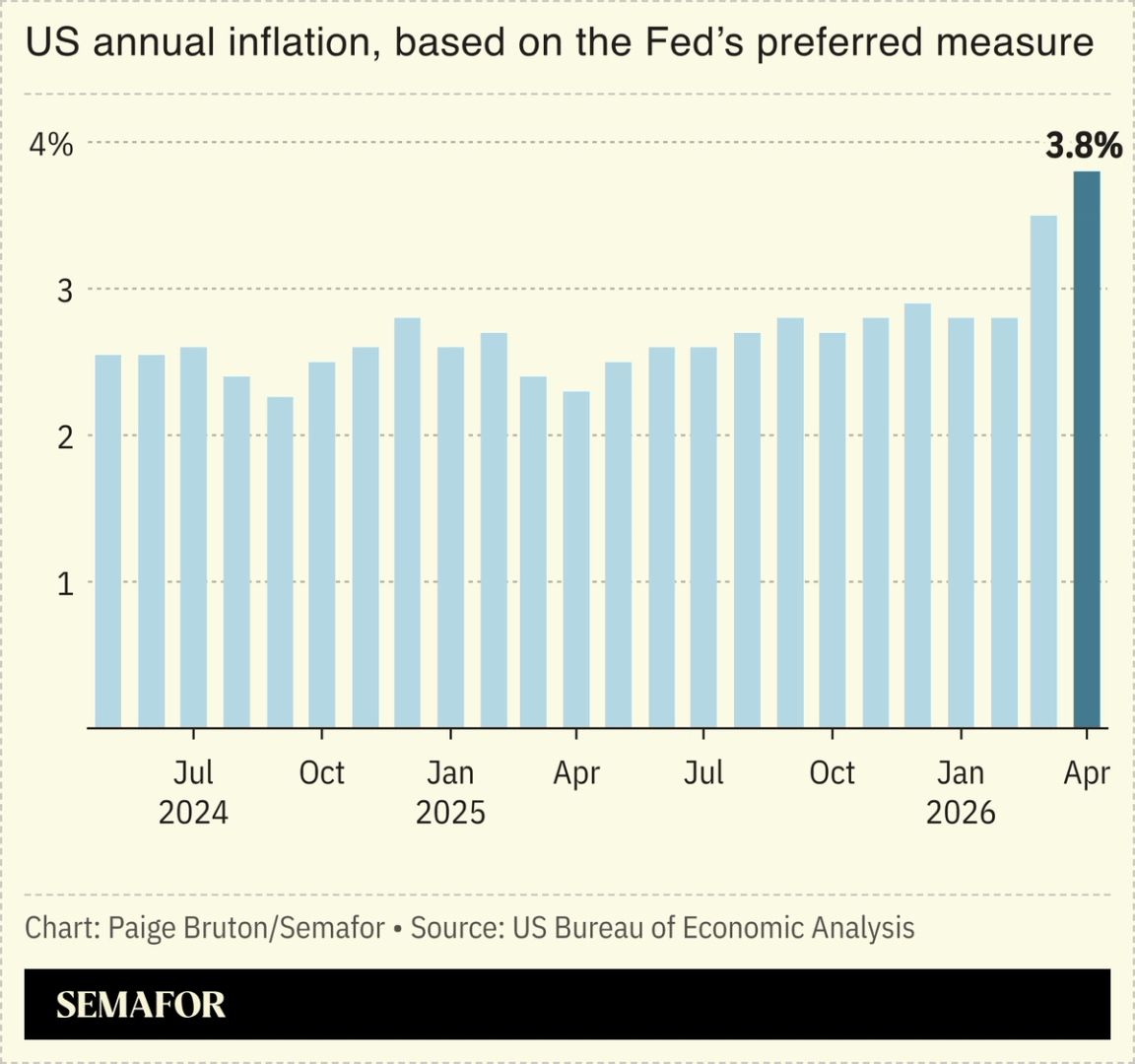 Economic data continues to break against the White House. Core inflation, which strips out food and energy, came in hot at 3.3%, while headline inflation spiked to an annualized 3.8%. That data, along with GDP growth that was revised down to 1.6% from 2%, will complicate both the Trump administration’s affordability messaging and the path ahead for new Fed Chair Kevin Warsh, who campaigned for the job by mapping out a path to lower interest rates but now has to contend with stubborn inflation and a growing hawkishness among his Fed colleagues. (Fed Gov. Lisa Cook said Wednesday, before the latest numbers, that she was prepared to raise rates if inflation stayed high.) The combination of slower growth and higher prices would put the Fed in a stagflationary pickle that’s hard to dig out of through monetary policy alone. Treasury Secretary Scott Bessent will hold a press conference on the economy at 2 pm. |
|
Dems criticize Pentagon Wall Street push |
 Kevin Lamarque/Reuters Kevin Lamarque/ReutersThe Pentagon’s new Wall Street-style investing unit is drawing criticism from Democrats. In a letter first reported by Liz, Sens. Elizabeth Warren, D-Mass., and Richard Blumenthal, D-Conn., along with Rep. Ro Khanna, D-Calif., warned that letting private-equity firms deeper into the defense base risks weakening contractors and exposing classified work to foreign investors. Semafor reported in March that the Defense Department is hiring from top investment banks for an “Economic Defense Unit” to arrange $200 billion of deals in industries central to national security. Recruits are promised “unmatched access to top-level government officials and privileged information flow — whatever you need, you can get,” according to the presentation prepared by the Pentagon’s headhunter. (Based on the emails I got after our story in March, Wall Street is interested — if you’ve applied for a Pentagon job, get in touch!) The Democratic lawmakers are seeking communications between the Pentagon and Wall Street investment banks, records of any deals the new unit has done, and conflict-of-interest policies tied to the operation. |
|
Robinhood gives YOLOers permission to log off |
 Vlad Tenev, CEO and co-founder of Robinhood at the New York Stock Exchange. Brendan McDermid/Reuters. Vlad Tenev, CEO and co-founder of Robinhood at the New York Stock Exchange. Brendan McDermid/Reuters.Robinhood’s plan to let AI agents trade stocks on a user’s behalf has cued the what-could-possibly-go-wrong chorus. I’m actually bullish on the idea — not because it’s an extension of YOLO finance, but because it’s an antidote. There are clearly risks to putting hallucination-prone and unregulated bots in charge of customers’ money. But the problem with the rise of YOLO finance was that it wasn’t automated and instead ran on a dopamine doom loop of the always-on, thumb-on-the-trigger trader. Strip away the novelty of Robinhood’s launch, and what these bots will probably be doing is the unglamorous, disciplined housekeeping of investing: maintaining target allocations, harvesting tax losses, buying the dip on a fixed rule rather than a Celsius-fueled panic. The same logic has powered target-date 401(k) funds for decades — set it, forget it, and let it compound. My skepticism of YOLO trading was a critique of the behaviors technology encouraged, not an allergy to the tech itself. If it can be pointed the other way — toward putting the phone down rather than picking it up — that’s progress. It’s permission to disengage. — Liz |
|
 Caroline Brehman/Reuters Caroline Brehman/ReutersHollywood’s last hope of stopping Paramount’s takeover of Warner Bros. Discovery may be California Attorney Gen. Rob Bonta. The US Justice Department appears ready to approve the $110 billion takeover, Semafor scooped this week, after David Ellison reiterated a commitment to releasing movies in theaters in an hours-long meeting at DOJ headquarters. The department’s antitrust attorneys — nonpolitical employees who have privately broken with Trump-appointed leadership in recent months — seemed swayed by arguments from top Paramount executives that the deal would not hurt other studios and creative talent, people briefed on the meeting said. Talks remain ongoing, and the department’s analysis could change, but we can see where this is heading on the federal front. In the states, however, there’s Bonta, who met last week with Hollywood talent opposed to the takeover. He’s joined forces with New York Attorney Gen. Letitia James to review the deal, Politico reported in March. The American Economic Liberties Project, a DC-based anti-monopoly think tank, is also organizing a series of dinners in New York, Los Angeles, and Atlanta next month, including one featuring Sen. Cory Booker, to try to gain traction on the ground. — Liz and Rohan |
|
BP’s board chair won’t go quietly |
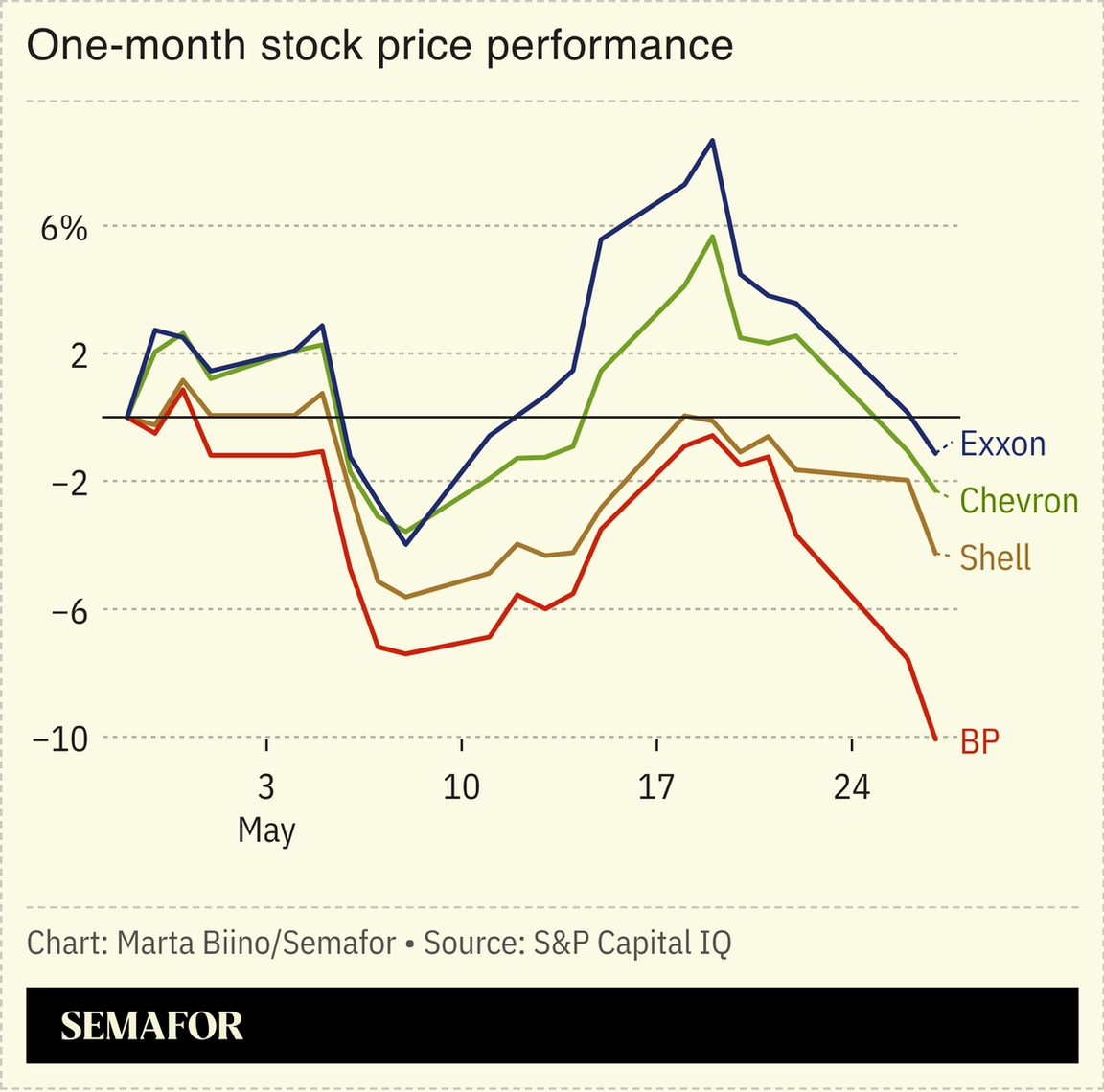 BP’s former board chair Albert Manifold told the New York Times he “dispute[s] entirely” the oil company’s vague accusations of “serious concerns” related to “governance standards, oversight, and conduct” and plans to challenge his abrupt firing. BP’s decision to oust its board chair follows a high-stakes game of musical chairs: The company has been through three CEOs and three board chairs in as many years, as well as pressure from activist investors. Its expensive push into renewables, then headlong retreat back into oil and gas, also roiled investors. Manifold’s operating style rankled senior management and frustrated directors, who pushed for his ouster, a person familiar with the matter told Semafor. The decision to oust Manifold also had the tacit approval of the company’s newest CEO, Meg O’Neill, the person said. That take lines up with reporting in the FT and others about bullying-style behavior toward senior staff, which Manifold disputed. He said he “will not allow a false narrative to go unchallenged.” — Rohan Goswami and Tim McDonnell |
|
➚ BUY: Schmoozing. You can’t just prompt your way into a job at Anthropic. Extensive culture interviews, ethical quizzes, and tests of people skills are central to an oddly human hiring process at the AI startup. ➘ SELL: Boozing. The unstoppable force of the World Cup revenue machine is running into the immovable object of Massachusetts’ liquor laws. While other US host cities have extended alcohol sales and suspended open-container laws, Boston remains a puritanical holdout. |
|
 Companies & Deals- Game on: Billionaire Tilman Fertitta’s entertainment company will acquire Caesars for $5.7 billion, and will assume the casino owner’s $12 billion in debt.
- Bill it, and they will come: Kirkland & Ellis will spend half a billion dollars to develop in-house AI tools. Technology is “raising the floor,” its chair told the FT, but “we don’t get hired for the floor.”
Watchdogs- Zone of contention: A growing White House rift on AI regulation — with David Sacks in the “low regulation” camp and Pete Hegseth on the other side — was partly behind Trump’s last-minute decision to pull his AI executive order, Politico reported.
- Search bets: A Google engineer who went by “AlphaRaccoon” on Polymarket was charged with insider trading after allegedly making more than $1 million betting on 2025’s top Google search terms before they were announced.
- Pied-à-tax: While NYC Mayor Zohran Mamdani tries to smooth things over with the city’s billionaires, state lawmakers passed his pied-à-terre tax.
Markets |
|
|


